Theatre arts students Korhonen and Ikhilor create productions exploring painful relationships with the body and the magical hereafter

Jussi-Matias Korhonen will complete his master’s degree in theatre arts in the spring of 2026. For a long time, he imagined himself becoming an actor with a permanent theatre contract, performing works created by others. Yet as part of his studies, he developed a production that is deeply rooted in his own personal experiences and artistic identity.

His production, titled MITTA, premiered at the TeaK Club of the Finnish National Theatre on 25 February 2026.
“During my studies, I attended a course titled Performance Workshop, where we created imaginary productions and learned how the freelance arts scene operates and how performances are created. This led me to discover my own artistic identity,” says Korhonen.
“While attending the course, I devised an imaginary production on the same theme as MITTA and agreed with a friend studying dramaturgy that one day we would stage it for real. Somehow it grew into something much larger, as if by accident, and suddenly I found myself on stage at the Finnish National Theatre!”
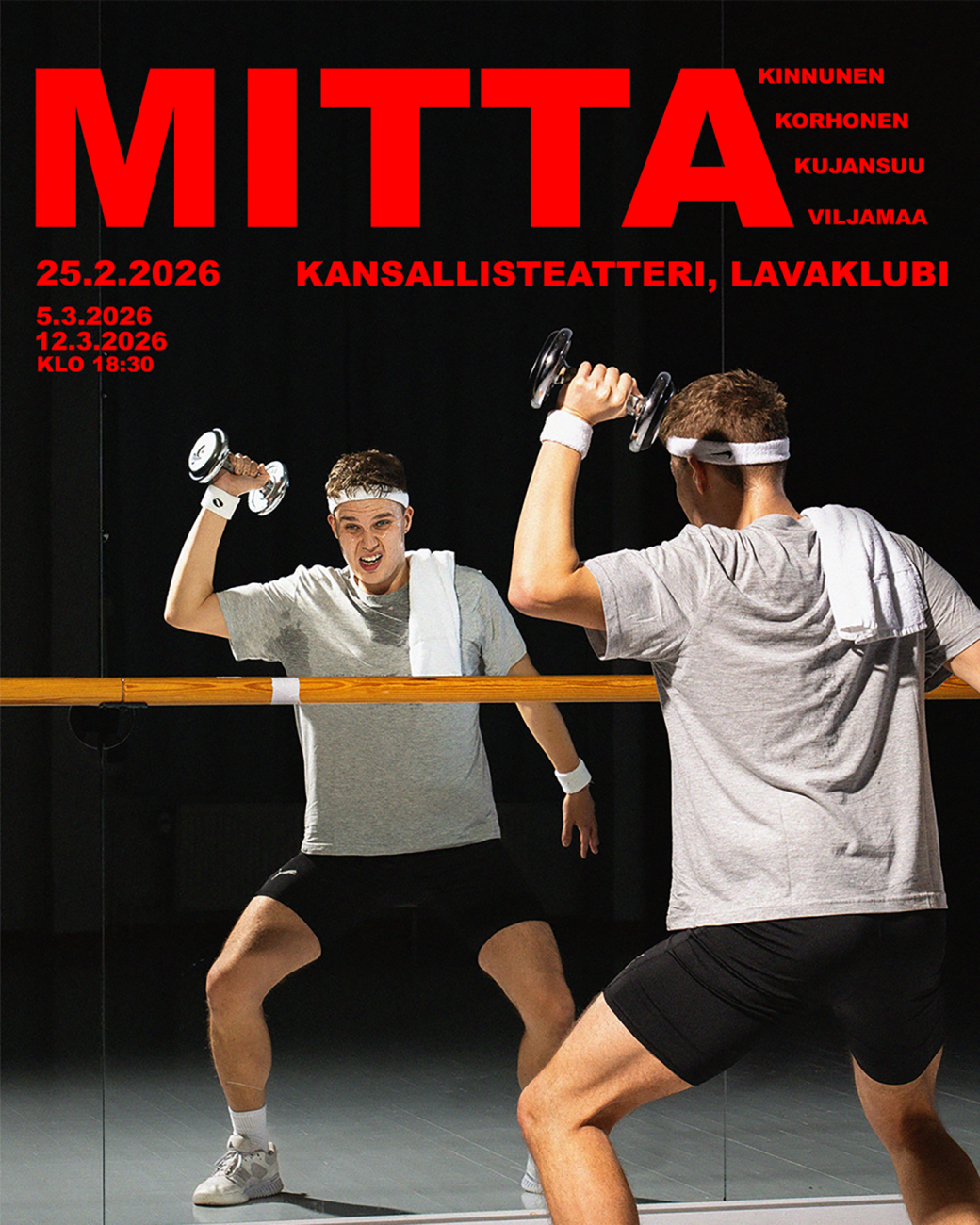 Photo: Petri Summanen
In addition to Korhonen, the working group for MITTA included dramaturge-director Venla Kinnunen, visual concept designer Elli Kujansuu and sound designer Eedit Viljamaa. A key factor in forming the group was that everyone had a personal connection to the theme and felt safe discussing it together.
“Personally, my need to create this performance stemmed from having a chronic condition and experiencing major fluctuations in my weight. I have lived in an overweight body and encountered fatphobia. I have thought about how discussions about broadening representation are common in the world of theatre, but the physical norms for specific types of roles still remain strikingly rigid,” says Korhonen.
The collaborative experience of creating the production was at once painful and enjoyable. The members of the working group talked at length, sharing memories relating to body image and diet culture. Through the production, they sought to explore a theme that has rarely been addressed through the medium of theatre.
“While many recent theatre productions have focused on themes such as gender and sexuality – both of which are extremely important themes – the struggles and discrimination linked to weight gain and weight loss have rarely been portrayed on stage.”
MITTA is a one-hour monologue following the lifestyle overhaul of a character named Johannes. According to Korhonen, the piece is equal parts emotionally intense and absurdly funny, featuring outrageous fad diets and advertisements for weight‑loss devices.
“After one performance, someone said that MITTA was like a mix of sketch comedy, a music video and harrowing drama,” says Korhonen.
“It has been sad to realise that this theme strikes such a personal chord for so many. When speaking about others, it is easy to be kind and to hope for a theatre stage filled with people of all sizes and appearances, yet we often judge ourselves far more harshly. I have struggled with my body image during my acting studies, too,” he adds.
Thesis supervisor provided invaluable support for Leo Ikhilor
Leo Ikhilor is another student who will soon graduate with a master’s degree in theatre arts and who recently performed his piece at the Finnish National Theatre’s Maalaamo Studio. As part of his master’s thesis, Ikhilor created an autofictional piece exploring loneliness, disability and generational cycles.
 Photo: Antti Yrjönen
“Oboh is autobiographical, a journey into my personal history and how my sense of self has evolved over the years,” Ikhilor explains.
In addition to Ikhilor’s personal experiences, Oboh draws from the cultural heritage of the Esan people of southwestern Nigeria. According to Esan beliefs, specific burial rituals ensure the rebirth of the soul.
“Oboh contains many ritualistic elements. I try to bring a magical, otherworldly presence to the stage and create a sense of connection with ancestors and the afterlife. A sort of initial framework for the production involved finding a sense of liberation, both for the character and for myself, through rituals.”
 Photo: Kansallisteatteri
Even though Oboh explores difficult and even traumatic experiences persisting across generations, Ikhilor found the creative process relatively easy.
“The dramatic arc emerged naturally from my own experiences. From the start, I knew what I wanted to express through this piece. I am an audiovisual thinker, and I worked by reflecting on the visual scenes I wanted to create and the atmosphere I wanted to evoke. For example, I wanted the performance to open with a loud, grandiose sound before shifting into something small and intense.”
Oboh is Ikhilor’s solo performance which he also wrote, produced and directed. The only other team member was lighting designer Pinja Kokkonen. Ikhilor’s thesis supervisor, Professor Pauliina Hulkko, was also a great help.
“Hulkko played a vital part in the process. This could not have been done without her. She was able to analyse the piece from an external perspective and offer insights that would never have occurred to me.”
For questions relating to Esan cultural heritage and ritual practices, Ikhilor consulted his father’s relatives in Nigeria.
“I bounced my ideas off members of the Esan community. I had to do a great deal of ethnographic research. I learned about actual ritual practices and was given written materials in the Esan language.”
An actor’s own voice is always allowed to shine through
Although Ikhilor had no previous experience of taking on such extensive creative responsibility, he has always known that expressing his own artistic identity is what drives him.
“Having my own voice and being able to do things that reflect who I am has always been incredibly important to me. And I can say, without any bragging, that I am rather good at it, too. I can create a piece from multiple angles, designing sounds, producing text and working persistently towards goals. In a sense, it feels as though everything has inevitably led to me creating Oboh. I heard many people say that the piece reflected my personality very strongly.”
However, Ikhilor is not planning to take on another project of this magnitude for some time. He is currently performing in an opera at Tampere Hall, with his next role at Helsinki City Theatre. With his degree now nearly complete, a summer holiday might also be in order.
“In future, I could delegate tasks more than I did with Oboh. I definitely had my hands full with this one, but it was all part of my degree programme and a brilliant learning experience!”
Jussi‑Matias Korhonen recently signed a contract with Rovaniemi Theatre. He is becoming a theatre actor, which he continues to find exciting, and this will not prevent him from expressing his distinctive artistic voice.
“For me, perhaps the most significant shift during my studies has been in my understanding of what truly matters in art and acting,” says Korhonen.
“I would not have had the courage to create a piece like MITTA when I first enrolled at Tampere University. Back then, I was not ready to talk about my relationship with my body. I only wanted to train hard and become the epitome of a masculine actor –someone who could ‘push through a wall’ if necessary. Now it feels great simply to be myself. I can be both masculine and sensitive. My body has undergone operations and endured a great deal. All of that can be reflected in my acting. I do not like the idea that weaknesses must be turned into strengths. Instead, I can allow them to be present, and they take nothing away from the quality of my work. On the contrary, it is a good thing that actors are individuals who can draw inspiration from their own lives.”


