Sustainability: Toni Taipalus on the Environmental Cost That Modern Data Systems Cannot Ignore

“The growth of digital data did not stop with digitizing older materials such as photographs, books, or video. Over time, we started storing much more than that: transactions, browsing behavior, location data, search histories, and now increasingly data generated across many modalities, often at massive scale. Once you take that trend seriously, storage and processing stop looking like purely technical scaling challenges, and they become environmental questions as well.”
A layered challenge
Sustainability in data infrastructure is not reducible to a single variable. Energy consumption, the origin of that energy, hardware manufacturing, cooling requirements, and software efficiency all interact. In colder climates, cooling loads can be partially offset and excess heat redirected into district heating systems. But Taipalus's research focuses on a layer that receives less public attention: the way data is structured and managed within the database and software stack.
“It is a systems problem. The sustainability of a data center depends not only on how much electricity it consumes, but also on where that energy comes from, what kind of infrastructure is required to produce and deliver it, how the hardware is manufactured, and how efficiently the computing systems themselves are designed and operated.”
Database design and software architecture determine how much computation a system actually performs, how much data must be moved between components, and how much storage capacity must be allocated. These are decisions made by engineers, often early in a project, and their downstream consequences for resource use are rarely the primary consideration.
“In practice, sustainability is shaped by trade-offs across all of these layers. Our work focuses especially on how smarter data organization can reduce resource use without treating inefficiency as inevitable.”
Testing under realistic conditions
A central commitment of the DigiSus project is empirical: testing real hardware under conditions that reflect actual workloads rather than relying on theoretical models or standardized performance tests. Benchmark results in database research are known to diverge from production behavior, which makes experimental infrastructure particularly valuable for generating credible findings.
“A design choice that looks good in development or in a benchmark does not always behave the same way under realistic workloads. That is why the experimental side matters so much. With dedicated hardware, we can study these questions under controlled conditions and measure the effects of different design choices more credibly.”
The results so far suggest that data restructuring can produce simultaneous gains across several dimensions at once, rather than the trade-offs that engineers often expect.
“What we have seen is that restructuring can have very large effects, not only on performance but also on energy use and storage requirements. In our case studies, the same redesign has improved efficiency across multiple dimensions at once, rather than forcing a trade-off between them.”
The role of DigiSus funding
The DigiSus starter grant supported both the acquisition of experimental hardware and the development of a wider research network. That combination, empirical capacity alongside collegial connection, shaped the trajectory of the project.
“The starter grant was important because it gave us the means to build the research on a more rigorous empirical basis. At the same time, the funding helped us connect with other researchers working on related sustainability questions, both in Finland and internationally. That has been valuable not only for exchanging ideas, but also for positioning the work within a broader research community.”
Research on the project continues this year with foundation funding, and the themes are being integrated more directly into teaching at Tampere University.
Into the classroom
Taipalus has spent a significant part of his research career studying how computer science students develop technical competence, including how clearer feedback systems in database languages can help novices overcome early barriers. That background in learning and pedagogy now informs how sustainability is brought into the curriculum.
“Future software and data professionals will make decisions about how systems are designed, what is stored, what is recomputed, what is replicated, and what is optimized for. Those are technical decisions, but they also have environmental consequences. Good engineering is not only about making systems fast or functional. It is also about understanding the broader costs of those systems and designing them more carefully.”
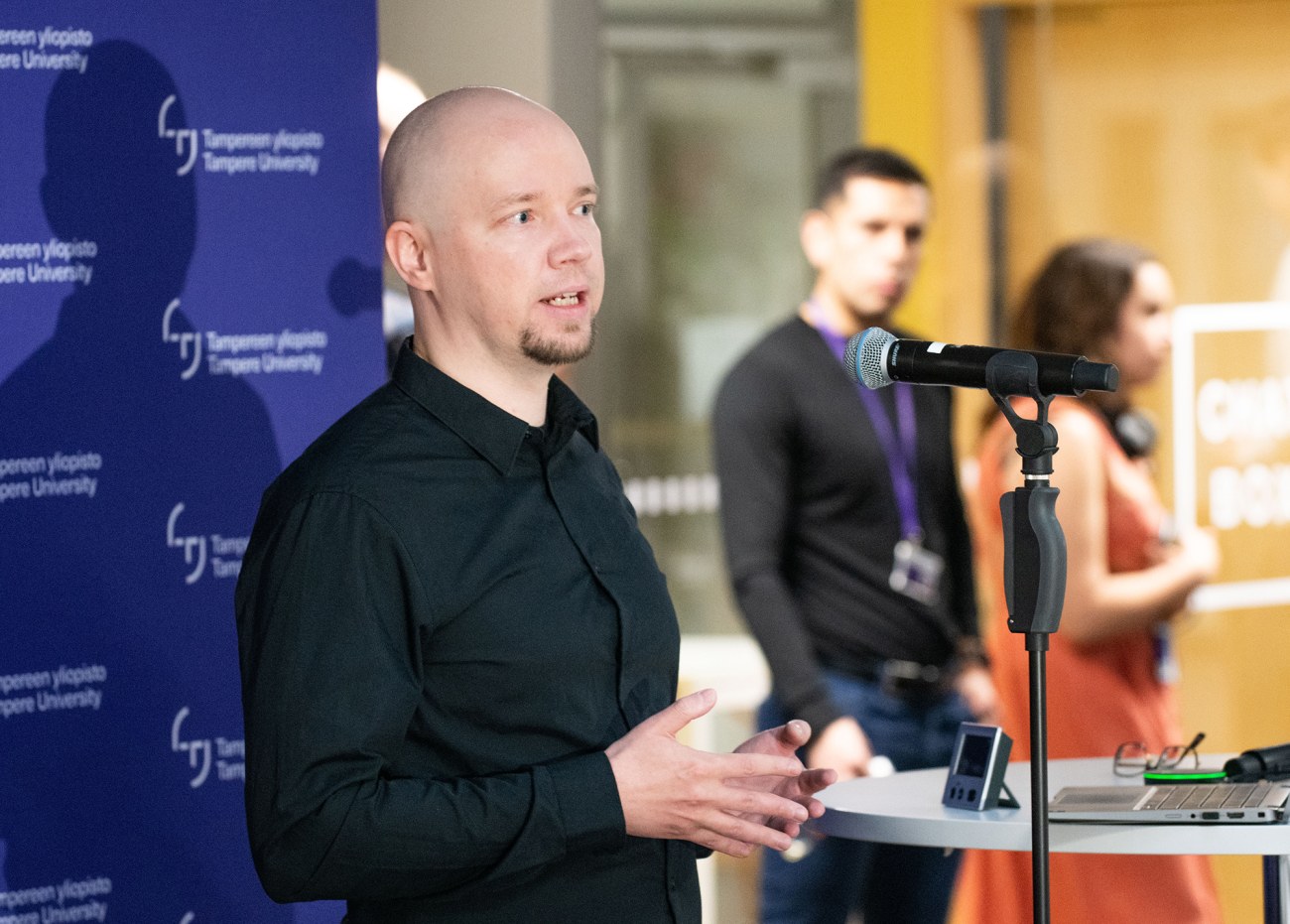 Photo: Eelis Berglund
Beyond the technical
On the question of what it would take to produce meaningful reductions in data center energy use, Taipalus draws a distinction between technical capability and organizational priority. The tools and knowledge are largely available. The gap lies elsewhere.
“I would not describe this primarily as a lack of engineering capability. It is more a question of incentives, priorities, and adoption. We already have substantial knowledge, tools, and educational capacity to reduce waste and improve efficiency. The harder part is making sustainability a real priority alongside cost, speed, convenience, and time-to-market.”
Research like DigiSus contributes by grounding that conversation in evidence. If organizations are prepared to treat sustainability as a design objective rather than a secondary consideration, the technical foundations to act on it are already in place.
Focus Areas
Green data storage and processing, sustainable databases, data engineering, vectors as data representations, data-intensive software systems.
TASE - Software Engineering Research Center
Author: Sujatro Majumdar


