Professor Pekka Abrahamsson wants AI research to be visible in students’ and companies’ everyday life

For Pekka Abrahamsson, Professor of Software Engineering at Tampere University, it is essential that research is visible in companies, in students’ everyday lives, and as concrete solutions.
“A guiding principle throughout my career has always been that science must also have an impact,” Abrahamsson says.
Abrahamsson has a long and international academic career behind him. He earned his PhD from the University of Oulu in 2002 and has since worked as a professor and dean at the Free University of Bozen-Bolzano in Italy, as a professor at the Universities of Helsinki and Tampere, and as a Research Professor at VTT Technical Research Centre of Finland. In addition, he has served as a visiting professor at several European universities and as a professor at the Norwegian University of Science and Technology.
Abrahamsson joined Tampere University in 2023. His primary location is the University Consortium of Pori, an inspiring campus environment where he feels he can combine international research with strong local engagement.
At the Pori University Centre, Abrahamsson sees an environment where AI research can be rapidly translated into practice. The region is home to many highly competent companies with real needs related to data, software development and decision support.
“What matters here is how we can develop software and make better use of it, for example through collaboration with companies. We can securely feed all of a company’s data to AI, which then computes and explains any information in an understandable way – both for the CEO and for frontline employees. Now we need to build demos around this,” Abrahamsson says.
According to Abrahamsson, Pori has significant untapped potential.
He sees his own role as a catalyst who brings companies, researchers and funding together – and lowers the threshold for engaging in research collaboration.
Students and Doctoral Researchers at the Core of the Work
Pekka Abrahamsson founded the GTP-Lab research group in 2023.
“Our goal is to strengthen Finland’s position as a frontrunner in software development and AI research,” Abrahamsson summarises.
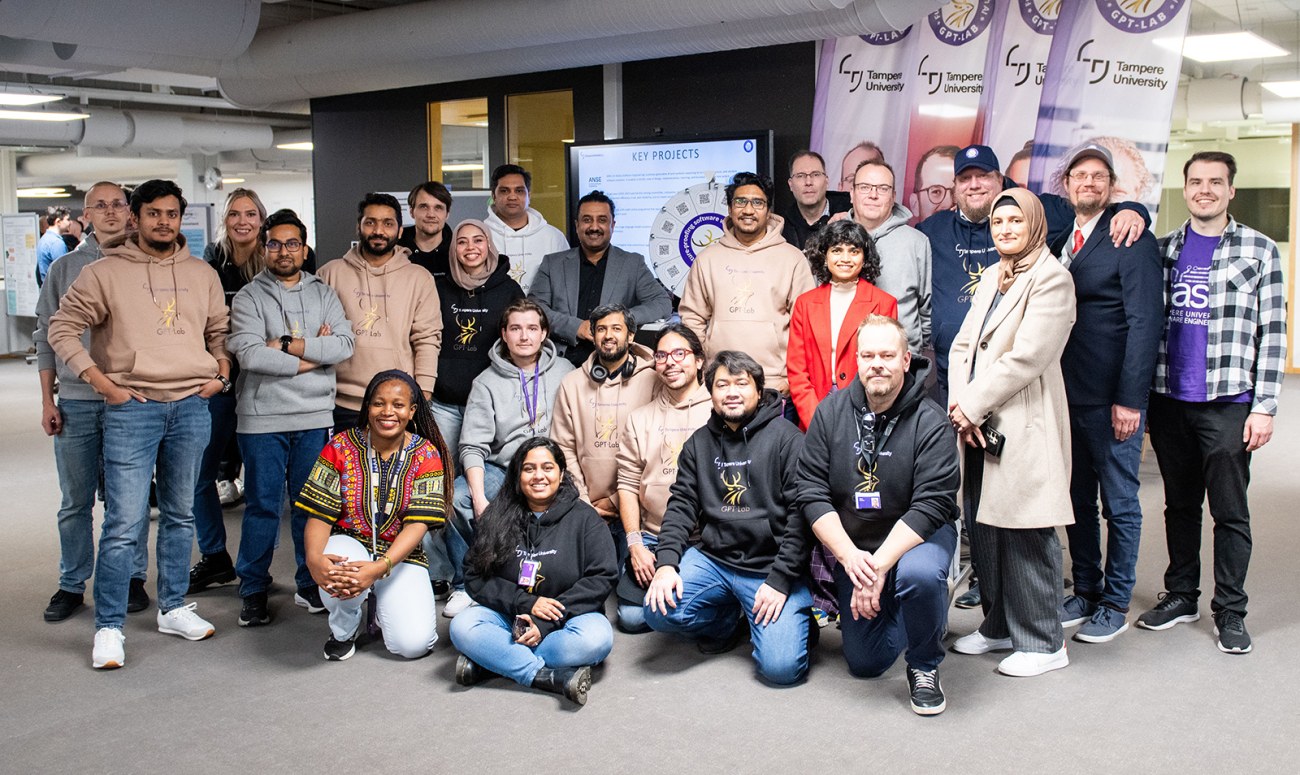
“With teams located in Pori, Tampere and Seinäjoki, and partners operating in Sweden, Norway, Brazil and Tanzania, we are building one of the largest AI research laboratories in the region. The work is only just beginning, but our team has grown rapidly and the atmosphere is excellent.”
For Abrahamsson, collaboration with companies and working with students go hand in hand. The GTP-Lab research group also functions as a learning environment for students and doctoral researchers.
At GTP-Lab, students are not passive observers; they actively participate in developing AI-based solutions, experiments and company projects. Their work may involve software development, data analysis or the use of generative AI to support decision-making.
“We use it for software development and testing. AI writes code even in programming languages that hardly anyone masters anymore. It’s a tireless assistant in almost everything: you can work on strategies with it, build future scenarios, or even ask for bread-machine recipes for the Christmas holidays.
AI is, of course, excellent at structuring information, but it also has a tendency to lie or hallucinate, as the term goes these days. That’s why AI literacy – in other words, critical thinking – is a core civic skill today,” Abrahamsson says.
For doctoral researchers, GTP-Lab offers an opportunity to combine internationally high-level research with practical impact. Research topics often emerge from real-world needs, and collaboration with companies brings a new level of concreteness to academic work.
Relaxed in Style, Ambitious in Goals
Abrahamsson does not see himself as representing a traditional professor’s role.
“Many people are surprised when they meet me, because I don’t fit easily into the traditional image of a professor. I see a professorship as a rare kind of job: one where you can genuinely aim to be among the best in the world. But that requires accepting that the path is not a straight line. You have to be willing to take risks and pursue ideas that raise more questions than they provide answers.”
His aim is to build a culture of action where new ideas can be tried out with a low threshold. Opportunities should be seized, new ideas are born together, and in new interdisciplinary groups, different perspectives generate innovations that would not otherwise emerge.
My strength is that I don’t say no. I know the word, but I don’t use it.
Pekka Abrahamsson
Multidisciplinary Projects
Pekka Abrahamsson is involved in several large-scale and very different research projects that reflect the multidisciplinary nature of his work and its broad societal relevance. The projects range from core questions in software engineering to ethical challenges in AI, the built environment and journalism.
One of these projects is ANSE (AI Native Software Engineering), a jointly coordinated research initiative by Tampere University and the University of Jyväskylä. The project develops an entirely new kind of software engineering approach that is natively based on AI. Professors Pekka Abrahamsson and Tommi Mikkonen describe ANSE as the world’s first project that genuinely prepares for the arrival of AI-native systems in software development. The project is funded through Business Finland’s Näytönpaikka pilot programme and aims to make AI not just a tool for software developers, but an integral part of the development process itself.
Another key initiative is Tampere University’s EVIL-AI (“Evil-eye”) – Negative Impacts of AI Agents and Their Prevention project. The four-year project is led by Professor of Knowledge Management Henri Pirkkalainen and includes, in addition to Abrahamsson, Assistant Professor of Gamification Johanna Virkki. EVIL-AI focuses on AI agents – autonomous systems capable of making intelligent decisions while pursuing specific goals.
“AI agents can be harnessed to deceive people, they can form groups, and they may break free to carry out undesirable actions. That makes them difficult to stop,” Abrahamsson explains.
The project examines how risks related to AI agents can be identified and mitigated before they become part of everyday life.
One of the most recent projects is AI Champion, a Business Finland–funded initiative launched at the end of 2025, which explores the use of AI agents in construction and building services engineering. From Tampere University, multidisciplinary research teams from the faculties of Built Environment, Management and Business, and Information Technology and Communication Sciences are involved. The project also includes the University of Oulu and several companies, such as Granlund, Fira and Koja Chiller, with additional funding provided by ETS Nord, Kiilto, GF BFS, Nimlas, LVI-Info, STK and Airlyse.
The project investigates, among other things, why centralized and monolithic systems should be built at all, if AI agents can instead stream and enrich information across existing silos. Abrahamsson’s GTP-Lab serves as the technological backbone of the AI Champio project, and the AI developed within the project also acts as a showcase for domestic data and AI sovereignty.
Another example of Abrahamsson’s interdisciplinary work is Tampere University’s AI Newsroom project, which explored the practical possibilities and limitations of large language model–based AI in journalism.
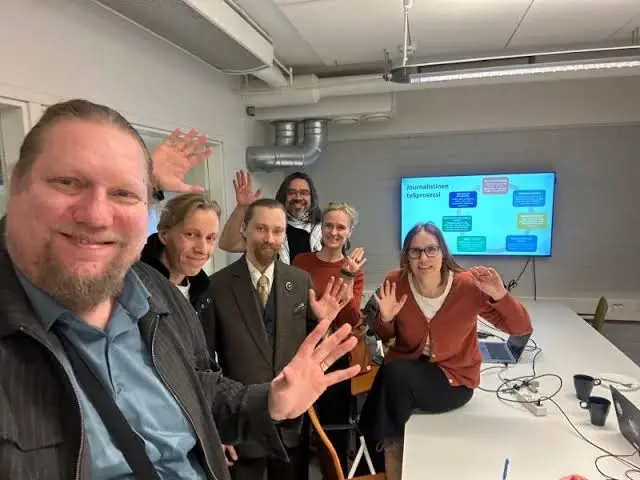
“To study this, we built a fully AI-driven, 24/7 newsroom in which we modelled editorial roles such as editor-in-chief, news editor and journalist,” Abrahamsson explains.
As a result, the project produces recommendations for the use of AI in newsroom work: what AI is suitable for, what it cannot do, and where humans should not be replaced. The project combines the disciplines of software engineering and journalism.
Check out the GTP Lab video
Author: Riitta Yrjönen


