AI translation requires AI literacy – Mary Nurminen shares her tips for AI-assisted translation

It may not be immediately obvious, but the roots of ChatGPT and other similar chatbots can be traced back to translation technology. Neural machine translation (NMT) tools became widely available in 2016, and their underlying algorithms share important similarities with today’s GenAI systems.
“That was, in fact, how AI took off,” says Mary Nurminen, University Lecturer at Tampere University who specialises in translation studies.
This is the reason translators are used to the question: “Will AI take your job?” Translation memories were developed as early as the 1990s and proved similarly disruptive within the translation industry as NMT and, later, GenAI. Despite their impressive capabilities, GenAI systems cannot fully replace professional translators as AI translation tools still struggle, for example, with terminology.
Ideally, LLM‑based tools support seamless communication across languages, but their careless use can also have serious consequences. The ease of using AI may discourage organisations from learning to use carefully developed processes. For example, medical professionals may be tempted to rely on machine translation during patient appointments, even if they could easily contact a professional interpreter who would provide a more reliable service via a remote connection. In the worst-case scenario, they never learn to use remote interpreting services because it is easier to open an AI translation app.
Tips from a translation professional
Nurminen refers to the concept of AI translation literacy, which has been actively developed since 2019. After the release of OpenAI’s chatbot in 2022, many translation professionals recognised the urgent need for clearer guidelines and recommendations for AI-assisted translation. Nurminen shares three professional tips for working with AI translation tools, framed as questions:
What language pairs are you working with? This question concerns the language model’s training data. AI systems perform better when translating, for example, from English into Finnish than from Finnish into Mongolian. This is because English-to-Finnish translations are widely available online, resulting in higher‑quality AI outputs.
Are human-made translations of this material already available? The text may already have been translated, so it is worth checking before producing a new version. For example, the websites of governmental agencies are often published in multiple language versions.
Why are you translating this text? What risks are involved? Translating a recipe for fish soup is a low-risk task. However, translating an interim financial report for a publicly listed company carries significant responsibility, and the risks are much higher.
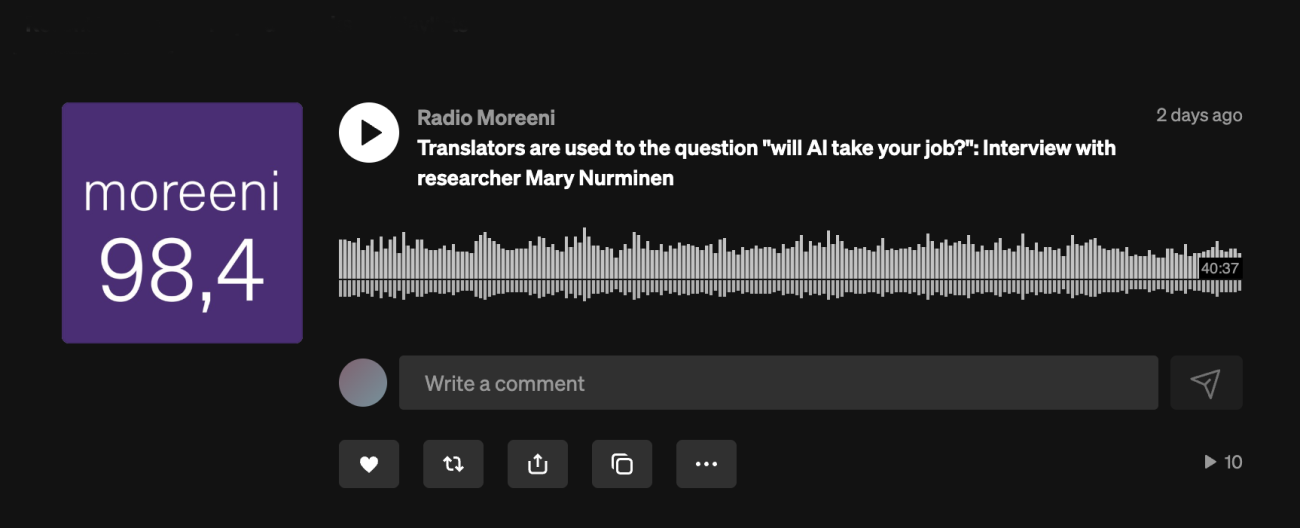
Listen to the full interview: Translators are used to the question "will AI take your job?": Interview with researcher Mary Nurminen
Artificial intelligence and Large Language Models
Large Language Models (LLMs) are advanced AI systems capable of generating human‑like text and simulating language understanding. They are trained on vast datasets to recognise grammatical structures, vocabulary and meaning across a wide range of contexts. LLMs can produce human‑like language, code and other types of content by mathematically predicting the most likely next word.
Examples of LLMs
ChatGPT
Google Gemini
Mistral and LLaMA
Poro (Finnish open-source LLM)
Watch our new video on Mary Nurminen’s research.
Author: Jaakko Suorsa


