New innovation could revolutionize the everyday lives of diabetics: needles would be replaced by light

Measuring glucose is one of the main ways to monitor diabetes.
– My father has diabetes. When I talked to him, I used to ask him how his diabetes was going, if it was under control. I was always worried because he was getting older. In Bangladesh, where I come from, the measurement is done in the hospital with blood tests. My father wants to know his blood sugar level, but he doesn't want to go to the hospital to have it measured, Razib Hasan says about the background to the idea.
Puncturing the skin means a risk of infection, and it takes time for the skin to heal. Hasan wondered if there could be a non-invasive way to measure glucose.
Hasan pitched his idea to his fellow student Jingjing Yang to solve the problem with the help of light. It turned out that Yang also has relatives who are struggling with a similar problem. Hasan and Yang formed a well-working thesis team together: Hasan says that he is an idealist who wants to make things happen, and Yang brought the necessary realism to the work.
A simple physical idea
When light travels from one point to another, it travels through various mediums, such as air or paper. The medium always absorbs some of the light. The rest of the light ends up on the other side of the medium. Light carries information that can be measured. However, light has thousands of spectrums, and there is also light that is visible to the human eye and non-visible light.
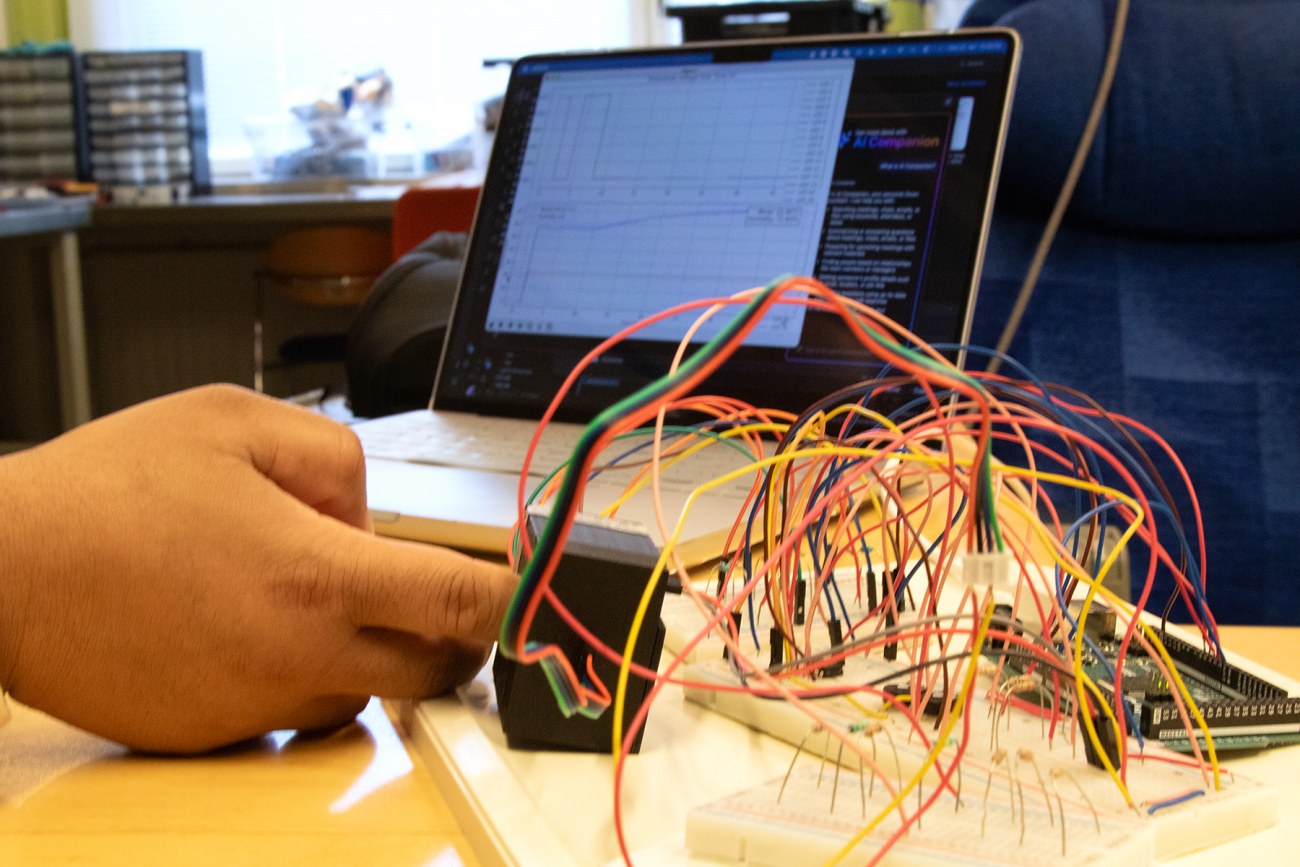
– Light penetrates the body. Our research problem was to find the wavelengths of infrared lights that interact with glucose. Once we find these, we can produce a certain kind of light that penetrates the skin tissue. We measure the amount of light before and after it passes through the tissue, and from this we can deduce the glucose level. In addition, we need metadata such as temperature, humidity and age of the user. The collected data can later be used in a mobile app, Yang and Hasan explain.
Both studied at TAMK in the English-language Sotfware Engineering degree program. While working on their bachelor’s thesis, they had to familiarize themselves with a large number of medical articles. In the early stages, they received a lot of practical help from Tuomo Nieminen, a Senior Lecturer in physics, who validated the theory behind the research. Nieminen also helped the team in the physics laboratory outside of his working hours.
− Razib came to present his idea, and together we started to think about the physics behind it and how the device could work in theory. The idea is really interesting, and the principles behind it are quite well-known, but it quickly became clear that many things still need to be solved before the device could work in practice. It is always inspiring to guide students who boldly take up new ideas and start taking them forward, Nieminen says.
Recognition inspires to push forward: huge markets for the product
The thesis was supervised by Vihtori Virta, a Senior Lecturer in information technology, whose support the team praises.
– As a teacher of hardware, I want to take my hat off to Razib's and Jinjing's open-minded attitude to tackle such a hardware-centric thesis, even though their studies are clearly focused on the software side. It's great to see how a need meets a vision in their work and how they managed to create something new, even though they haven't studied all the necessary tools or skills beforehand.
Virta encouraged Hasan and Yang to give permission for the project to participate in the Evertiq Global Expo for the electronics industry and to it's thesis competition, so that they could get the visibility they deserve for their work. The fair was held at Tampere Hall in March 2026. TAMK’s Senior Lecturer Jaana Hännikäinen then applied on the team’s behalf.
– They have worked a lot on their thesis, also outside of the actual work, and the project has significant potential for further development. In addition, their thesis was excellent as a whole, which led to a well-deserved victory in the competition. I hope that this will give them a good boost for the next stages of their careers, Virta says.
Hasan and Yang's project was selected as the recipient of the 2026 fair scholarship. The value of the scholarship is 1000 euros.
– This recognition really encourages us to continue with our work, they both say.
– However, there is still a long way to go before the finished product, Yang adds.
The idea will furthermore be presented at the *ship Startup Festival in Kotka and at the European Photonics Partnership Annual Meeting in Brussels, where people working with light will gather.
The duo's work on the topic continued after the completion of the thesis. Their long-term goal is to create a medical device, but first they are trying to implement their innovation as a wellness device, because it is easier and faster to get one on the market, and it would quickly benefit people. They already have a visual idea of the finished product. Hasan hopes that the work will proceed so that EU funding can be applied for it.
– At the moment, similar work using the same method is not done elsewhere in the world. Whoever gets this to the market first, it will be a big deal. It is an industry worth about 40 billion dollars, Hasan says.
Dreaming about solving problems and improving lives
Currently, Jingjing Yang is continuing her studies at the University of Tampere, majoring in Embedded Systems.
– I enjoy working close to real systems and solving practical problems, and I’m looking forward to applying this in an industry environment, Yang says.
Razib Hasan is studying in the master’s programme in Computer Science at the University of Helsinki, specializing in Algorithms. At the same time, he is working at TAMK FieldLab as a Robotics Software Engineer. His work is related to industrial robotics R&D.
– In my future career, I would like to work with things that improve people's lives and well-being, possibly in the healthcare field, Hasan says.
Hasan's father has been excited about his son's work for people with diabetes.
– He's already asking when I'll bring the device to him, Hasan laughs.
Author: Emmi Rämö


