Media and emotions are at the center of Professor Kaarina Nikunen’s research.

“Perhaps I ultimately became a researcher because I want to make a difference to the society we live in,” says Kaarina Nkunen, Professor of Communication and Media Research at Tampere University.
“Of course, it is rare for the world to change immediately after a study has been completed. Media research, in particular, often takes a critical approach and may expose problems, but resolving them is typically a slow process. It may take time before the impact of this research is felt.”
Nikunen graduated from the former University of Tampere, where she studied at the then Department of Journalism and Mass Communication, the predecessor of Tampere University’s current specialisation in journalism. Her interest in popular culture and television research was sparked during her student years, and she wrote her master’s thesis on television studies.
After completing her degree, Nikunen spent many years working as a journalist for Finland’s national public service broadcaster Yle as well as for the newspapers Aamulehti and Helsingin Sanomat.
“My work kept me busy and interested, but the pull towards a research career never really went away. It felt like a stone left unturned.”
Nikunen decided to apply for a doctoral programme at the University of Tampere and was accepted. She then found herself weighing up the two career paths, and the decision was far from easy.
“Eventually, I resigned from my excellent, permanent post as an international journalist at Helsingin Sanomat and embarked on a research career. I told my dear colleagues that I was leaving a sinking ship! It was, of course, a big joke.”
Researchers seldom secure a permanent position straight away, and it took years before Nikunen landed one herself. At the time, she kept reminding herself not to complain, as she had made the choice knowingly.
“I had to keep trusting that everything would work out. Still, I am sure I had the odd grumble every now and then.”
Research under the umbrella of media and emotions
In 2005, Nikunen completed her doctoral dissertation that explored Finnish television fan culture at the turn of the millennium.
Since then, Nikunen has pursued research on a wide range of topics. In addition to television and fandom, she has studied refugees in the media, the datafication of society, hate speech and the pornification of popular culture, among many other themes. Often, the ideas that emerge during one study have sparked the next.
“My career has largely been driven by my personal interests. Social media platforms began to appear in the early 2000s while I was working on my dissertation. Research on social media was a natural next step, and it has since become one of my research priorities. I have also conducted extensive research on migration-related media production and media communities, such as the use and significance of media among migrant youth. Inevitably, questions of racism and hate speech surfaced during this research.”
Many of the research themes that interest Nikunen are connected to human encounters. Emotions and the media have been recurring themes throughout her career: how emotions are expressed, articulated and shared in a digital media environment.
“In the end, we researchers tend to gravitate towards topics that resonate with us personally. I, for one, believe that emotions play quite a significant role in shaping our relationship with the media. They have a powerful influence on how we interpret media and how it motivates us to act. Emotions are a potent force, for better and for worse.”
Broad-ranging research is not especially encouraged in the field of media studies, not least because funding policies tend to emphasise specialisation.
“What I work on is also influenced by which projects receive funding. There are so many excellent research ideas out there in the world that remain unrealised because funding cannot be secured. These days, the competition for research grants is fierce. And yet, a broad perspective is immensely valuable in teaching, and it is easier to identify new research topics when one approaches issues from multiple angles.”
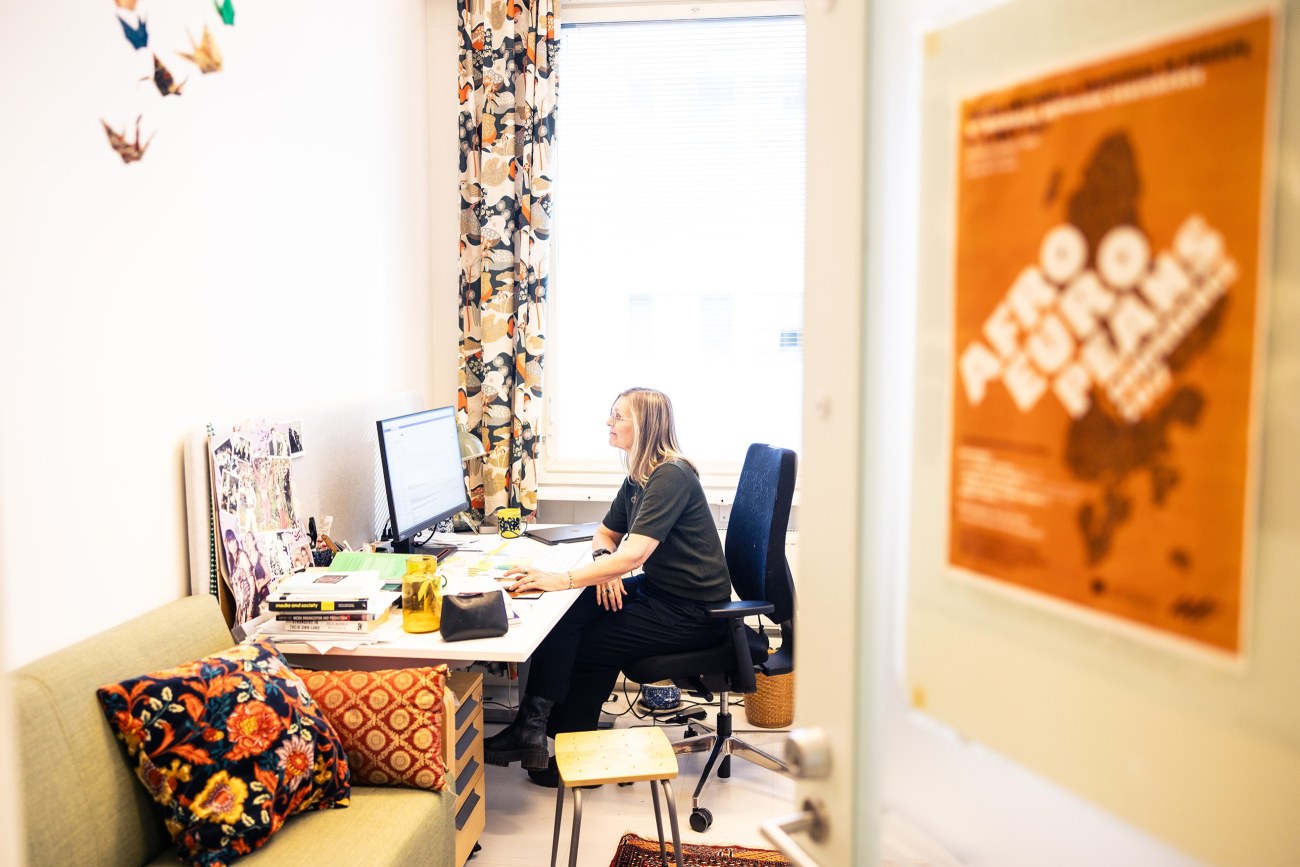 Photo: Jonne Renvall
From VHS cassettes to Zoom
The media landscape has changed profoundly over the past few decades, and this shift is naturally reflected in the work of media researchers. They must continually keep up to date with the latest developments and move on to the next new thing as soon as they have mastered the previous one. As an example of the rapid pace of change, Nikunen recalls a discussion that took place during a lecture back in 2019.
“TikTok was still a relatively new platform at the time, and we asked the students what it was. They replied dismissively that it was only for young children. That perception changed pretty quickly.”
Some of the changes reshaping the media landscape have had a tangible impact on research practices.
“In the past, we might record data on VHS cassettes, which we then lugged around in plastic bags,” reminisces Nikunen.
“Today, everything is available to us in ways that simply did not exist before. Research material can be collected from social media and online discussion forums, and interviews can be conducted via Zoom.”
With new technologies and phenomena come entirely new research environments and questions to explore.
“Social media enables so much, and it has become a fascinating area of inquiry. It has also made many societal phenomena more visible, such as hate speech and the rise of the far right. In addition, there are many datafied and AI‑driven environments in which we do not decide what we see as the feed is generated automatically. This steers users towards particular content and towards particular communities. The places where people talk and interact have changed tremendously.”
When teaching, it is important to consider which content and questions are fresh and relevant to young people today.
“The issues we explore in research and in the classroom must stand the test of time, but media content is constantly changing. It is a balancing act that requires careful consideration. New TV series and documentaries are released all the time, and after a while no one remembers them. When I am teaching students in their twenties, I cannot talk about content that they do not understand or are not familiar with. At the same time, we need to introduce students to older media content that remains societally significant.”
Media change people
According to Nikunen, the field of media research is currently in a state of flux. Artificial intelligence has rapidly become an integral part of everyday life, and media research has for some time been undergoing a material and infrastructural shift focusing on the impact that media content, data collection and AI have, for example, on the environment.
Nikunen refrains from predicting the next major shift in her research field. She remains fascinated by how people encounter and understand one another, and she has no shortage of research ideas.
“I have a somewhat critical view of the claim that AI could solve our problems. Perhaps this is the line of inquiry that I will pursue next.”
When the media landscape changes, how do the people who use and meet one another through different media change as well?
“I believe that changes in the media have reshaped us in many ways in the past, too. As we continuously interact with the media, it influences the way we respond to different things and the world around us. We now carry media with us at all times, and this has prompted much discussion about how its constant presence affects us.”
Still, many of the things that matter to us have not changed. We still seek to connect with others, whether via media or in person.
“Media can pull us apart and divide us into opposing camps, but it can also bring us together, and this hope for connection remains very much alive. In my latest study, I think I have witnessed some of that longing for human connection. When everything is mediated through technology, people begin to look for alternatives.”
 Photo: Jonne Renvall
Project links


