The plastic waste problem costs Finland millions: a project focusing on responsible packaging puts consumers at the center

According to the EU, there is still room for improvement in consumers' enthusiasm for returning plastic packaging to recycling points and in the recycling of packaging received by companies. Only a small number of member states have achieved their recycling targets.
Although Finns feel that they sort plastics and other materials carefully, Finland has fallen behind in its plastic recycling targets. The recycling rate for plastic packaging is currently only around 30 %, while the EU target was 50 % by 2025.
Unrecycled plastic packaging costs Finland nearly 90 million euros in fines per year, which means that the problem also affects consumers' wallets. Furthermore, there is room for improvement in the recycling of cardboard, glass, and metal.
The ResPa project involves consumers in finding solutions
The ResPa project (Consumers' Role in Responsible Packaging – Improving Circular Economy Innovation Capacities in the Packaging Value Chain), coordinated by Tampere University of Applied Sciences (TAMK), responds to the need to improve the circular economy of packaging, reduce overpackaging, and minimize waste to achieve the EU's sustainability goals. The reuse and recyclability of packaging can be promoted by changing consumer behavior.
The ResPa project consortium is exceptional as it brings together all levels of education.
Together we promote the development of circular economy business models and strategies between higher education institutions, the vocational sector, and companies, which is something new. We focus on recyclable and reusable consumer packaging, consumer behavior before and after the purchase, and integrating consumers as active participants in the packaging value chain.
Project Manager Nina Kukkasniemi, TAMK
All actors in the packaging value chain are involved in development and information sharing.
“We offer companies opportunities to create new technologies and business models by involving and activating consumers. We develop the skills of those working with packaging and create training content in the form of small, micro-credentials and digital open badges. These make it possible to identify existing skills and update and fill any gaps”, adds Kukkasniemi.
Challenges are best solved when information and ideas flow freely between parties
The project applies the Quadruple Helix and living lab approaches. The Quadruple Helix model refers to a form of collaboration in which the research community, businesses, the public sector, and ordinary people work together to create new solutions. When users and citizens are involved in solving problems, the solutions become functional, sustainable, and useful in everyday life.
A living lab, on the other hand, can be either a method or a development environment in which user-driven experiments are conducted in real-life situations. This ensures that the service or product meets the needs of users.
Partners from Spain, Italy, Germany, and Sweden are already partially familiar
The project is funded by the Erasmus+ Alliances for Innovation (2021–2027) program. Competitive funding strengthens Europe's innovation capacity. TAMK has been and continues to be involved in the circular economy of packaging through several projects. Cooperation has been ongoing for some time with, among others, the Italian company Proplast.
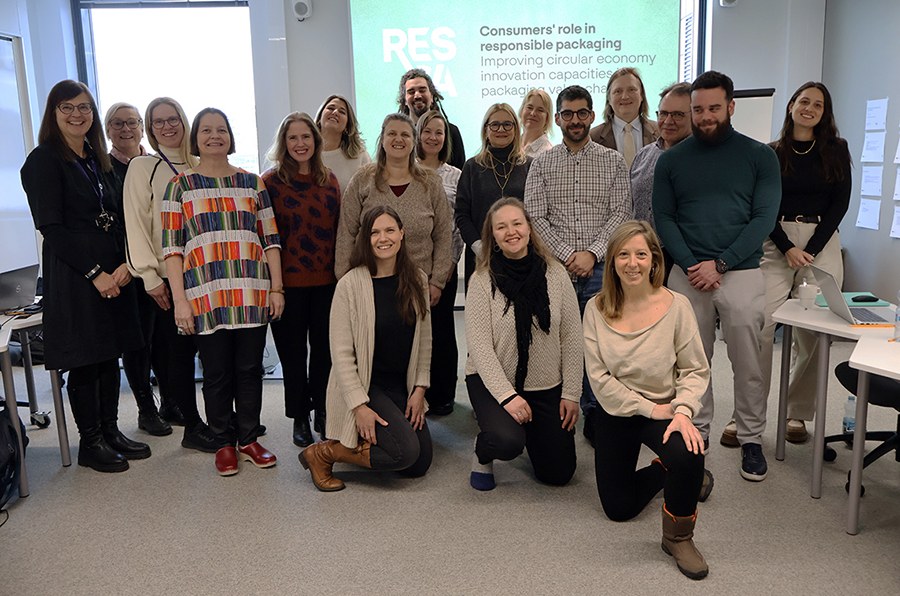
In addition to TAMK and Proplast, other partners in the ResPa project include the Spanish Asociación Valenciana de Empresarios de Plásticos (AVEP) and Ecoembes, the Swedish Brobygrafiska, the German Hochschule München University of Applied Sciences, and the Italian University of Trento. Tampere Region Vocational College Tredu is also participating from Finland.
In Sweden the focus is primarily on reducing the amount of waste
There is a clear focus on reducing the amount of waste and, in particular on ensuring that materials do not end up in the natural environment.
We need to broaden our view of the role of packaging in the value chain to develop more resource-efficient and circular systems.
Sara Larsson, Head of Graphic Design, Brobygrafiska
In Sweden the focus is primarily on packaging as a product – that is, the amount of material used and how it can be recycled. According to Larsson, this very narrow perspective risks causing us to overlook the role of packaging in protecting a product from production until the product is used, as well as overlooking the importance of the consumer in how packaging is used and recycled.
“Using too little packaging material or selling excessively large packages can lead to food waste or other forms of product waste. We need to better understand how packaging can help reduce food waste, for example by facilitating proper storage, dosing, and complete emptying. It is also important to understand how material choices and design can influence the consumer’s willingness and ability to sort and recycle packaging after use”, Larsson says.
Italy is currently a European leader in the circular economy
In Italy the recycling rate for all waste types reaching 85,6 %, the highest in the EU. Specifically for plastic packaging, Italy has shown remarkable progress: in 2024, the effective recycling rate reached 49,6 %.
“The main reason for this success is an integrated system based on extended producer responsibility, which links the fees paid by companies to the actual recyclability of their packaging. This has incentivized a massive shift toward eco-design. Additionally, Italy relies on a highly automated national network of selection and storage centers”, describes Susana Remotti, Project Manager in Proplast.
In Italy the consumers are viewed as essential stakeholders whose "small daily gestures" make the entire circular economy possible. However, the role of the consumer must evolve from simple waste sorters to informed participants in the material's "new life". To improve engagement, Italy is focusing on innovative and rewarding collection methods.
Susana Remotti, Proplast
Remotti emphasises that communication must be factual and data-driven, moving beyond green claims.
“We must tailor content for different audiences, such as TikTok and Instagram for younger generations and specific educational programs for schools. Companies need clear technical support to ensure that packaging labels help consumers sort waste. We have to show the tangible economic and social benefits of recycling, such as job creation and resource preservation. By doing that we can make the circular economy a shared civil value”, says Remotti.
In Spain the overall performance of packaging recycling is relatively strong
According to Eurostat, Spain recycled 70 % of total packaging waste in 2023, meeting the EU’s 2030 overall target. However, plastic packaging remains the main challenge as only 42.1% was recycled in 2023. The key gap is recycling quality and clarity, not awareness.
“The main reason is not only collection coverage, but material complexity and quality issues: plastic packaging is often multi-layered, contaminated with food residues, or composed of mixed polymers, which reduces the proportion that can be effectively recycled into high-quality secondary raw material”, says General Manager Christina Monge Frontiñan from AVEP.
Even though Spain’s packaging waste collection is relatively high, the main challenge is not getting people to participate, but getting clean, correctly sorted material that can be recycled.
In Spain the consumer motivation is already there but there is confusion about what belongs in each bin, and with packaging that is not emptied or is heavily contaminated which lowers the quality of the collected stream. That contamination and mixing then reduces sorting efficiency and leads to more rejects or downcycling.
Christina Monge Frontiñan, AVEP
According to her, Spain needs to convert good intentions into consistently correct behaviour through simpler, standardized disposal instructions on packs, clearer local guidance, and communication that explains why small actions can have a big impact on whether plastic packaging becomes new material or ends up rejected.
In Germany the recycling quotas are good, but consumers should be more active
In Germany, the consumers should be more aware of the recycling of materials – plastic, paper, boards, glass, aluminum, iron-metal, and beverage cartons – as well as the right way to recycle.
Despite the good recycling quotas, the recycling industry is under pressure in terms of costs and efficiency.
German consumers can help by sorting more effectively, leaving less product in the packaging, separating packaging components, and generally being more aware of how they use packaging. Sorting errors and waste that do not belong in the recycling stream are a problem.
Sven Sängerlaub, Hochschule München University of Applied Sciences
He emphasizes that consumers can also help by tolerating or even accepting slight flaws in packaging when recycled materials are used, e.g., a slightly gray color.
“The more consumers desire and appreciate the use of recycled materials, the more worthwhile recycling becomes for companies. And the sooner we will achieve a circular economy", says Sängerlaub.
Read more about the project at website.
Funded by the European Union. Views and opinions expressed are however those of the author(s) only and do not necessarily reflect those of the European Union or the European Education and Culture Executive Agency (EACEA). Neither the European Union nor EACEA can be held responsible for them.
Author: Hanna Ylli


