Terhi Kilamo advocates for safe and inclusive spaces across academia

Terhi Kilamo was promoted to the position of Senior University Lecturer at Tampere University in January 2026. This title may be awarded to teaching‑focused staff who are primarily engaged in teaching, pedagogical development and supporting the wider university community.
Kilamo has previously worked at the former Tampere University of Technology and progressed through every possible stage of an academic teaching career. Still, becoming a teacher was not part of her original plan.
“If someone had asked me 30 years ago what I wanted to be when I grew up, I would probably have said that anything but a teacher! There were so many teachers in my family, and I was convinced that teaching was not me.”
Kilamo discovered the appeal of teaching while working as a course assistant during her studies.
“Teaching creates a dynamic social environment that I found genuinely meaningful. That experience marked the beginning of my academic career.”
Kilamo’s extensive teaching experience meant that her promotion to Senior University Lecturer had little effect on her day‑to‑day work. The same could not be said of her appointment as Head of the Software Engineering Laboratory in November 2025.
The Software Engineering Laboratory is one of the seven laboratories within the Computing Sciences Unit at Tampere University and employs approximately 90 staff members. As Head of Laboratory, Kilamo is responsible for overseeing daily operations, managing operational resources and keeping the Head of the Computing Sciences Unit informed about the laboratory’s activities.
In addition, Kilamo oversees the Degree Programme in Computing and Electrical Engineering.
“I wear many hats at Tampere University. I took on the role of Head of Degree Programme about four years ago, when the previous curriculum was being designed. I have completed a doctoral degree and worked as a postdoctoral researcher, but I suppose I am ultimately a teacher at heart. I enjoy teaching because it allows me to interact with students and talk science with them, but I am very much a ‘rolling‑stone‑gathers‑no‑moss’ type of person who likes to keep busy with many different things.”
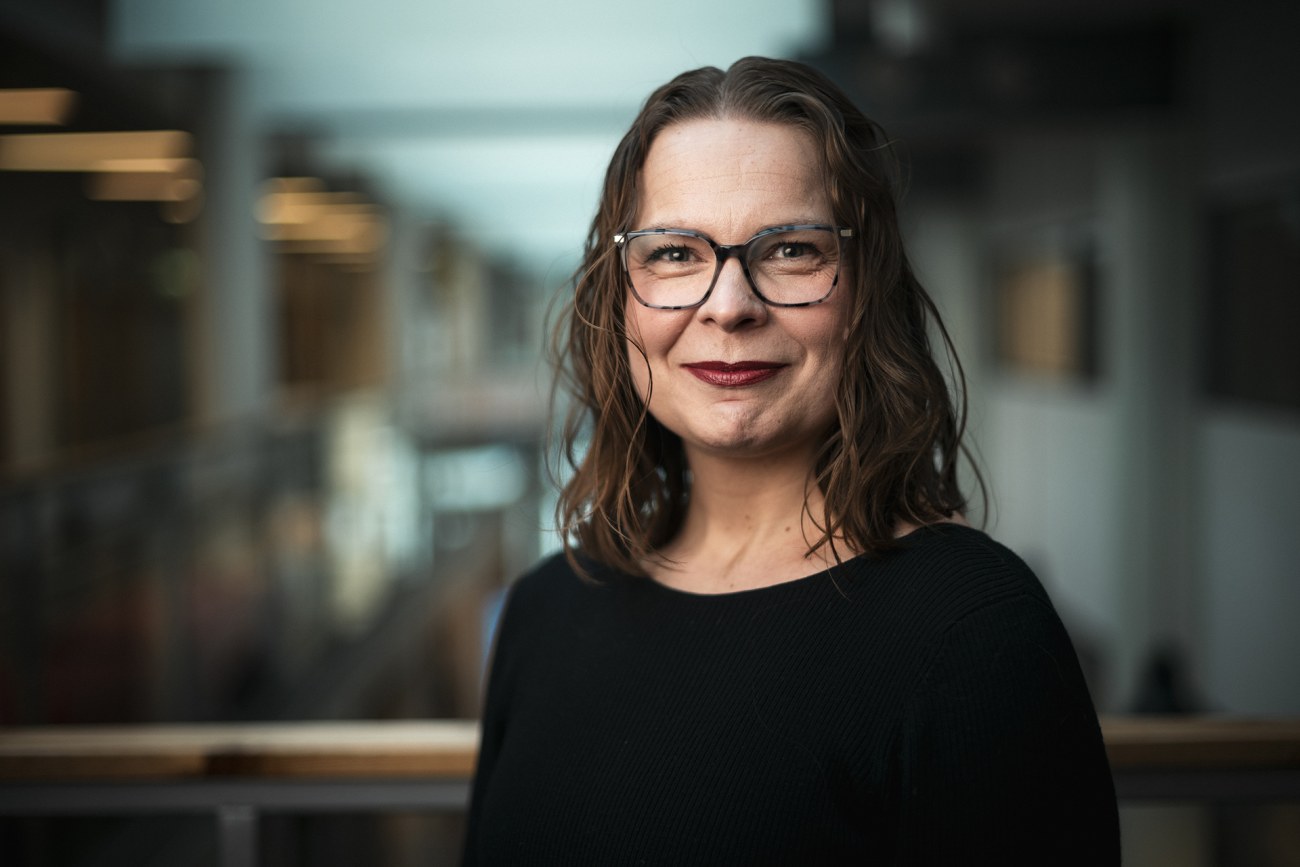 Photo: Antti Yrjönen
Playing with programming and curriculum design
In her youth, Terhi Kilamo imagined she might one day become either a medical doctor or an engineering professional. Information technology, however, was not her first choice: she enrolled at Tampere University of Technology to study electrical engineering, but the appeal of programming soon began to outweigh that of her original field.
“This may sound funny, but my decision to switch degree programmes was influenced by the fact that I had a natural flair for foreign languages, especially when I was younger. Programming is a language built on mathematical logic, and the problem‑solving inherent in engineering is akin to playing with linguistic LEGO blocks. There was also a social element that affected my decision, as a couple of other electrical engineering students transferred to IT at the same time. But what goes around comes around – now, in my role as Head of Degree Programme, I am responsible for the same electrical engineering courses I once completed as a student.”
Kilamo’s position as Head of Degree Programme also enables her to keep playing with building blocks, in a manner of speaking.
“Not everyone loves curriculum design, but I do. It is like a giant puzzle that must be divided into pieces and then fitted together to form a coherent whole. It is basically like building with blocks, much like software design, except that the blocks are courses. I find this type of problem-solving immensely enjoyable; it brings me to life.”
Quickly evolving field poses challenges for teachers
For Kilamo, the appeal of information technology lies not only in ‘playing with blocks’ but also in the rapid pace of development in this field, which makes it ideal for quick thinkers and those who enjoy working on a wide range of tasks.
The previous transformation that profoundly affected the IT sector – the shift towards agile software development – reshaped established working methods and changed how users see software. The agile approach places greater value on responsiveness than on adhering to a ready-made plan. Software is created in bits and pieces, with input invited from both the client and team members.
The latest major shift has been brought about by what is commonly referred to as artificial intelligence (AI), meaning the large language models (LLMs) such as ChatGPT and Copilot. The influence of AI tools and LLMs on both teaching and the IT sector has become a central concern for staff responsible for administering the Degree Programme in Computing and Electrical Engineering.
“Educators are now envisioning the professional landscape that future computing and electrical engineering specialists will inhabit in the year 2030 and beyond. I would say that virtually all software is currently developed using at least some degree of AI assistance. The challenge now is to integrate LLMs into teaching in a manner that is both sustainable and future‑proof.”
Kilamo anticipates that the next major transformation in IT will be driven by quantum computers and the new opportunities afforded by quantum physics.
“If I let myself speculate a bit, LLMs might also help us get more out of quantum computers. Still, I cannot make any certain predictions about this yet.”
With the field evolving so rapidly, some of the IT teaching content must be revised each year. Although the core material – such as the principles of communications engineering or the foundations of electrical engineering that underpin the entire field – remains unchanged, new innovations and research findings necessitate regular updates to course content.
“Teaching is, and will always remain, a human activity. However, universities are expected to provide higher education at a time when research is generating new knowledge at roughly the same pace as we are able to teach it. This is the challenge we face.”
Information technology needs idealists
Even though Kilamo encourages students to graduate within the target timeframe in her role as Head of Degree Programme, she is equally keen for them to lead full and balanced lives: to work, socialise with their fellow students, go to parties and make time for their hobbies.
“We have a responsibility to deliver high-quality academic education, but we must also understand the realities of students’ everyday lives. After all, university is the best time of one’s life! It is a transformative period, and it should offer genuine opportunities for self‑discovery. I believe it is also our responsibility to create a safe and inclusive space where students can be themselves and to support them in finding their passion and their own way of pursuing their chosen career.”
The field of IT offers a remarkable variety of roles. Software is ubiquitous in modern life, and IT is embedded in almost all the devices we use. Software engineering professionals may find themselves working on technologies that power ocean‑going vessels or support life‑saving medical equipment.
“When discussing IT, the conversation often centres on the perceived dominance of social media platforms and market forces. And yet, software has enabled progress and prosperity that would have been unimaginable otherwise.”
The sector is profoundly connected to the future of humanity. However, there is also a downside: the ethical implications of IT in relation to sustainable development.
“It is fair to say that information technology can pose risks to sustainability. AI systems consume vast amounts of resources, clean water and electricity, and they may take over roles that would still require a human touch. We need professionals who understand these issues and are committed to using technology responsibly.”
 Photo: Antti Yrjönen
It may not be immediately obvious that IT is also a great fit for people with a knack for languages, a fondness for ethical reflection or strong social skills, but it is. Kilamo dismisses the outdated stereotype of engineers as middle‑aged men driving a Skoda.
“Engineering does attract more men on average, and I hope that more women and people from minority groups apply with study with us. The traditional image of an engineer does not reflect today’s reality. Studying at Tampere University is so much fun, and our community is warm and welcoming. Anyone can find their place here if they have the courage to take the first step.”
Author: Eli Harju


