Inside complex systems: How Gerardo Iñiguez maps human interactions

Similarly to meetings face-to-face, online we gather around those who are similar to us and form tribes of common ideas and behaviours, which might become echo chambers for our thoughts, affirming what we already believe in.
That is what associate professor of complex systems Gerardo Iñiguez studies – how social groups interact in online spaces. More simply put, he studies how we share messages, interact with each other, generate content, and create communities. These complex social systems in online environments are influenced by constantly changing algorithms and the collective behaviour of every user. For Iñiguez, the web is not unpredictable chaos, but a system to be studied by the tools of complexity and network science.
“Instead of analyzing the actions of each individual separately, we take a statistical look at the behaviour of entire groups of people. We download a lot of information about how these social systems behave, and then find statistical patterns in the data”, he explains.
From complex systems to algorithms
The study of complex systems examines phenomena where many components affect each other via networks of interactions. Complex systems can be made of people online, but they could also be made of companies or countries interacting in the geopolitical space, or proteins interacting in cells during biological processes. Even though these systems may look very different, they share similarities in their structure and collective behaviour across time.
Before studying complex systems, Iñiguez was a physicist specializing in a field called statistical mechanics. That background is the reason he has learned to come up with relatively simple mathematical models that capture the collective behaviour of systems made up of many interacting units.
“People are complicated and heterogeneous, they can have so many behaviours in response to the same stimulus. But once you put them together in a collective space, like an online social platform, they tend to follow very specific collective patterns that can be reproduced with simple mathematical models inspired by physics”, Iñiguez says.
These collective patterns can be used to make predictions that help understand how people form social groups. Iñiguez studies the underlying mechanisms by which ideological divides in, say, politics, appear. People may become more polarized due to their own opinions, how they connect with others, and their perception of the political landscape, leading to segregation and potential echo chambers or ideological tribes.
Most social platforms work via content filtering algorithms that tend to show us things that are similar to what we already like. Filtering information can compound the natural tendency of humans to strive for similarity, making them more certain of their own opinions. Only companies know exactly how these algorithms work, since most of their code is proprietary. Professor Iñiguez finds this problematic due to the still uncharted role algorithms play in the formation of opinions.
“We really need to explore the effects of these platforms and their algorithms on the behaviour of entire populations, especially in the current age where so many of our activities happen online”, Iñiguez emphasizes.
“These companies have a lot of power and undue influence.”
Tribalism is a natural tendency, but some people may act differently
Humans have a natural tendency to generate very cliquish communities – groups of people who are very well connected, share similar opinions, and do not interact much with outsiders. Iñiguez explains that this tendency is evolutionarily ingrained in human behaviour since ancient times, but extends to online platforms as well. Big media companies have understood such a tendency to an extent and use it to maximize engagement by pushing content similar to what we already consume.
Gerardo Iñiguez works on the question of whether or not there are differences between human behaviour in online spaces and interactions in the physical world. Do we behave differently based on the social context or space where we are?
Previous research suggests that we have the same capacity for meaningful and stable social connections online as we do offline – relationships that require emotional effort and time. The limit is often called Dunbar’s number, and it is hypothesised to range around 150 relationships for most people, although it may vary with traits like age and gender.
Iñiguez explains that with the vast amount of social data available online, scientists in his research group, the Tampere Complexity Lab, alongside colleagues have calculated how millions of people communicate across online platforms. When analyzed at scale, they have found that everyone has a so-called social signature. This means that if you place the order of your friends on the x-axis – best friend first, second best second, and so on – and the fraction of time you spend with each person on the y-axis, the result forms a curve with a shape specific to each individual. A rapidly decreasing curve means you favour your most important friends, while a flat curve indicates that you spend roughly the same amount of time with everyone.
“The shape of this curve – basically the way you distribute time among your friends – seems to be a stable feature of your personality. It doesn’t vary much. Even when people change their social environment by, say, moving to another city, the shape of their social signature stays the same; they replace old friends with new people in the same spot of their own friendship hierarchy”, Iñiguez says.
There seem to be two major types of people, as far as social signatures go. The first, described above, consists of those who tend to have hierarchical friendships and make up to 66–99 percent of the online populations explored. The rest have very flat social signatures, meaning they spend roughly the same amount of time with the people they interact with. This minority might be associated with what sociologists call ‘weak ties’, social connections that do not take much time but maintain the cohesion of society as a whole, found across social platforms and in physical spaces too. Professor Iñiguez and his colleagues are currently wondering about the social functions of this minority.
“Everyone has this special type of acquaintance – people with whom you do not interact that much, but who might connect you to vastly different groups from your day-to-day experience. These acquaintances might be able to ‘jump’ between social groups and keep society connected”, he explains.
“They are not a big fraction of society, but they are very important because they hold it together. They prevent us from basically disintegrating society and ending up as just a collection of tribes.”
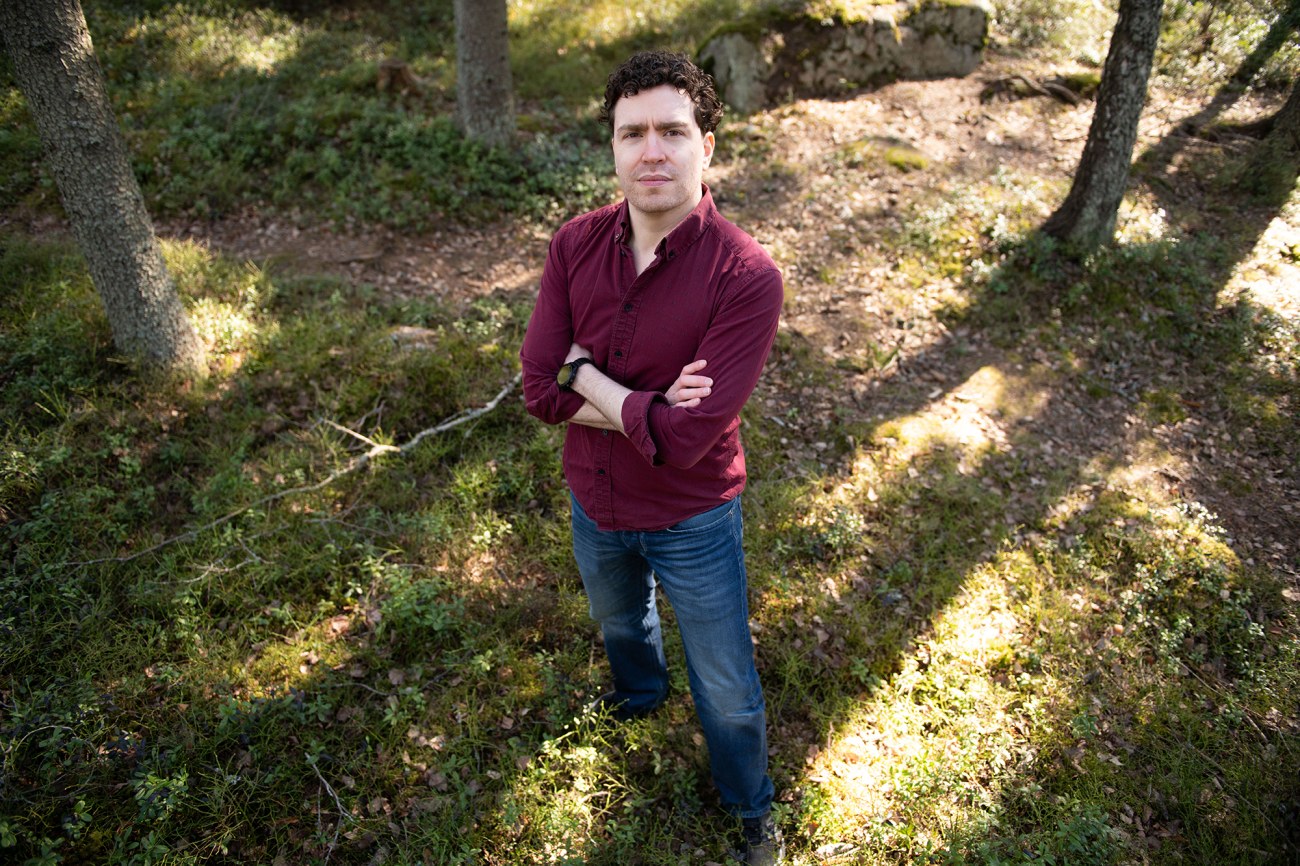 Photo: Eelis Berglund
From chaotic Mexico to calm Tampere
Iñiguez is originally from Mexico, but his career has taken him to many places – Oxford, Aalto University, Budapest, Vienna, and finally to Tampere. He says that academic mobility is an unavoidable feature of many researchers’ lives.
Tampere felt a bit small at first, but it has grown on him. Finland, in general, feels like a highly organized and stable place compared to the Mexican way of life, which he describes as full of flavour and colour, but also of chaos. Over time, he has come to appreciate Tampere as a balanced city that is large enough to offer cultural activities, yet small enough to feel calm and close to nature.
Another thing Iñiguez values in Finland is its continuing societal support for research and academic activities. He is concerned about global developments in which funding for universities and research has been increasingly cut. The same trend shows signals of appearing in Finland as well, he says, but at a slower pace that can hopefully be overturned.
To balance his academic life, Gonzalez has creative hobbies: he plays electric guitar in an amateur band called Entropy Ensemble and writes science fiction and fantasy stories in his free time.
“There is something very alluring to a physicist’s mind in music. It is about improvisation, about finding hidden patterns in the sound, about creating something that feels new while still containing elements of previous creations”, Iñiguez explains.
“The same is true in science. In physics, you need to be very creative. You can always attempt to come up with a new idea, but it needs to connect to what came before and follow familiar patterns to what is already known to be true.”
Gerardo Iniguez Gonzalez
Research topics
- Rank and hierarchy dynamics in complex systems
- Dynamics on/off techno-social networks
- Opinion dynamics and algorithmic bias in online platforms
Publications: Google Scholar
Author: Mira Kokko


