“Mullet” appears on a computer screen – unique research on speech and voice at Tampere University

“No bob, no bun, no ponytail – just a perm…”
Takatukka (“Mullet” in English), the song made famous by Finland’s national Eurovision Song Contest selection, growled into life at Tampere University’s Speech Research Centre as throat singer and accordionist Antti Paalanen arrived at the lab as a test subject.
Electrodes placed around Paalanen’s neck measured the vibrations of his vocal folds via an electrical signal recorded from the skin. An ultra‑high‑precision microphone captured the sound signal and its frequencies, while the flow mask recorded the air pressure and airflow he used while singing.
The measurements produced curves on the computer screen that clearly illustrated how Paalanen’s throat singing differs from his normal speaking and singing voice.
“This was a fascinating and highly educational experience,” Paalanen said after the session. “It confirmed things I had been thinking about myself, but I also learnt a great deal that was entirely new.”
Doctoral researcher and voice teacher Tero Ikävalko explains that in throat singing, vibration is not limited to the true vocal folds; the ventricular, or false, vocal folds are also engaged. This produces a subharmonic tone an octave below the original pitch, which sounds beneath the main voice.
On the laboratory display, this was reflected in a vibration curve with alternating higher and lower peaks. The audio signal itself resembled a recording of two simultaneous pitches rather than a single voice.
“We also found that throat singing requires significantly greater lung pressure and airflow than ordinary speech or singing,” Ikävalko adds.
The voice can reveal Parkinson’s disease
The Speech Research Centre, which is part of Tampere University’s NEXUS infrastructure, moved into new premises on the ground floor of the Linna Building in spring 2025. The Speech Research Centre – better known as PUTUKE – brings together research on logopedics, which focuses on the study and rehabilitation of voice and speech disorders, and vocology, which specialises in the analysis and training of healthy voice production.
The same research methods used to investigate the mechanics of throat singing are also applied to the study of neurological conditions. At PUTUKE, they are used, for example, to identify early signs of Parkinson’s disease.
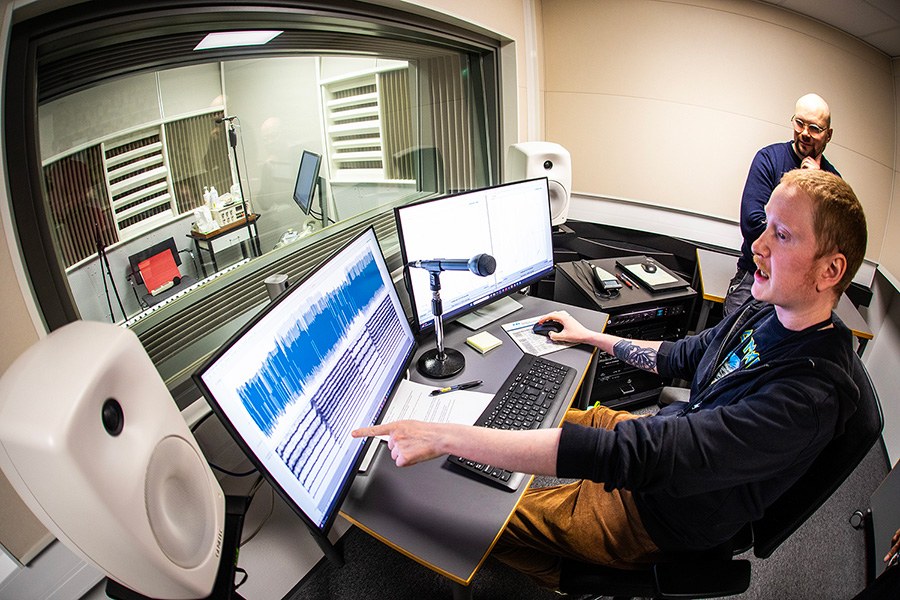
PUTUKE’s Director, Docent Nelly Penttilä, explains that in Parkinson’s disease the voice gradually becomes softer, hoarser and more breathy. Thanks to the centre’s high‑precision measurement tools and machine‑learning techniques, such changes can be detected even before they are audible to the human ear.
“We are conducting research together with the Pirkanmaa Wellbeing Services County and Aalto University on patients who are suspected of having Parkinson’s disease or who have only recently received a diagnosis. Using nothing more than a voice sample, we can distinguish these patients from healthy age‑matched controls with 81 per cent accuracy,” says Penttilä.
Penttilä also leads the AAVISTUS project, which focuses on the early detection of Alzheimer’s disease based on text read aloud. The study involves participants whose functional ability remains good and who are only at the stage of suspected memory impairment.
“Analysis of narrative speech shows that their intonation patterns and rhythm already differ from those of healthy peers. In other words, changes in memory, language and cognition can be identified at a very early stage through speech production,” Penttilä notes.
Looking ahead, Penttilä believes the human voice could provide a low‑cost, non‑invasive tool for detecting a wide range of diseases. Earlier diagnosis enables earlier access to treatment and rehabilitation.
Culture shapes speech and mental impressions
In addition to the acoustic characteristics of speech, PUTUKE also explores the cultural images and associations evoked by different voices. Research shows that cultural background plays a decisive role in how voices are perceived and interpreted.
“If a speaker’s voice is very breathy and airy, Finnish listeners tend to find it unpleasant and untrustworthy. By contrast, Arabic‑speaking listeners may perceive the same voice as a sign of attractiveness and trustworthiness,” Penttilä explains, referring to findings by Nilsson and colleagues (2024).
Culture also influences how we speak and use our voices. PUTUKE’s research indicates that the average pitch of young women’s speech has risen from the 1990s to the 2020s, while the prevalence of vocal fry has increased fourfold over the same period. At the same time, the speaking rate of television news anchors has accelerated.

According to Waaramaa and Laukkanen (2024), these changes are partly driven by popular culture and social media. Online communication is increasingly fast‑paced, and intonation patterns typical of English – especially rising intonation and higher pitch – may be influencing Finnish, which is traditionally lower‑pitched and more level in intonation.
“People naturally adapt their voice use to their surroundings and to the company they keep, often without realising they are doing so,” Penttilä adds.
What helps you sing high and loud?
While this session gave Tero Ikävalko the opportunity to analyse throat singing, his own research focuses primarily on belting – a vocal technique commonly used in musical theatre and rock music, characterised by powerful singing at high pitches.
At PUTUKE’s laboratory, Ikävalko has examined how belters use their voices and compared this with shouting produced by untrained speakers.
“Our research shows that belters are, on average, slightly more vocally efficient,” he explains. “In practical terms, they use less aerodynamic energy to achieve the same level of loudness as untrained shouters.”
Ikävalko’s work is part of a project funded by the Research Council of Finland, which investigates the efficiency and economy of powerful voice use in both classical opera and contemporary musical styles. The findings have practical implications for the teaching of singing and speech alike, as vocal overloading is a key risk factor in the development of serious voice disorders.
Throat singing takes years of practice
When Antti Paalanen switches from his normal speaking and singing voice to throat singing, it sounds deceptively effortless. Yet when an ordinary karaoke enthusiast attempts the same technique, the result is typically little more than indistinct growling and a sore, hoarse throat.
Paalanen readily acknowledges that mastering throat singing has taken years of dedicated practice. His interest in the technique was sparked while working on his third solo album, Meluta, released in 2014.
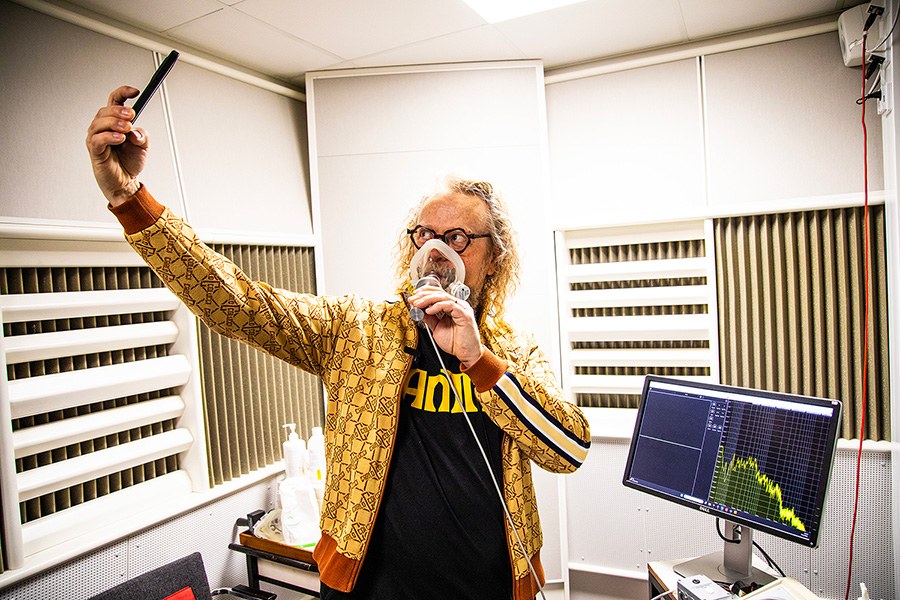
Previously, Paalanen’s music had centred primarily on playing the accordion, but he wanted to introduce new elements into his work. To him, throat singing sounded as if the accordion itself had begun to speak or sing.
“My aim was to alter my voice using the throat‑singing technique so that it would sound metallic. That’s how I began practising,” he explains.
Song by song, throat singing has become an increasingly prominent part of his music.
When we clear our throats, a low sound is produced by the vibration of the false vocal folds. With sustained practice, Paalanen says, this sound can be harnessed for making music.
“For me, this growling voice has developed into a kind of character or role that is easy to step into when I go on stage. It is playful role‑playing,” Paalanen says with a smile.
Today’s test subject: Antti Paalanen
Watch the video for highlights from the session in which Antti Paalanen’s throat singing was measured at the Speech Research Centre’s laboratory. (English captions available.)
How does it feel now, Antti Paalanen?
In the video, Antti Paalanen talks about what it was like to have his singing analysed and what the results revealed. He also explains how throat singing differs from traditional singing and how one can learn to become a throat singer. (English captions available.)
Author: Virpi Ekholm


