Concerns over press and academic freedom brought researcher Soma Basu to Finland to study online hate

Around 2017, while working as an investigative journalist in Delhi, Soma Basu began to feel that she could no longer work freely. The role of the newsroom editor was shifting. The editors were increasingly functioning as people managers rather than custodians of journalistic values.
– I refused to navigate through internal policies and self-censorship in Indian newsrooms, Basu recalls.
At the time, she’d been working around 15 years as a journalist in South Asia, receiving noticeable awards. For example, the United Nations Correspondents’ Association has awarded her coverage of Uttarakhand floods with the Global Prize for Climate Change reporting and the Kurt Schork Memorial Award for International Journalism for her story on human organ trafficking.
Fortunately, in 2018, Basu was given an opportunity to breathe more freely in the United Kingdom as a Journalist Fellow in Reuters Institute for the Study of Journalism, Oxford University. She joined over 200 political Indian WhatsApp groups that circulated religious polarisation between Muslims and Hindus. In India, WhatsApp groups function as a key channel for political propaganda (Manufacturing Islamophobia on WhatsApp in India).
Basu had noticed worrying developments in the media landscape. As pro-government forces gained influence over mainstream media, the ruling party mobilized a large network to spread divisive, hateful content online, particularly targeting Muslims. This was part of a broader effort to shift the secular democracy toward Hindu majoritarianism and electoral autocracy.
– What worried me was how access to smartphones, combined with limited media literacy, led people, including my own relatives, to share propaganda without realizing they were engaging in political work.
Her experiences at the Reuters Institute and the anxiety for what was happening to public discussion in India prompted her to dive deeper into the world of research.
– Once the fellowship ended, I wasn’t really satisfied. I wanted to research more, so I decided to do my doctoral thesis.
Eroding academic freedom led the way to Finland
Soma Basu’s path as a researcher has led to Tampere University, made possible by the EDUFI (Finnish National Agency for Higher Education) fellowship and a 4-year-grant by Kone Foundation (Koneen Säätiö). She was accepted as a doctoral student in 2021 and received the grant from Kone Foundation in 2022. Currently, she’s working with her doctoral thesis on rumours and memory making during riots.
Doctoral education in Tampere was not the first option for Soma Basu, however. She first began her doctoral program in an Indian university – AJK Mass Communication and Research Centre, Jamia Millia Islamia. She came soon to recognize that, in India, it was not only press freedom but also academic freedom that were under serious threat.
Large-scale protests broke out in late 2019 against the Citizenship Amendment Act (CAA), a law widely criticized for introducing religious criteria into Indian citizenship. At Jamia Millia Islamia, the police responded to student demonstrations with force, entering the campus and assaulting students, including those who were studying in the library.
– The police were beating up students sitting just peacefully and reading in the library. Two students lost their eye sights. It was a very deliberate attempt to target the university which focused on education of minority communities, Basu says.
The crackdown at the university became a turning point. It sparked nationwide protests, most notably the Muslim women-led sit-in at Shaheen Bagh, which quickly became a symbol of resistance. At the same time, political rhetoric grew increasingly polarizing, and social media played a significant role in amplifying communal narratives and spreading disinformation. (Article Porn, Protests, and Politics: Hindu Male Imaginations of Muslim Women)
– Unfortunately, I couldn’t stay at my university anymore because of increased government surveillance. I decided to leave India and continue my research, as similar patterns of social media-driven violence were emerging in other countries as well.
Basu has still been able to conduct research on her home country. For example, from 2021 to 2024, she was a co-investigator on the four-year project “Muslims in a Time of Hindu Majoritarianism,” funded by the Henry Luce Foundation and Columbia University and led by Sciences Po. In the project, she led the Media and Culture cluster, examining digital media’s role in statecraft, repression, and violence.
Violence that never ends on social media
The articles of Basu’s doctoral thesis focus on violence and hate that circulate between online and offline worlds.
– My main argument is that, in the age of social media, violence never ends. It continues to circulate across different loops, moving between infrastructures, media and bodies, and keeps registering itself sensorially. It is sustained through speculation, imagination and anticipation of violence.
Rumours have always incited violence, but in the age of social media, the scale and speed for that are unprecedented.
– Academics often draw a strict line between online and offline, asking if online violence is “real” violence. But given the density of digital life today, this distinction no longer holds. What matters is how rumours make violence imaginable and plausible, and in doing so lay the groundwork through which violence becomes possible, Basu states.
Algorithms bring faraway acts of violence into disturbing proximity, whereas violence in one place can incite similar imaginaries elsewhere. Basu names an example: the Norwegian mass-murderer Anders Breivik had several mentions of the ethno-nationalistic Hindutva ideology – the same that is espoused by the ruling regime in India – in his manifesto.
In her doctoral thesis, Basu has used sensory ethnography as her primary methodology. Her work examines how violence circulates across bodies, infrastructures and digital media, rather than remaining confined to a single site.
One of the articles emerging from this research focuses on northeast Delhi, where she conducted fieldwork on how the memory of the 2020 anti-Muslim riots circulates through everyday infrastructures such as drains.
During the 2020 Delhi riots, rumours of bodies in a drain circulated widely online. The physical opacity of the water intensified a wider psychological murkiness, transforming the unseen into a site of speculation where imagination reactivated violence beyond the event.
Basu studied how residents experienced and navigated a landscape shaped by what she describes as a haunted infrastructure.
– I conducted sensory walks where I recorded different kinds of sensations. Do the people start to walk more slowly, do they stop or hesitate somewhere, do they try to guide me to certain areas, what are the kinds of smells they react to.
The article Phantoms of the drains: imaginations of conflict in everyday infrastructures was published in the end of March.
Another article on AI-generated war images is currently under review, as part of her ongoing work on violence and visual media. Her research also extends beyond India to other conflict settings, including Kosovo.
– How do people in different places come to sense and live with violence?
In Tampere, at ease
Soma Basu, a researcher with background as a journalist, is concerned about the longstanding divide between academics and journalists, and the ways in which their knowledge-making practices often remain at odds.
In her work as a journalist, she felt that academics were not taking journalists seriously. Journalists, in turn, often felt that researchers “live in their own bubble.”
– In times of polycrisis, it is very important for academia, journalism, and civil society to come together and actively bridge this divide. I try to bridge that gap in my own writing too, says Basu.
Her time as a doctoral researcher in Tampere, Finland has offered Basu a different view of academic life, which often feels overly competitive elsewhere.
– I hate the dog-eat-dog world that’s elsewhere. Here, I’m able to do what I do without having to deal with professional selfishness. That lack of toxicity saves time and energy, so you can actually focus on your work. I love my work, I really love Finland, and I want to continue doing it as long as possible.
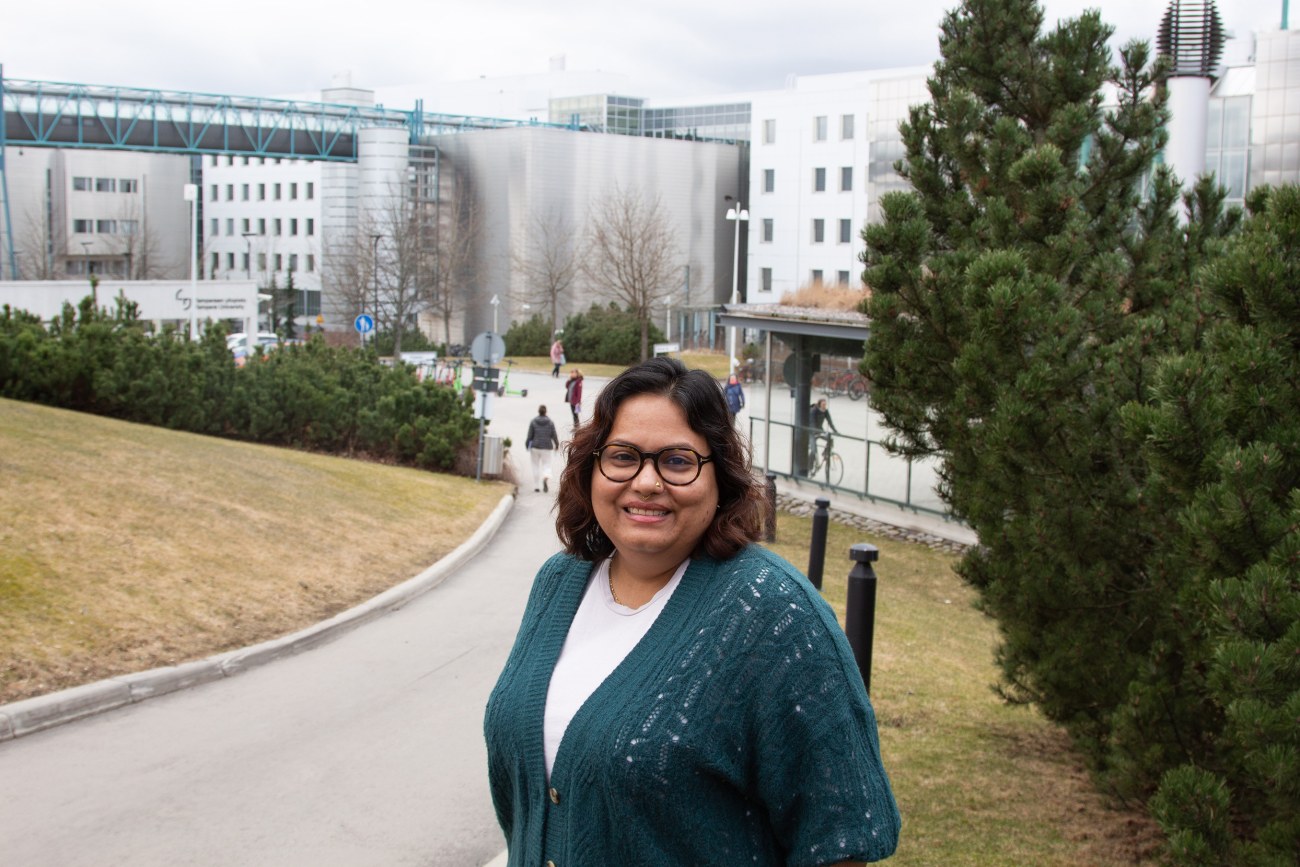 Photo: Eino Rissanen
Author: Eino Rissanen


