Professor Mikko Kanerva draws inspiration from natural materials and collaboration across a wide network of colleagues

What are your main research interests?
The core of my research lies in material interfaces, in which one of the components is typically a polymer. Polymers are chain‑like molecules that consist of many individual, small molecules called monomers.
Natural polymers play a major role in my work and include a range of plant‑based fibres, such as wood and flax. The plant world contains truly fascinating materials whose structures closely resemble synthetic polymers, including plastics.
At least half of my work involves building models, in other words, creating theoretical counterparts to real materials. I want to study and model the materials and interfaces that nature has already created and to understand how they function.
For example, we are currently conducting research on fungi in collaboration with researchers participating in the doctoral education pilot. In this project, I model how a fungal composite behaves. The aim is that, in the future, fungal materials could be used to produce lightweight building blocks..
What makes your research significant?
My research helps us better understand how interfaces between synthetic and natural materials function and behave in our environment. When natural materials are combined with synthetic ones, factors such as the effects of ultraviolet light and moisture need to be taken into account.
Another key aspect in the study of composite materials is orientation: quite literally whether the material being tested is subjected to stress along its length or across its width. Research offers new insights into how a particular polymer should be used. A concrete everyday example would be chopping firewood: the task is much easier when the log is upright rather than lying horizontally.
Sustainable development lies at the heart of my work because it is essential in today’s world. Sustainability considerations are becoming evident even in the defence industry, and for example, repair methods for materials have improved, extending their usable life.
Recently, the use of natural materials has also been explored in space applications, such as the structures of satellites orbiting the Earth. The idea is that the structure could break down into parts that can be reused in space at an appropriate point in its lifecycle.
What would you like to research next and why?
It would be fascinating one day to study how a naturally growing material forms an interface with, for example, a synthetic material used in industry. In medicine, this already takes place in implant research.
If we want to live in harmony with nature, then sooner or later we must find ways to integrate ourselves into what nature does and how growth occurs. We also need to understand this interface with the living natural world, which makes it a vast research topic.
It is also closely linked to issues such as recycling, which must inevitably be considered in the use of all materials. However, recycling alone does not solve the problem that, even with the most efficient industrial recycling system imaginable, various substances still end up in the environment from all materials through processes such as degradation and erosion.
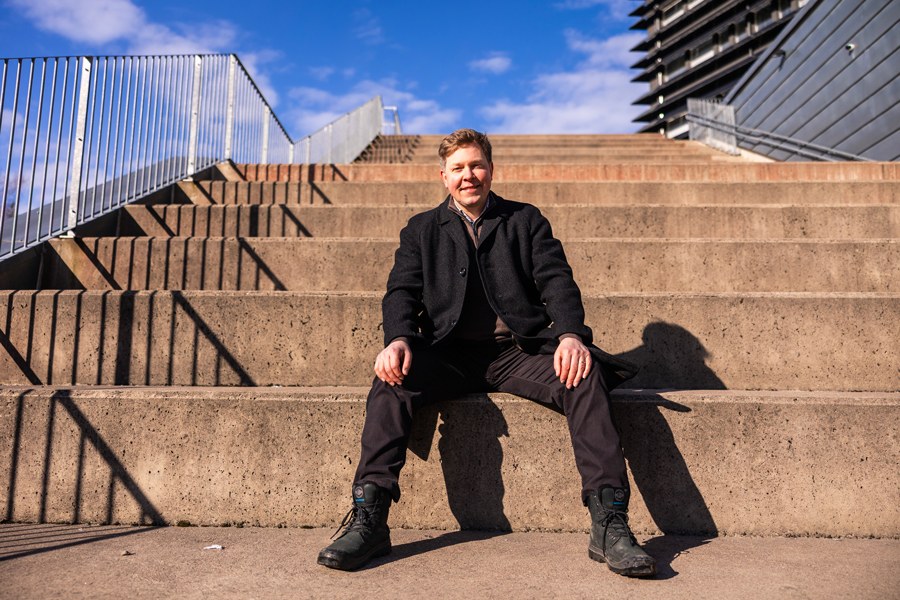 Photo: Jonne Renvall, Tampereen yliopisto
Where do you draw inspiration in your work as a professor?
“I feel a responsibility to inspire students. As a teacher, I do not give many direct answers; instead, I try to encourage students to think independently and engage with problems that may not have clear‑cut or definitive solutions.
I believe that challenging courses and approaching topics as concretely as possible help prepare students to succeed in their career, where the tasks and problems they encounter are not always easy. I also develop my courses in collaboration with industry.
For me, diversity is essential. I enjoy working with researchers, who bring in different ideas, skills and visions, and creating synergy together. I am also pleased to be internationally connected, as there is much we can learn from beyond Finland’s borders.”
What do you do in your free time?
I sing in a choir and as a solo tenor. I run and spend a great deal of time in the forest. Our family moved to Sastamala specifically for its proximity to nature. We pick mushrooms and berries together.
I am also active in my field outside my day job. I hold several positions of trust in various academic and industrial communities. At the moment, I participate in the development of the Nordic SAMPE network of the Society for the Advancement of Material and Process Engineering.
Mikko Kanerva
- Professor of Polymer Materials at Tampere University’s Faculty of Engineering and Natural Sciences since February 2025.
- Visiting Professor of Space Materials and Technologies at AGH University in Kraków, Poland, from 2025.
- Associate Professor at Tampere University of Technology and Tampere University, 2016–2025.
- Part‑time Lecturer at Satakunta University of Applied Sciences (SAMK), 2022–2024.
- Post-doctoral Researcher in Applied Mechanics at Aalto University, 2014–2016.
- Doctor of Science (Technology) in Materials Engineering, Aalto University, 2014. Doctoral dissertation topic: Rough interfaces.
- Master of Science (Tech.) in Aeronautical Engineering, Helsinki University of Technology, 2009.
- Author of 135 articles in prestigious scientific journals and conferences.
- Positions of trust: Tampere University’s representative on the Composites Section of the Finnish Plastics Industry Association; President of SAMPE Nordic; Board Member of the Finnish Society of Aeronautical Engineers (FSAEA); Member of the Programme Committee of the International Council of the Aeronautical Sciences (ICAS).

Author: Anna Aatinen


