Professor of Human-Centred Design Thomas Olsson combines the “how” of engineering sciences with the “why” of human sciences

The study of human-technology interaction brings together the “how” of the engineering sciences with the “why” of the human sciences. This cross‑disciplinary field is well suited to Professor of Human‑Centred Design Thomas Olsson, who describes himself as a generalist working with complex phenomena.
June 2026 will mark 20 years since Olsson took up a position as a research assistant on the Hervanta campus of the former Tampere University of Technology.
Olsson’s research interests focus on understanding why, and for what purposes, people use technology, especially information technology. When designing information systems, it is important to consider what constitutes appropriate design from the perspective of human users. This idea first emerged more than 50 years ago. Concepts such as usability and user experience gained prominence later, closer to the turn of the millennium.
“We are currently examining, for example, how the integration of immigrants could be supported through digital services that strengthen trust in the public sector and encourage participation in society,” says Olsson.
Olsson explored socio‑technological phenomena in his master’s thesis and initially continued along similar lines in his doctoral research. This was in the early days of social media when platforms such as IRC‑Galleria and MySpace were widely used. Olsson was interested in how small communities share experiences in digital environments.
However, Olsson’s doctoral research on this topic was interrupted when he became involved in another large‑scale project, for which he received a salary. He subsequently shifted the focus of his doctoral research to this project, completing a dissertation that examined the early applications of augmented reality and the user experiences associated with them.
Artificial intelligence (AI) will also change the world in accidental and unplanned ways
Olsson is fond of evolutionary biologist Edward Wilson’s interpretation of the key problem facing humanity. According to Wilson, humans possess Palaeolithic emotions, medieval institutions and god‑like technology.
By this, Wilson meant that advanced technology has the potential to empower individuals and democratise opportunities. However, Olsson notes that the dark side of human nature is not something we can fully regulate on our own. Institutions, such as religion and penal systems, were originally established to restrain the destructive impulses of human beings.
“Now that AI enables the development of all kinds of applications, society can no longer control their potential misuse. Students using AI to write essays is only the tip of the iceberg in this dilemma,” he says.
Olsson often reflects on AI from the perspective of emergence, a concept that refers to the way in which a new entity arises from a set of components and can no longer revert to its original form. For instance, life itself emerged from a mass of atoms.
“The origin of life remains one of the great mysteries of science. Similarly, the human brain consists of billions of neurons, and it is from this complexity that consciousness emerges,” says Olsson.
“We are now observing how the ability to generate high-quality text and other content emerges from artificial neural networks. It is extremely difficult to predict whether these systems could also give rise to artificial consciousness.”
In addition, human‑centred design examines why current information systems and their developers wield such tremendous power. While developers aim to create the best possible systems, all the future outcomes and scenarios associated with these technologies are difficult to foresee. The emergence of a general‑purpose technology, such as AI, is certain to change the world in both positive and negative ways, including through unintended and unplanned consequences.
Wearing a multitude of hats
Olsson devotes approximately 50% of his working time to research and teaching. As a human‑centred field, teaching in human-technology interaction focuses on the computing sciences, but his courses are also widely attended by students majoring in information technology.
The remaining 50% of Olsson’s working time is dedicated to administrative responsibilities, arising from his membership of the Academic Board and his roles as Head of Degree Programme and leader of the DigiSus research platform.
Olsson is one of eight professors elected to the Academic Board, a governing body that represents the entire university community and holds decision‑making authority over matters such as the establishment and discontinuation of degree programmes. Olsson is strongly committed to supporting the development of Tampere University, which is still a relatively young institution following its formation through a merger.
“Those early promises of a hopeful future remain partly unfulfilled, and the full potential of a cross‑disciplinary approach has yet to be realised. A similar process took place at Aalto University, where it took nearly a decade before a cross‑disciplinary focus began to bear fruit,” notes Olsson.
As Head of Degree Programme, Olsson oversees the international Master’s Degree Programme in Computing Sciences and Electrical Engineering. It has long been the largest programme at Tampere University, admitting well over 100 new students each year. In the upcoming curriculum, this programme will comprise 15 specialisations.
Students from outside the EU/EEA currently pay full‑cost tuition fees, meaning that they cover the costs of providing their education, amounting to more than €10,000 per year. According to Olsson, the introduction of full-cost tuition fees has reshaped working practices across the University as students, now paying customers, expect a high level of service.
A third major strand of Olsson’s administrative work involves leading the DigiSus research platform, which conducts research at the intersection of digitalisation and sustainable development. The platform aims to build networks and foster collaboration among researchers from different fields who share an interest in the same phenomena. It also supports access to funding opportunities and seeks to create optimal conditions for world‑class research at Tampere University. In addition, DigiSus provides seed funding for new research initiatives and projects that deliver positive societal impact.
Olsson feels that he has found an ideal place for making his mark in academia. He is committed to improving the conditions for increasingly high-quality teaching and research within the university community.
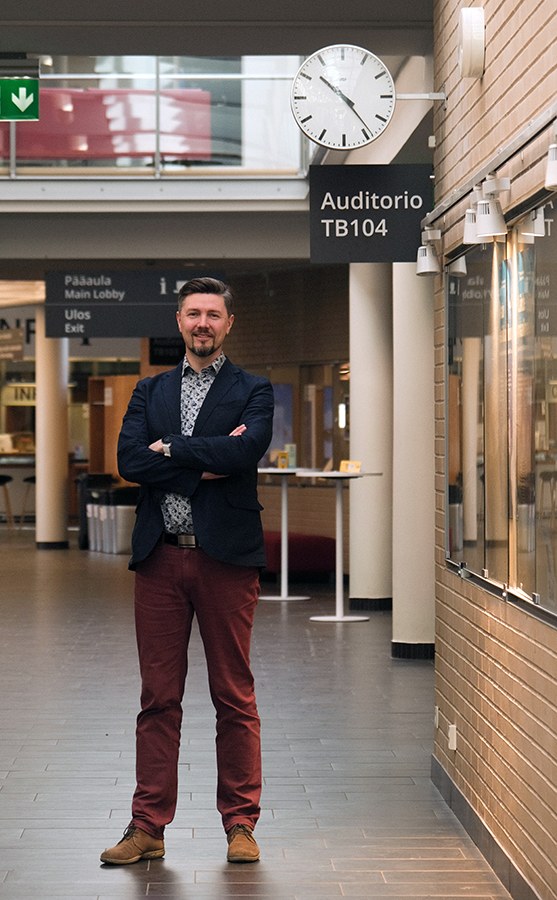
“Today, pedagogy is light years away from what it was two decades ago, and the arrival of international students has further accelerated this development,” says Olsson.
More room for drifting and broad-based learning
Olsson observes that the academic world has changed considerably over the past decade. In the early 2000s, an average professor might publish only a few research articles each year. Today, producing around ten articles annually has become the norm, a standard that applies to Olsson as well.
“Productivity is expected to increase even when public funding is reduced. Publications, theses and degrees are largely monitored using quantitative indicators, and the Finnish Ministry of Education and Culture allocates university funding based of these metrics.”
Funding cuts have also affected students. Olsson notes that he completed his bachelor’s and master’s degrees in 6.5 years, exceeding the Ministry’s target timeframe for graduation. He admits to feeling a degree of nostalgia when reflecting on a time when students had greater freedom to take intellectual detours during their studies.
“When I was studying at university, a certain type of drifting and active participation through student clubs and associations was considered highly valuable. We had a band, and I was involved in organising academic kyykkä competitions as well as the unique Mikontalon Lights event, where Tetris was played across the windows of a student housing block,” recalls Olsson.
Today, however, there is a stronger push to encourage students to graduate on time. Olsson’s courses are attended by students specialising in computing sciences and information technology, who often take longer to complete their degrees, as many of them secure employment even before graduating. Ironically, the University is financially penalised for educating students who enjoy high employment rates.
Olsson also emphasises the importance of general, broad‑based learning.
“In this role, especially as a professor, learning never stops. One is never fully complete or perfect, either in terms of knowledge or skills,” he says.
Olsson has a daily habit of listening to diverse content, for example, while walking the dog to spark what he describes as everyday eureka moments. Olsson is at his most creative when exercising or carrying out home renovation projects while listening to audiobooks or podcasts, and he encourages people to continually broaden their thinking. He says he has learned a great deal about critical thinking from social scientists and hopes that this approach will gain a stronger foothold on the more engineering‑oriented Hervanta campus. At the same time, he believes the city centre campus could benefit from the solution‑oriented mindset that characterises engineering disciplines.
“For me, this combination – a kind of two-handed approach – is a strength. We need more people who are capable of both critical analysis and solution-oriented action.”
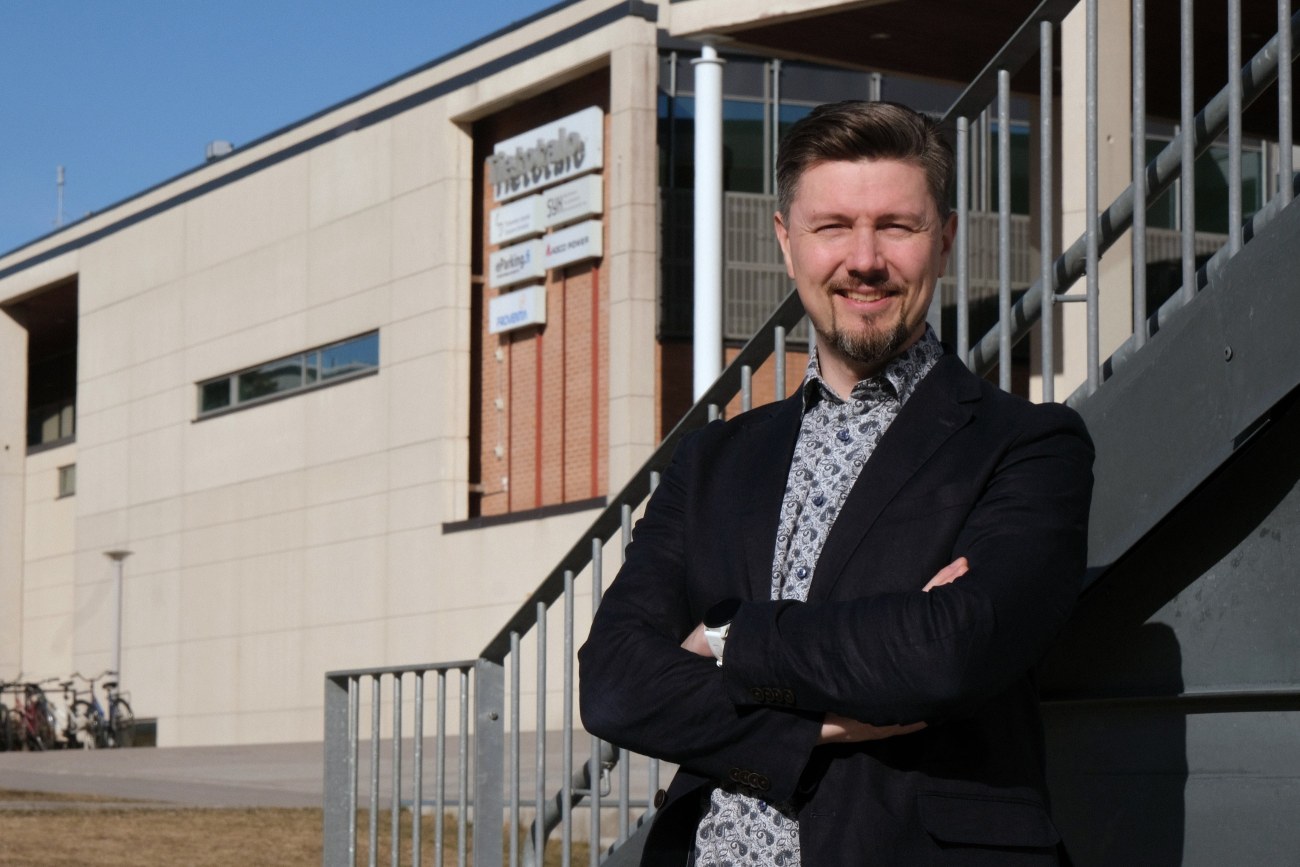
Specializing in:
Social Technology — Sustainable Design of ICT — Digital Ethics
Roles (examples)
- Leads the Technology x Social Interaction Research Group (Tampere University)
- Serves as Academic Director of the Digital and Sustainability Transitions in Society platform (TAU)
- Heads the international MSc Programme in Computing Sciences and Electrical Engineering (CSEE)
Author: Mira Kokko


