Training opportunities for aspiring accessibility specialists are limited – Tampere University’s digital accessibility courses are in high demand

Our digital future depends on experts in digital accessibility, and Tampere University offers students the opportunity to develop exceptionally broad expertise in this field. The module titled Accessibility in Digital Society carries over 40 ECTS credits and is available to all students across the University.
The module comprises two five-credit courses and several one-credit units, all designed to be relevant across a broad range of academic disciplines.
“The courses cover topics such as accessibility in social media, the use of artificial intelligence, and the accessibility of games and virtual reality,” says Professor Markku Turunen, who oversees the teaching of information technology within the module.
“A multidisciplinary approach was one of our key priorities when designing the module. From the outset, my colleagues and I set out to create a module that would be useful to as many students as possible. This is also reflected in the diversity of students the module attracts from all across the University.”
The individual courses included in the module have also been extremely popular. According to Professor Turunen, the course Fundamentals of Accessibility was the most popular MSc-level course at Tampere University in 2024, even though it is not a compulsory component of any degree programme.
“This course was completed three times more often than the second most popular course. Naturally, some students opt for these courses because they are delivered fully online, but even so, their popularity has been unmatched.”
The Accessibility in Digital Society module was developed by Tampere Accessibility Unit (TACCU). Turunen is one of the founders of TACCU, which has approximately 30 members but holds no formal status within Tampere University.
“TACCU is an organically evolved, independent and multidisciplinary hub for research and teaching. The Accessibility in Digital Society module reflects a similarly anarchistic approach, as it is positioned outside the formal structure of degree programmes.”
Cultivating an accessibility mindset
In addition to courses available to all students, Tampere University offers a more formal pathway for studying accessibility. Markku Turunen oversees the Master’s Degree Programme in Sustainable Societies and Digitalisation, which is delivered in English.
“This degree programme is based on the principles of inclusivity, accessibility and societal sustainability, viewed through the lens of digital services. The primary aim of the programme is to educate professionals who are capable not only of developing future digital services that align with sustainability principles but also of addressing the complexities that accessibility entails,” says Turunen.
Three specialisations are available in the master’s programme: Sustainable Digital Life, Accessibility and Diversity in Digital Services, and Artificial Intelligence for Sustainable Societies. The latter brings together accessibility, citizen engagement and AI and is delivered in collaboration with Tallinn University and Lusófona University.
The master’s programme is a relatively recent addition to Tampere University’s curriculum. The University started offering studies in Sustainable Digital Life a few years ago, but the full master’s programme with all its specialisations was launched in 2024. Students enrolled in the programme come from diverse backgrounds and represent dozens of nationalities.
“The world needs accessibility specialists, yet hardly anyone is training them,” Turunen points out.
“When asked, everyone agrees that accessibility is important, but this commitment rarely translates into anything tangible or visible. Both in Finland and internationally, accessibility has gained attention largely because it is mandated by EU regulations and legislation. As software companies have begun to develop accessible digital services, they have quickly realised the need for professionals with in-depth expertise in this field.”
According to Turunen, information security is one area where greater digital accessibility is needed.
“Information security has rightly received a great deal of attention, but increasingly stringent requirements are excluding users. The solutions are not only difficult to use, but also problematic from an accessibility standpoint. However, the expertise needed to address these issues is lacking.”
Even when accessibility is considered when designing digital services, it may be only superficially understood. It may be perceived as relevant only to marginalised groups, or the full spectrum of accessibility needs may be overlooked.
“Some people may even feel slightly intimidated by the sheer breadth of the topic. What works well for one person might place someone else at an even greater disadvantage. For example, the wide variety of visual impairments means that accessibility solutions tailored to specific needs may end up cancelling each other out.”
Turunen finds that developing expertise in accessibility requires a whole new mindset. It is not simply about creating an accessible version of an existing service or piece of content. Instead, accessibility must be embedded in the design process from the very beginning, with the understanding that content may not be identical for all users.
“Solutions often need to be tailored to individuals rather than broader user groups. This approach gives users greater control over how they interact with the service. It is also important to recognise that accessible services are not only intended for people with disabilities. At some point in our lives, any one of us may find ourselves in need of accessible services.”
Accessibility solutions are shaped by societal context
Accessibility solutions are not universally applicable: what works in one part of the world may not be effective elsewhere. TACCU is currently participating in a project titled Breaking Barriers in Education: Inclusion, Rehabilitation, and Technology (BERT), which is funded by the Ministry for Foreign Affairs of Finland. The project is coordinated by Jyväskylä University of Applied Sciences and also involves the University of Rwanda and the State University of Zanzibar in Tanzania. BERT examines how accessibility can be integrated into higher education in Rwanda and Tanzania.
“TACCU’s role in the project is to develop an accessibility manual that teachers can use in their work,” says Turunen.
“While effective technologies often exist, they may not perform well across different contexts or may be prohibitively expensive. The availability of public funding also plays a role in the adoption of new technologies.”
Turunen cites public transport and physical accessibility as an example of this: while buses and trams may be technically accessible, they are rarely the chosen mode of transport for wheelchair users.
“This is not because people in wheelchairs are unable to use buses or trams, but because society encourages them to use door-to-door transport services. It simply makes more sense for them. Understanding the local context is therefore essential. Accessibility solutions that align with Finland’s support structures may not be effective elsewhere.”
The project participants visited Zanzibar, Tanzania, in 2024 and Kigali, Rwanda, in the autumn of 2025. These on-site visits provided valuable insight into the environments for which accessibility solutions are being developed as well as an understanding of what is already working well locally.
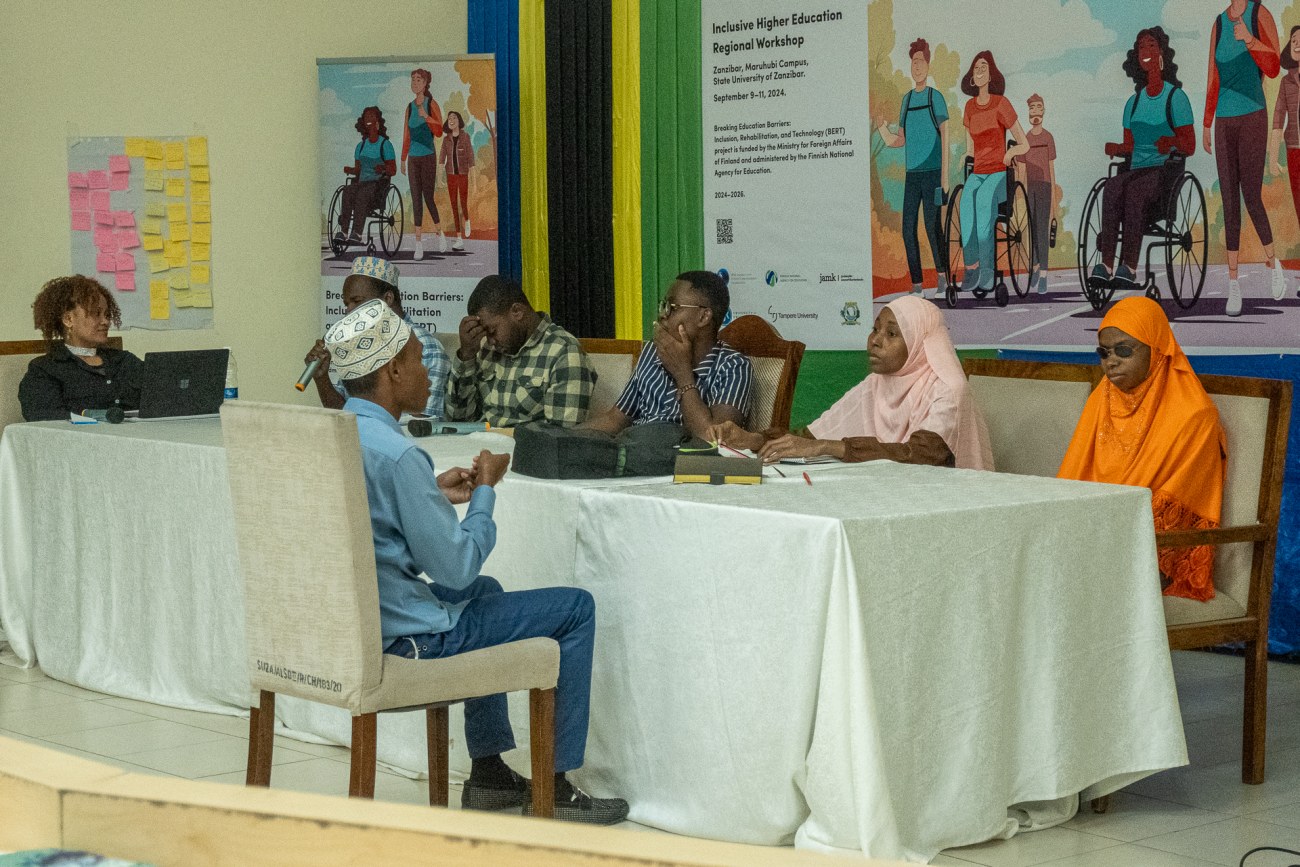
“There are still challenges related to physical accessibility in East Africa, and all digital services inherently involve a physical component. It is important to consider whether digital services can replace existing ones, or whether their creation is even advisable. People with disabilities continue to be stigmatised in these regions.”
TACCU is actively involved in international collaborations. For example, the unit recently hosted a workshop in Tallinn.
“We have organised dozens of events, which has enabled us to build an extensive network of contacts both in Finland and abroad,” says Turunen.
“It is fair to say that we have shown how much can be achieved within a university setting even without formal structures."
Author: Eli Harju


