Convergence: Aleksandr Ometov on Building the Researchers that Technology Actually Needs

Where Engineering Meets Behavior
Most of what people associate with wireless technology lives at the application layer: the apps, interfaces, and services visible on a screen. Ometov's work sits much further down the stack, where devices negotiate access to a channel and exchange data with the network. The central question his research asks is what that process should look like when the person carrying the device is treated as part of the system, not an external variable.
"If you look at today's systems, engineers mostly still design wireless and computing hardware as if it operates in isolation from the people using it. But the reality is that human behavior, movement, habits, and even social patterns directly shape how these systems perform. The gap between how technology behaves on paper and how it behaves around real people is where the biggest opportunity lies. The future is in designing systems that treat humans not as external disturbances but as active parts of the system."
Movement patterns, routines, and behavioral data become, in that framing, inputs that can make systems more efficient, more adaptive, and more responsive to the conditions they actually encounter.
When and Where to Compute
The practical stakes of that design challenge become clear with a concrete example. When the first Apple Watch launched, it had very limited functionality away from a paired iPhone. All computation was routed to and through the phone, with the watch handling only transmission. The tradeoff is straightforward: not computing on the device saves battery from processor load, but it burns energy in transmission and creates a dependency on a nearby phone.
Today, devices can offload computation to edge nodes in cellular infrastructure, or further into the cloud. For demanding applications like Augmented Reality or remote-assisted surgery, where latency above twenty milliseconds becomes perceptible and consequential, the question of where computation happens, and when, carries real weight.
"In a lab, it's easy. But what if you are moving through a city? You leave a building with Wi-Fi and the connection breaks. How can the network use the fact that we usually walk to work in the same pattern? We can look at network data and say with 80 or 90 percent certainty what will happen, and how can the system react to potential connection disturbances."
Predictive algorithms, developed using real-world datasets from metropolitan networks, allow devices to anticipate what will be needed before it is needed. The same principle extends to eHealth and Extended Reality applications, where timing and reliability are often more critical than raw bandwidth. One area with particular significance is affective state detection, where biometric data from a wearable could eventually allow a system to identify and respond to shifts in a person's emotional state in near real time.
"If you have certain biometrics being computed on your watch, how fast can we take preventive measures if a person is going through something irregular? From a data perspective, that's a change of norm. People from different fields need to talk and discuss these phenomena together."
Building a Shared Language
Realizing systems of this kind requires drawing on expertise well beyond any single field. The CONVERGENCE of Humans and Machines project, which Ometov coordinates at Tampere University, is structured around exactly that premise, bridging the deep technical expertise of the Hervanta campus with the social research hubs at the main City Centre campus and beyond with industry and organisations. Supported by the Jane and Aatos Erkko Foundation, it trains PhD researchers under joint supervision from different disciplines, building future experts who approach problems from an integrated perspective from the outset.
"CONVERGENCE exists because both society and technology are changing faster than our academic structures can follow. Technology alone cannot solve problems that are deeply human, cultural, or organizational, and the inverse is equally true. It is about building a new generation of researchers who don't see these domains as separate, but who instinctively integrate them when approaching real-world challenges."
Coordinating across disciplines requires a shared vocabulary and a shared pace, things that take time to develop. The urgency of doing so is, in his view, tied directly to how quickly the technology itself is moving.
"As engineers, we have new technology every half-year. Other fields usually take a lot longer time to evolve. We don't have time to catch up anymore. We would rather be ready to talk straight away."
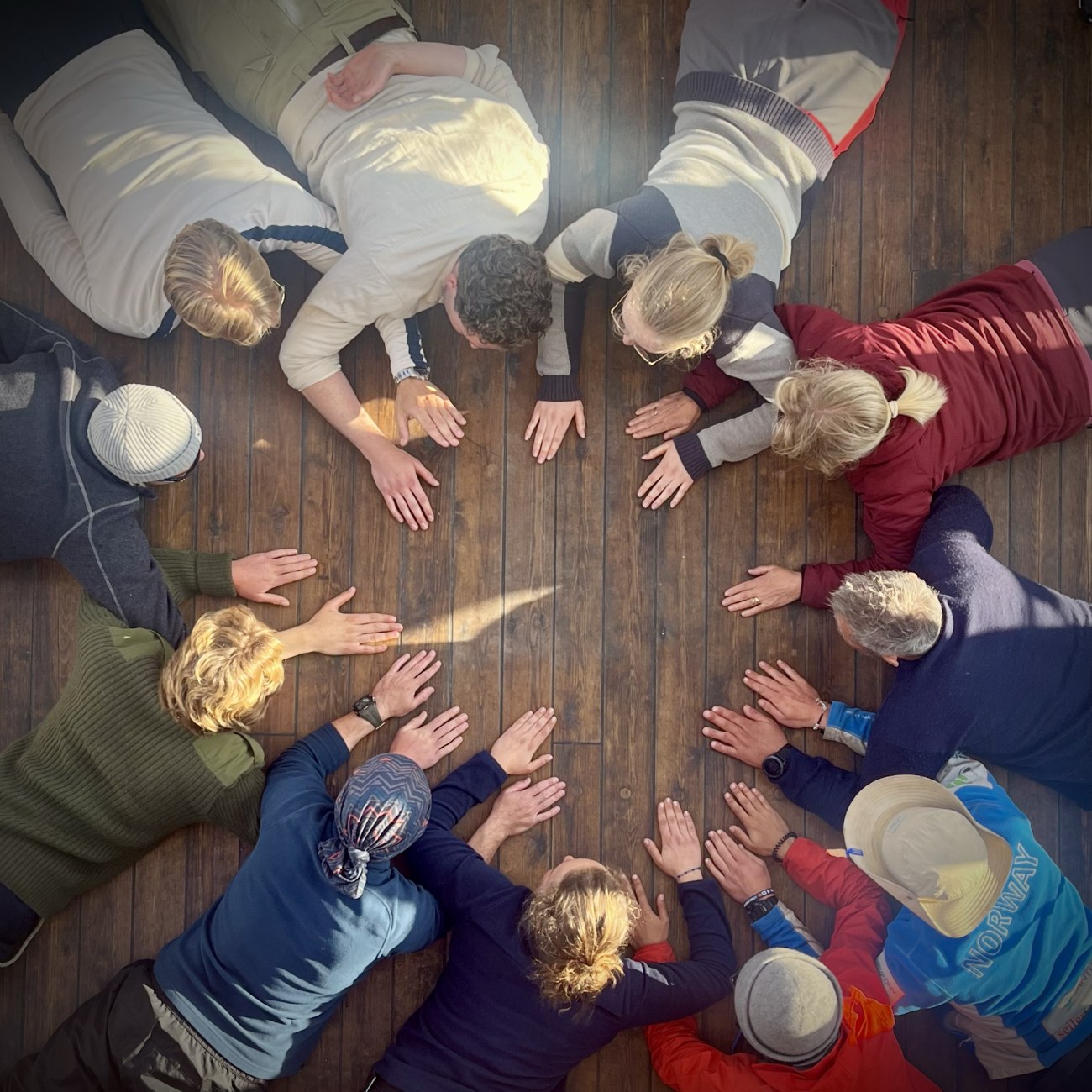 Photo: Aleksandr Ometov
Going Far Together
The same orientation toward collaboration shapes how Ometov works with his own doctoral researchers. He has been sailing tall ships since he was thirteen, and the parallel informs how he thinks about the work.
"If you want to go fast, go alone. If you want to go far, go with people. Doctoral projects don't just make a person; they make a team. These people are together for three to four years. My role is to train them to be ready for their own travels."
A doctoral project, in that framing, is as much about building capacity in a group as producing individual theses. Students develop expertise in their own domains that extends well beyond their supervisors' knowledge, and several of Ometov's former researchers have moved into leading industry and permanent faculty positions ahead of the usual timeline.
"I try to create an environment that allows for interaction. Progress will slow down if everyone just works alone at home. You miss those whiteboard moments, the coffee room chats where you find an answer to a question you've struggled with for months."
It is a philosophy grounded in the conviction that research, like long-distance sailing, travels furthest when the work is genuinely shared.
It is a philosophy grounded in the conviction that research, like long-distance sailing, travels furthest when the work is genuinely shared.
 Photo: Aleksandr Ometov
Aleksandr Ometov
Fields of expertise
Wireless communications; computational offloading; wearables; distributed systems; information security.
Author: Sujatro Majumdar


