Erja Sipilä sees engineering as a creative means of making sense of the world

Erja Sipilä, Vice Dean for Education and Senior University Lecturer in Electronics at the Faculty of Information Technology and Communication Sciences (ITC) at Tampere University, originally chose to study electrical engineering to better understand how the world works and to create something new. For her, engineering is about continuous creativity. Whether developing software, algorithms or physical components, the outcome is invariably something that did not exist only moments before.
“Engineering teaches us how the world works and how we can improve it. I chose to study engineering because it allowed me to build something tangible. I have always enjoyed crafts, and sewing, like engineering, involves bringing something new into existence.”
Sipilä has served as Vice Dean for Education for three years and was appointed Senior University Lecturer at ITC in January 2026. Her role spans everything from everyday interaction with students to large-scale international projects.
Sipilä is passionate about education and its development. Even before enrolling at university, she coached young people in hobby groups. Later, her experience as a course assistant during her fourth year of study inspired her to pursue a career in education.
“The best part of my work is seeing students learn. They may initially struggle with demanding content, but then there is always that moment when understanding dawns.”
Sipilä worked briefly in industry before returning to academia.
“My role in industry was exactly what my Master of Science in Technology degree had prepared me for. The workplace was supportive and everything worked well, but something was missing: students and education. When a vacancy was advertised at the former Tampere University of Technology, I applied and resumed my academic career.”
Students’ enthusiasm is rewarding
If Erja Sipilä were not working as Vice Dean and Lecturer, she would still want to be involved in the development of education, perhaps in another organisation. Alternatively, she might have pursued a career as a personal trainer if it had provided a stable livelihood.
“Or I might have become a crafts teacher, which was one of the options I considered in upper secondary school. I would still be teaching, but without having to grade exams. If anything about teaching is ever so slightly tedious, it is marking exams.”
While examinations offer valuable learning opportunities for both students and teachers, marking hundreds of exams can become somewhat monotonous.
“Marking the first few exams is always useful, as they show me what I need to improve in my teaching. For example, if I am teaching a course that introduces transistors and students struggle with related exam questions, the topic has clearly not been covered in sufficient depth. However, this becomes apparent after marking the first 50 exams. After that, the same patterns tend to repeat.”
Sipilä has taught the Basic Electronics course, which has remained largely unchanged, for more than two decades and also oversees a project included in the Introduction to Studies in Technology course, where students design and build an LED flasher. Still, she never tires of teaching the same courses, as the creative nature of engineering continues to inspire her.
“Each year, students come up with new ways to apply the principles of electrical engineering that have never occurred to me. Even after so many years of teaching, they continue to surprise me with their fresh insights and perspectives.”
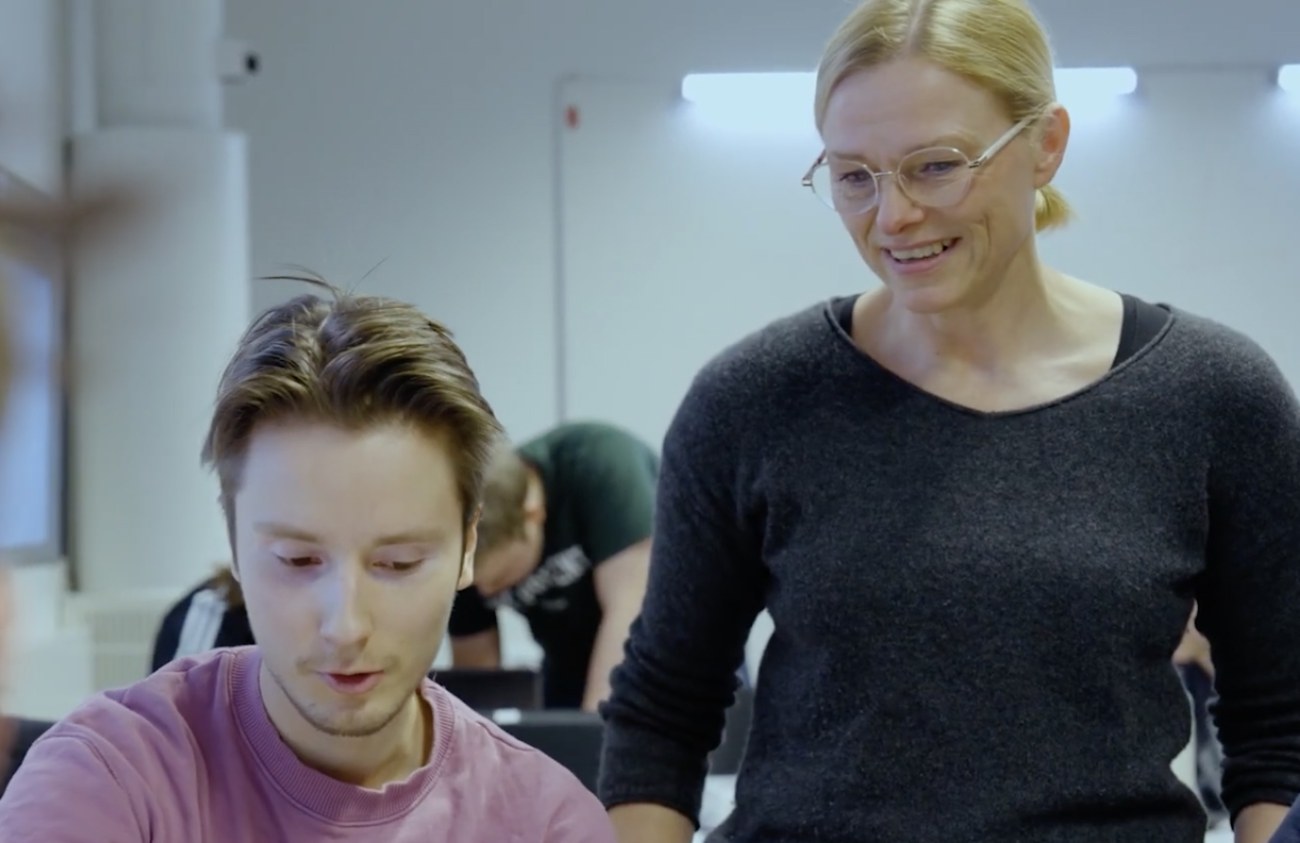
Students solder and assemble their LED flasher from scratch and programme it according to their own ideas.
“Students are usually very enthusiastic about this type of hands-on assignment that leads to a tangible outcome. It is rewarding to witness their enthusiasm. After all, sparking students’ excitement about their field lies at the heart of academic education.”
Teaching students how to learn
Sipilä completed her doctoral dissertation on Radio Frequency Identification (RFID) tags in 2016. RFID tags are remotely readable chips that are used, for example, in key cards, car keys and library books.
Chips were a hot topic at the time and have recently regained prominence, particularly in Tampere where the System-in-a-Package Fabrication (SiPFAB) pilot line, a state-of-the-art research infrastructure for chip packaging, integration and testing, is currently under construction on the Hervanta campus.
“Although chips have been developed for a long time, they have once again emerged as a major topic of discussion in recent years. As manufacturing is largely concentrated in Asia, there is growing interest in strengthening expertise in this field in Europe.”
In engineering, familiar technologies often resurface as new trends when they are viewed from a fresh perspective.
“For example, solar and wind energy have attracted significant attention in recent years. These are not new technologies, but they have evolved considerably.”
It is not possible for education developers to foresee which areas will be relevant 30 years from now. The fundamentals remain the same, but the ability to continuously acquire relevant knowledge and skills is essential.
“The aim of academic education is to ensure that students master core knowledge and develop the skills that are needed to remain up to date in their field. Some people may find the idea of continuous learning throughout their career demanding, but it does not mean having to attend formal courses all the time. Learning also takes place through doing.”
The unlimited potential of ordinary people
Sipilä emphasises that engineers are not expected to be superhuman, although continuous learning should be an integral part of their careers. It is more than enough to be an ordinary person with common sense.
“Ordinary people are best placed to understand everyday problems. While engineering requires knowledge of advanced mathematics, I hope that this does not feel intimidating. A top grade in mathematics in the school-leaving certificate is not a prerequisite.”
Sipilä encourages everyone to consider studying engineering and especially hopes to see more women entering the field.
“An engineering degree opens doors to a million careers in almost any field, except medicine – and even doctors rely on equipment designed by engineers.”
If Sipilä originally chose engineering to better understand the world, has she achieved her goal?
“I am getting better at understanding the world, but also at recognising how much I still do not understand. This career has been a perfect fit for me. Engineers are fundamentally problem-solvers and often succeed in finding solutions. While they have not yet halted climate change or achieved world peace, they have found ways to overcome countless smaller challenges.”


