New training programme supports growth from researcher to research leader

The transition to a research leadership role requires the development of new competencies and perspectives on research practice.
To address this need, Tampere University has introduced the Research Leadership Programme, which was implemented for the first time in the autumn of 2025 and early 2026. The programme is specifically designed for researchers who are at the early stages of their tenure-track career and have recently moved, or are in the process of moving, into leadership positions.
Tapio Visakorpi, Vice President for Research at Tampere University, notes that there is a clear demand for this type of training.
“Many new research leaders feel they need additional support and training as they assume their new roles. From the University’s perspective, it is important to invest in these researchers, as they are the research pioneers of the future,” says Visakorpi.
The pilot programme was part of the University’s development activities aligned with the HR Excellence in Research development work and involved 15 researchers from different fields.
The next iteration of the programme will commence in October.
Leveraging in-house expertise
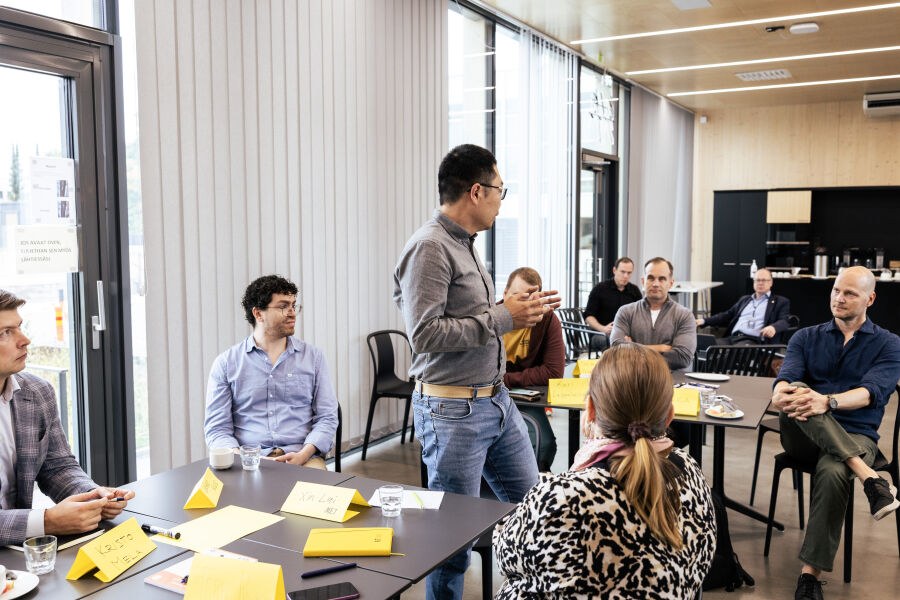
The pilot programme consisted of four full-day training sessions that focused, respectively, on the transition from researcher to research leader, strategic thinking and long-term planning, interaction and networks, and societal impact.
“The majority of the speakers were experienced research leaders from Tampere University. There is a wealth of in-house expertise available, and it is important to share it across the university community,” says Kaisa-Riikka Salomaa, HR Specialist at Tampere University.
In addition, the programme included group coaching sessions to support the participants in preparing a strategic career plan and navigating their transition into a leadership role. The participants were divided into two smaller peer groups to facilitate collaborative discussion and reflection.
After the training sessions, the participants visited Brussels to learn more about the EU’s decision-making processes related to science and research. The programme concluded with a joint session where the participants presented their career plans and reflected on the main takeaways.
Salomaa says that the first training programme received positive feedback, although the participants also identified some areas for development.
“The participants valued the fact that most of the speakers were from Tampere University, as this made them highly relatable. Peer learning and collaborative reflection were highlighted as especially meaningful.”
Moving forward, the programme will place even greater emphasis on peer learning.
Gaining insights into leadership roles
One of the participants in the first pilot programme was Associate Professor of Education Juliene Madureira Ferreira.
According to Ferreira, the programme provided valuable insights into what a leadership role in academia entails and how to grow into such a role.
In particular, she valued the opportunity to connect with colleagues at the same career stage. Although the participants represented different fields, they found it easy to share experiences and reflect on leadership challenges encountered in their day-to-day work.
“I even made some new friends, and we continue to meet monthly to carry on our discussions. This has been a valuable by-product of attending the programme.”
Ferreira holds a PhD in psychology from her native Brazil and a PhD in education from Tampere University. According to her, academic cultures and expectations differ significantly between the two countries, requiring a period of adjustment. In Brazil, researchers tend to work more closely towards institutional goals, whereas in Finland there is a stronger emphasis on individual research and academic career development.
“For me, leadership means being able to inspire others and support them in pursuing professional growth and conducting research that advances their field,” concludes Ferreira.
Writer: Virpi Ekholm
Our goal: a better everyday life for researchers
Tampere University is committed to improving researchers’ working conditions, career progression and skills development in line with the principles of the European Charter for Researchers. The aim is to ensure we have clear guidelines, effective support services, and responsible recruitment and assessment practices. In recognition of these efforts, the University has received the HR Excellence in Research Award from the European Commission. The next step will be to prepare for a site visit by external reviewers appointed by the Commission.
Read more about our work within the HR Excellence in Research framework.


