Practical and working-life oriented solutions to tackle the energy sector’s skills shortage and transition

Electrification, digitalization, and renewable energy solutions are rapidly increasing the demand for expertise in the energy sector. The ongoing energy-sector projects form a complementary, working-life-oriented whole. They develop practical learning and innovation environments, education models and pilots, strengthen skills, and enhance cooperation with companies.
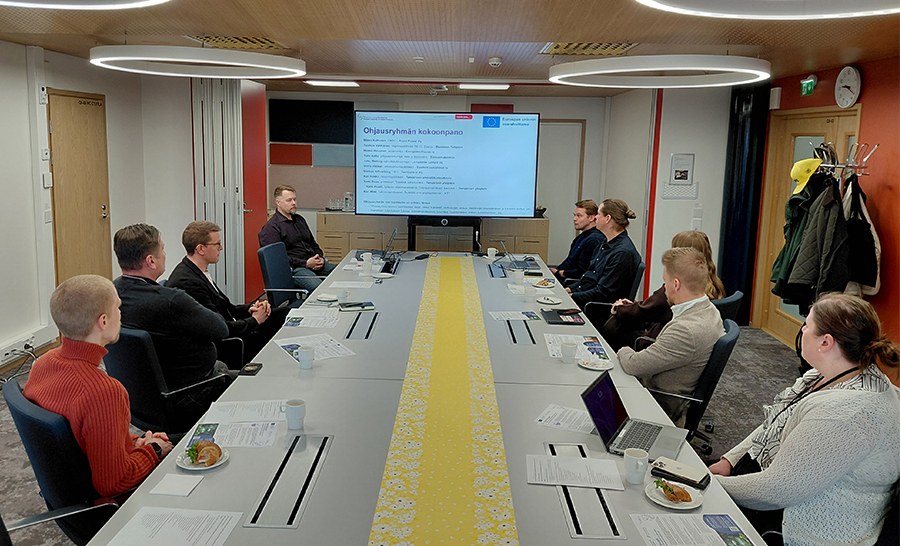
Thanks to an active steering group, the projects stay on target and genuinely respond to the needs of working life. Their perspectives, cooperation, skills development and networks are at the core when building the future of the energy sector.
Heikki Yli-Rämi
The steering groups include companies, development organisations and expert organisations from the Pirkanmaa region. Business perspectives are provided by companies such as Avant Power Oy, Lempäälän Lämpö Oy and TamControl Oy. In addition, representatives from Business Tampere, Finnish Energy, Renewables Finland, and research and educational organisations such as Tampere University, VTT and TAMK are involved
“In the first steering group meetings, we received valuable observations on how to make the projects’ objectives and results more concrete, usable and easier to adopt”, Yli-Rämi says.
Three solutions to the energy sector’s skills shortage
The Digi EnergIA project, funded by the Economic Development Centre, is developing a flexible education model for the energy sector. The project produces open and free micro-courses that offer an accessible way to update skills or enter the field.
According to Project Manager Tomi Salo, there is currently no equivalent training provision in Finland. An open, free-of-charge model built from small competence modules, also known as micro-credentials, provides a new option for continuous learning.
We address the growing skills shortage in the energy sector, the need to upskill people already in employment, and the need to reach new target groups such as those interested in entering the field and immigrants with electrical and automation engineering backgrounds. The increasing demand for professionals has also been strongly reflected in the steering group work.
Tomi Salo
The ResHil EnergIA project, funded by the Council of Tampere Region, is building a working-life-oriented innovation platform where companies, students and researchers develop and test energy system-related technology solutions.
The Smart Grid Knowledge project, co-funded by the Electrical Engineering and Energy Efficiency Promotion Center (STEK), strengthens expertise related to smart electricity grids and develops engineering education to meet the needs arising from the energy system transition.
Weather-dependent electricity production, increasing electricity consumption, price-driven demand response and new flexibility solutions are all central to this transition. Understanding them requires new kinds of expertise in both technology and system management.
Cooperation is key to addressing the skills shortage
Close cooperation with companies, regional developers and other stakeholders ensures that the expertise developed in the projects is transferred into practice.
The three projects show that complex challenges require multiple parallel solutions. When education, research and working life operate together, expertise turns into concrete solutions that support the transformation of the energy sector.
Additional information:
Heikki Yli-Rämi
Senior Lecturer | Industrial Engineering
Tampere University of Applied Sciences
heikki.yli-rami [at] tuni.fi (heikki[dot]yli-rami[at]tuni[dot]fi), 050 306 5804
Senior Lecturer | Industrial Engineering
tomi.salo [at] tuni.fi (tomi[dot]salo[at]tuni[dot]fi)

ResHil EnergIA: Innovation platform for a resilient, carbon-neutral and optimized energy system
The objective of the ResHil EnergIA project is to establish an innovation platform in the Pirkanmaa region that enables co-creation between different stakeholders and supports RDI activities closely networked with the business sector. The implementation of the innovation platform aims to advance regional and national energy-efficiency measures and carbon‑neutrality targets, as well as strengthen the security of supply and operational reliability of regional energy distribution. The technological core of the RDI environment is a microgrid implemented within the project, capable of autonomous energy and power balance management, and designed to model a geographically limited section of an electricity distribution network.

Digi EnergIA: Digital competence as an enabler of the energy transition
Companies in the energy, electrical, and automation sectors are facing skills gaps related to, for example, the digital management of smart energy systems, energy data analysis, the utilisation of automation, and cybersecurity.

Smart Grid Knowledge: An engineering degree programme to support the implementation of the energy transition
Smart Grid Knowledge project (2025–2027), funded by STEK ry, aims is to develop and implement educational content, learning materials, delivery methods, and pedagogical approaches for the new Smart Energy Systems study track within the Electrical and Automation Engineering degree programme at TAMK.
Author: Hanna Ylli


