Professor Maija Hirvonen works for an accessible world

Professor Maija Hirvonen is fascinated about language use - how we interact and make meanings through language.
“I hope that my research and new findings increase our understanding of how the world works from the human perspective,” Hirvonen describes her research.
She is interested in the comparison of languages and the resources languages provide for our thinking.
“Cognitive linguistic research studies the connection between language and mind. I am especially interested in the socio-cognitive perspective, i.e. how people’s language use, for example vocabulary, are connected to sensational experiences and knowledge structures and factors determined on the social and individual levels,” Hirvonen says.
In the study of translation and interpreting, Hirvonen investigates intermodal translation, i.e. transferring meaning from one mean of expression to another as in, for example, the verbal description of images. Hirvonen was the first researcher in Finland to complete a doctoral thesis in the field of audio description fifteen years ago.
In addition to human-generated audio descriptions, Hirvonen investigates linguistic descriptions produced through machine learning of e.g. videos and soundscapes. She is fascinated by examining the differences between human and computational meaning making and language use.
Hirvonen leads the Multimodality in Translation and Interpreting (MULTI) research group.
Research on asymmetric interaction is an emerging field
Hirvonen studies the fundamental phenomena of human social interaction. In the previous MUTABLE: Multimodal Translation with the Blind project Hirvonen explored what collaboration is like when interaction is asymmetric, meaning the participants use communication resources differently, for example, due to unequal sensory access.
“We have conducted basic research that generates new knowledge about how participants who are blind or have a visual disability collaborate in interactive situations,” Hirvonen says.
She says that researching asymmetric interaction is an emerging field.
“We have gradually learned a bunch about how sensorially symmetric human interaction happens. The next step is to investigate how interaction works when not everyone uses the same senses,” Hirvonen explains.
Trailblazing accessibility work
Hirvonen also conducts applied research, which strongly involves the theme of accessibility.
In the recently launched EU project NewWorkTech, Hirvonen continues investigating asymmetric interaction and applies the research to improving accessibility at the workplace.
“Our research focuses on how differently abled people, such as neurodiverse persons, participate in working life, how teamwork among people can be accessible, and which technologies can increase access to work,” Hirvonen says.
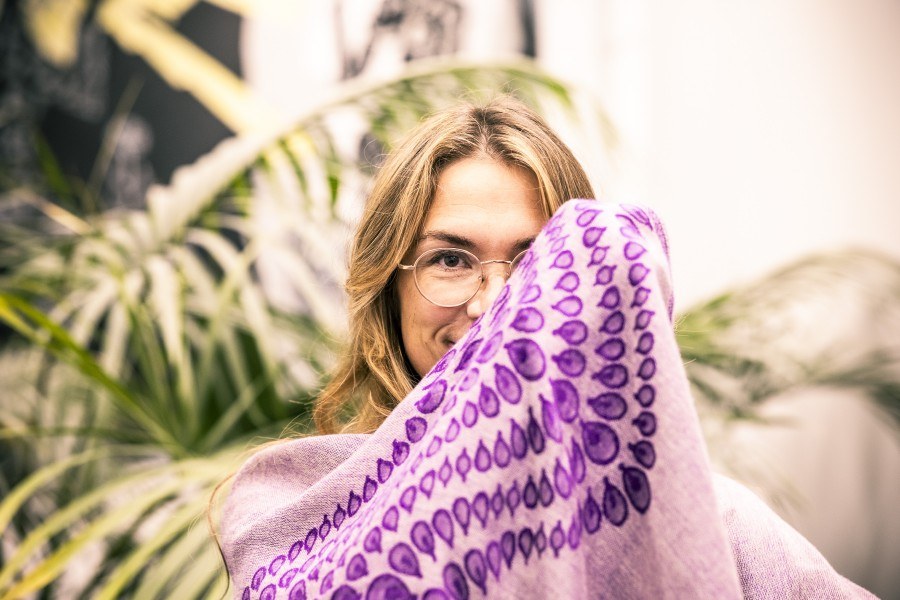 Photo: Jonne Renvall / Tampere University
She also serves as the co-director and one of the founding members of the multidisciplinary TACCU community (Tampere Accessibility Unit), which offers a comprehensive package of online studies on accessibility.
Hirvonen has also been awarded for promoting accessibility. In 2022, Hirvonen, together with Tuija Kinnunen and a group of authors, received the Communication Research in Finnish Award from the Helsingin Sanomat Foundation for the book Saavutettava viestintä (Accessible Communication) which Hirvonen and Kinnunen had edited.
“The award criteria highlighted how the book is an eye-opening experience for readers about the barriers in various areas of society and how different people could participate in it better, such as in cultural activities and the information society,” Hirvonen says.
Technology from a human-informed perspective
Technology has introduced new approaches to Hirvonen’s research since the postdoctoral phase when she served as principal investigator in the MeMAD project, combining linguistics with engineering sciences. In the NewWorkTech project, technology plays a significant role both as a theoretical concept and from the perspective of technical tools.
“It is fascinating to see how persons with disabilities utilise technical tools in real work situations, which is something we want to learn more about,” Hirvonen says.
She has also conducted interdisciplinary research on pragmatics and semantics together with other linguists, translation scholars, and signal processing researchers.
Technology intrigues Hirvonen from the human-informed perspective.
“While linguists analyse the language itself, in the field of language-based machine learning, the focus is on modelling language computationally and mathematically,” she explains the interdisciplinary collaboration.
Academic work is a passion
An interest in the German language initially led Hirvonen to the field of translation studies. She was drawn to the societal perspective, making the University of Tampere, with its flexible free-choice study rights, an appealing choice.
“I wanted to work broadly with languages and communication, and translation studies, which draw from various disciplines, interested me,” she says.
In addition to her professorship, Hirvonen currently leads the Langnet network for doctoral programmes in language studies in Finland. During her own doctoral research, she was a member of a Langnet doctoral programme, which gave her a broad foundation in linguistics.
Hirvonen says that academic work is her passion.
“I have been excited by producing new knowledge and exploring new areas since my doctoral studies,” she says.
Hirvonen conducted part of her doctoral research abroad, collaborating internationally with a Spanish research group and working as a visiting researcher at a German research institute.
After completing her doctoral thesis, Hirvonen continued her research as a Research Council of Finland Postdoctoral Research Fellow and as principal investigator of a Horizon Europe research and innovation action. During the postdoctoral period, Hirvonen worked at the University of Helsinki before starting her tenure track career at Tampere University as an associate professor in 2019. She was appointed full professor in May 2024.
“New challenges have motivated me throughout my academic career,” she says.
Professorship brings prestige and helps to highlight scientific research
Following her appointment as professor, Hirvonen finds herself in a position where she no longer needs to constantly strive forward to gain merits.
“Now I can calmly work on studies that advance humanity and that I love,” she says happily.
Hirvonen notes that the professorship comes with prestige and helps to highlight scientific knowledge and research.
“After my appointment, I received an invitation to join the international research council of the Leibniz Institute for the German Language, which has members from around the world. It’s a wonderful community and a vantage point,” she says.
Despite the leadership responsibilities associated with the professorship, Hirvonen wants to maintain the fundamental aspects of research in her work.
“I enjoy just observing data and delving into the phenomena of language and interaction and learning from and with colleagues, for example, in joint data sessions,” Hirvonen says.
She also wants to inspire students to pursue a career in research or adopt a research-oriented approach to expertise. In her courses, students analyse Hirvonen’s research data together with her.
“We need new researchers, and working with students can lead to discovering new things,” she says.
Maija Hirvonen
- Professor of German language, culture and translation at Tampere University.
- Leads the Multimodality in Translation and Interpretation research group (MULTI) and the Tampere Accessibility Unit network (TACCU) at the Faculty of Information Technology and Communication Sciences.
- Leads the Finnish Langnet network for doctoral programmes in language studies.
- Joined Tampere University as a tenure track associate professor in 2019. Previously a postdoctoral researcher at the University of Helsinki. Earned her PhD at the University of Helsinki in 2014.
- Nature and physical activity bring a balance to her intellectual work.

Author: Elina Kirvesniemi


