Innovative student projects help to expand career horizons

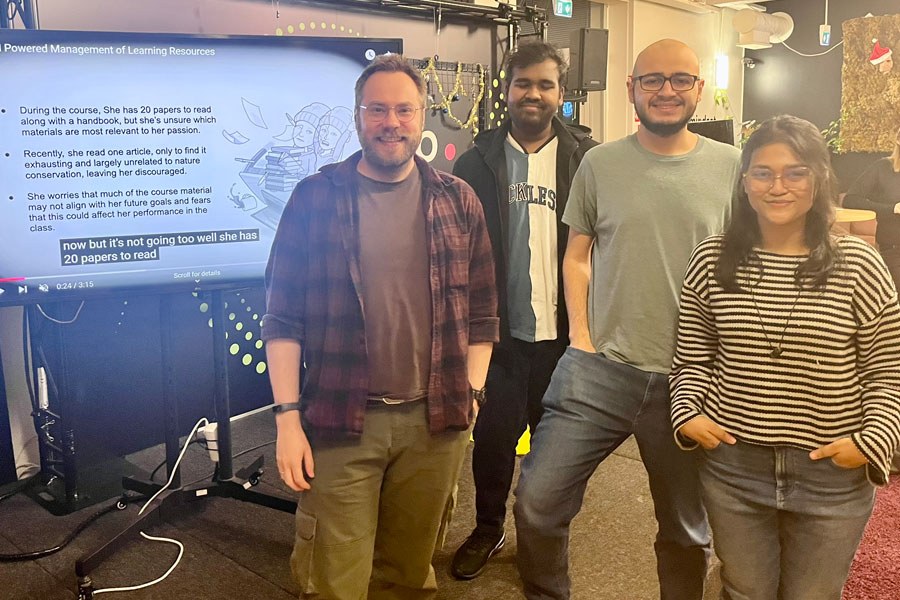
Paula Veras, Tingting Zhang, Faria Zahin and Thao Do, students in the Master’s Degree Programme in Teaching, Learning and Media Education at Tampere University, are not only classmates but also innovation developers. In the autumn of 2024, they participated in student projects offered by Demola to create demonstrations and concepts that address societal issues through facilitated co-creation.
Demola offers university students the opportunity to carry out projects over an eight-week period, tackling future-oriented, real-world challenges while earning credits towards their degree. These projects bring together multidisciplinary student teams to work both independently and collaboratively, with continuous support from Demola’s specialists and collaboration partners. The projects culminate in a national event showcasing the teams’ achievements.
Open experimentation sparked an idea for an AI assistant for students
Faria Zahin says that she particularly enjoyed the freedom to experiment at Demola. Her team developed an AI-based tool to help students navigate their academic career and align their academic goals with their studies. This tool can, for example, assist students in finding courses that match their interests and aspirations.
Before finalising their idea, Zahin’s team went through six rounds of iteration, experimenting with different user profiles each time to determine the best direction for their concept.
Feedback from Demola’s staff and the other student teams also helped them refine their idea.
“We wanted to bridge that gap between the expectations of the professional world and the outputs of universities. Our project was a step towards addressing this discrepancy,” she says.
Diverse team created a demo of speech learning apps for children
Paula Veras, Tingting Zhang and Thao Do were part of a student team that developed virtual solutions to support children’s speech and language development. Their demo also included additional features that could be integrated into the applications, such as children’s games. These features were designed to help children communicate with game characters and practice pronunciation, for example. In addition, the team came up with the idea of miniature games that support speech and language development.
The team members emphasised that their diversity was the key to the project’s success. Besides possessing complementary areas of expertise, they all come from different parts of the world: Brazil, China and Vietnam.
“Our team comprised two primary school teachers and an animator, while I am a psychologist,” Paula Veras points out.
Each team member could play to their own strengths: Paula Veras helped the team to maintain focus and fostered a positive atmosphere, Tingting Zhang contributed a parental perspective to improve customer understanding, Thao Do stayed up until the early hours of the morning, working her magic to polish the team’s visual presentations, and their other teammate, Meysam Eghbalpour, spent countless hours brainstorming new ideas and leveraging his technical expertise to bring them to life.
An eye-opening experience
Faria Zahin commends the student project for offering her the opportunity to reflect on her field of study from new perspectives. The project topic was closely aligned with and supportive of her studies.
“In addition, the experience provided inspiration for my master’s thesis topic and my overall research direction,” Zahin says.
Tingting Zhang highlights the project’s role in shedding light on future career opportunities.
“The project steered my career plans in a new direction. I will be able to apply the results in the professional world and combine the themes of digital environment and children’s speech and language development,” Zhang says.
Paula Veras and Thao Do agree that the project was an empowering experience, opening their eyes to broader career horizons.
“With my teaching degree, I used to believe that a teaching career was my only option. After the project, I found the confidence to say that my expertise in education opens doors to multiple careers, and now I can envision myself in new roles,” Thao Do says.
“We could even start our own company,” Paula Veras adds.
Many Demola projects advance beyond the demonstration phase
As the student teams own the results of their projects, they are free to continue their work after leaving Demola.
According to Demola’s Creative Director Jere Wessman, more than 50% of the student projects conducted in the autumn of 2024 advanced to further development stages within the Tampere Pre-Startup Programme, which is jointly run by the City of Tampere and Demola.
“Many of the students are inspired to apply their project results later in their master’s thesis and discover interesting research questions that they want to explore further in their thesis,” Wessman says.
Demola has been helping university students develop their employability skills since 2008. Wessman encourages all students to join Demola’s projects regardless of their field of study.
“Demola provides students with an excellent platform to gain exposure to the world of work, obtain practical experience, expand their network and build their professional identify before graduation,” Wessman concludes.
Author: Elina Kirvesniemi


