Celebrating 60 years of academic civil engineering education and research in Tampere

In the autumn of 1965, Tampere University of Technology (TUT) was established as a subsidiary of Helsinki University of Technology (now Aalto University) to meet the growing demand for engineering professionals in Finland. At the time, the country was in the midst of a construction boom and there was a pressing shortage of highly qualified engineers. The first 132 students at TUT studied mechanical engineering, civil engineering or electrical engineering. Teaching was provided across several locations in Tampere, including Pyynikki and the city centre. During the 1970s, academic education and research in civil engineering were brought together under one roof on the Hervanta campus.
Today, the Faculty of Built Environment (BEN) at Tampere University continues this legacy. The two units within BEN, the Civil Engineering Unit and the School of Architecture maintain close collaboration. Each year, around one hundred students enrol in the bachelor’s programme in civil engineering and dozens more continue to master’s level, some in the newly launched English-language degree programme.
The spirit of Hervanta lives on
Even when civil engineering was still in its early stages in Tampere, it was clear that local education and research would be strongly shaped by active collaboration with industry and other stakeholders. Low hierarchy, cross-sector cooperation and flexibility still remain the defining features of the renowned ‘spirit of Hervanta’.
Associate Professor Anssi Laaksonen, who specialises in concrete and bridge structures, emphasises that a practical focus has always been a hallmark of Tampere-based civil engineering expertise. In the early years, this was further supported by close cooperation in teaching with the former Tampere Technical College.
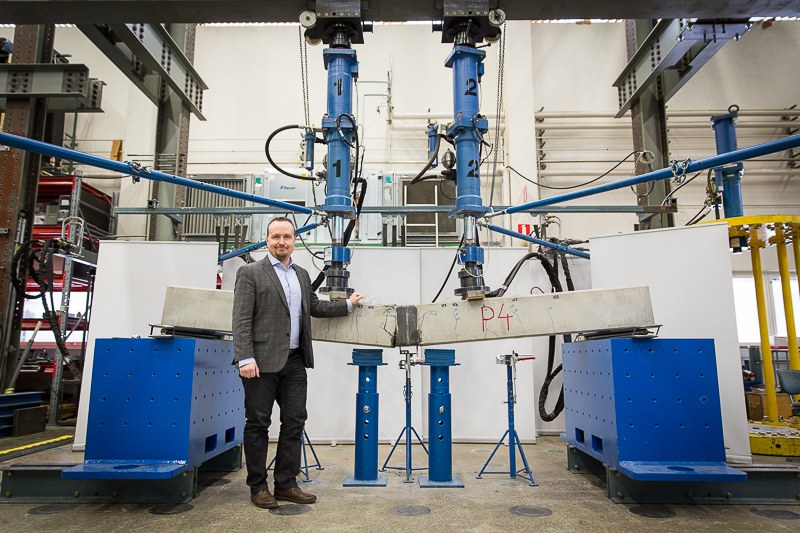
From the outset, civil engineering expertise in Tampere has been characterised by a distinctly solution-oriented mindset. The imprint of locally educated professionals is evident, for example, in international standards.
“Practical benefits have always been a priority. Our high-quality research has also made a global impact – notably through the Eurocodes, which are widely adopted as structural design standards around the world,” Laaksonen says.
Civil engineering professionals at Tampere University maintain extensive collaborations with industry. Over the years, these collaborative efforts are estimated to have involved more than 200 companies, along with a broad range of other stakeholders within the construction industry.
DIY attitude
Tampere-based civil engineering researchers have always embraced a strong do-it-yourself ethos. Laaksonen recalls a notable example dating back to 1972, when these researchers independently designed and conducted the first large-scale loading tests on hollow-core slabs in the building of the local telephone cooperative in Tampere city centre. Students were actively encouraged to demonstrate their capabilities as well.
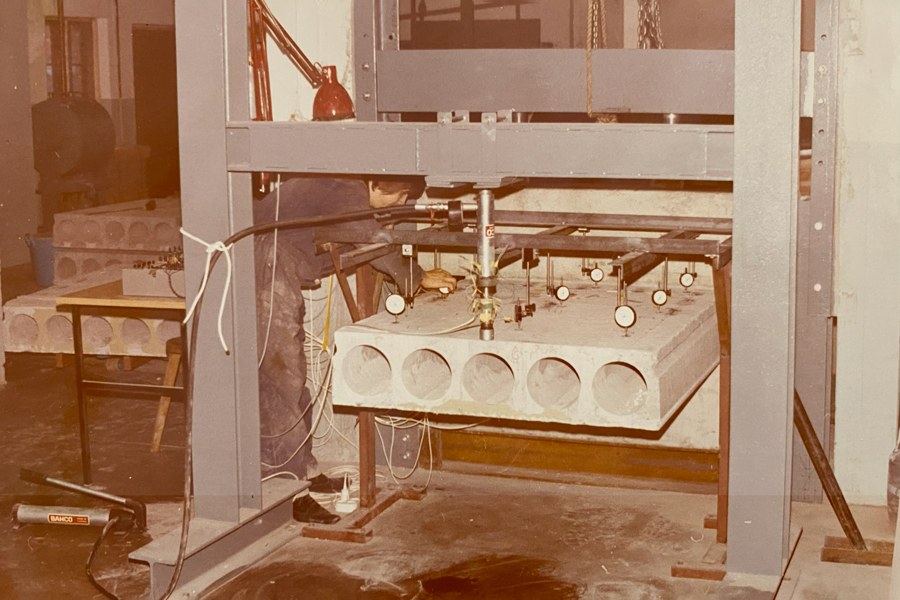
Professor of Earth Structures Pauli Kolisoja also highlights the open-minded approach to experimental research. From early on, the civil engineering laboratories on the Hervanta campus were actively used to study the behaviour of structures. The Hervanta campus holds a special significance for Kolisoja: he has spent a considerable portion of his time there since 1980, first as a student and later as a researcher. Today, Kolisoja leads the Research Centre Terra and the TerraRoad research group at Tampere University.
According to Kolisoja, the 1980s were a period of rapid development: the civil engineering unit expanded its commissioned research services and took on increasingly large-scale industrial projects.
The following decade brought setbacks, as the recession that hit Finland in the early 1990s took a heavy toll on education in the field: civil engineering programmes were discontinued at the University of Oulu. The future of the programmes at the former Tampere University of Technology also hung in the balance. However, determined efforts to preserve these programmes paid off, and the crisis was ultimately averted.
Diverse education at different stages of life
Today, research conducted within BEN is organised into two units: the School of Architecture and the Civil Engineering Unit. The Civil Engineering Unit currently focuses on four primary research areas: structural engineering, construction management and economics, the Research Centre Terra and the Transport Research Centre Verne.
Students can pursue a Bachelor of Science (Technology) degree and a Master of Science (Technology) degree within the Finnish-language Degree Programme in Civil Engineering, which offers specialisations in construction engineering, municipal engineering and building services engineering. For international students, BEN offers the English-language Master’s Programme in Civil Engineering, with specialisations in structural engineering, geotechnical engineering or sustainable transport.
The Doctoral Programme in Built Environment provides doctoral education and covers specialist fields such as structural engineering, infrastructure engineering, construction management and economics, and transportation systems.
The Hervanta campus has a long-standing tradition of collaboration, both in academic pursuits and leisure activities. The campus is home to the guild for civil engineering students at Tampere University TARAKI, along with dozens of student clubs and associations.
Continuing education is also part of BEN’s offerings. For example, hundreds of professionals have already completed the railway track design module (RASU).
Ready to adapt to future needs
The provision of civil engineering education in Tampere began in response to a clear demand: Finland needed more professionals in this field. Pauli Kolisoja points out that while this skills shortage remains largely unchanged – due to shrinking age cohorts and a growing number of professionals approaching retirement age – the industry is now facing an added layer of complexity. Climate change now stands out as perhaps the most critical challenge.
“The construction industry must respond to new demands related to the management of environmental impacts, sustainability and emissions. And once again, economic conditions are proving difficult for the sector,” Kolisoja says.
In the autumn of 2025, the Civil Engineering Unit launched a new Finnish-taught Master’s Programme in Building Services Engineering, the only one of its kind in Finland. This programme aims to address the growing demand for professionals capable of designing carbon-neutral solutions and healthy indoor environments.
Anssi Laaksonen finds that a strong foundation in core skills is now more important than ever.
“Students’ expectations have changed and continue to do so. Researchers need a deeper understanding of how structures behave. New research needs are constantly emerging, and there are no resources to waste,” he says.
Artificial intelligence throws a new twist into the mix.
“The pace of development is accelerating! While artificial intelligence will transform working practices, it is unlikely to replace the fundamental expertise required in civil engineering. However, the way that education is delivered will evolve, as today’s students have new ways of learning and acquiring knowledge,” Kolisoja sums up.
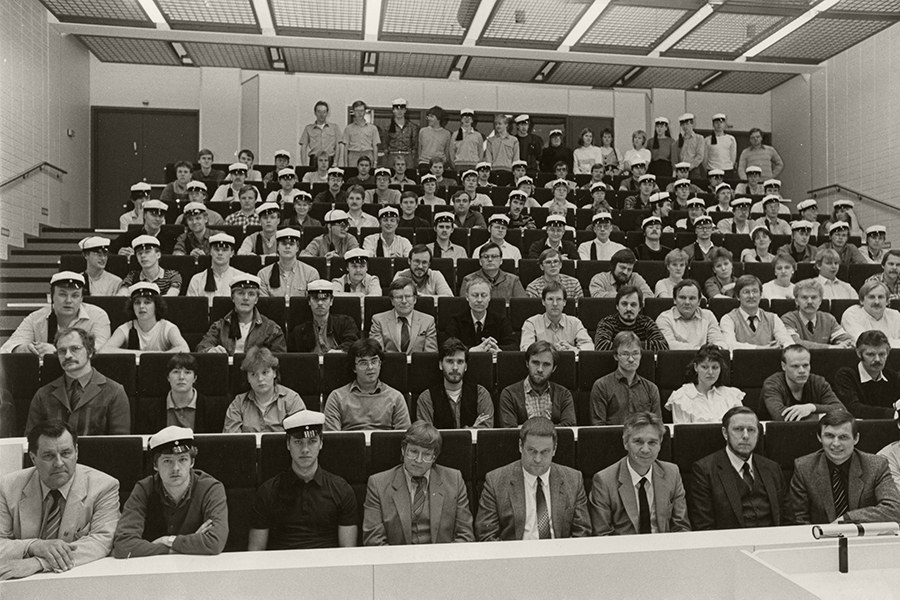
Kolisoja and Laaksonen are members of a committee contributing to a forthcoming book on the history of civil engineering in Tampere. The book is authored by Seppo Tamminen and due to be published in the summer of 2026.
Milestones of Tampere-based construction technology
- 1965: Tampere University of Technology (TUT) is established as a subsidiary of Helsinki University of Technology.
- 1966: Engineering students celebrate their first Wappu (May Day) in Tampere.
- 1967: TARAKI, the guild for civil engineering students in Tampere, is founded.
- 1969: Architecture education begins in Tampere.
- 1972: TUT gains independence.
- 1973: Konetalo, TUT’s first building on the Hervanta campus, is completed.
- 1975: TUT confers its first doctoral degree.
- 1982: The first ceremonial conferment of doctoral degrees takes place on the Hervanta campus.
- 1984: The Rakennustalo building and civil engineering laboratories are completed on the Hervanta campus.
- 1982: TUT establishes a centre for professional development.
- 1983: Research and teaching activities begin in the city of Pori.
- 2000s: Research and education expand to include building physics, railway engineering and bridge engineering.
- 2003: TUT changes its Finnish-language name from Tampereen teknillinen korkeakoulu to Tampereen teknillinen yliopisto (TTY).
- 2010: TUT adopts the legal form of a foundation.
- 2019: TUT is merged with the University of Tampere, known for its focus on social sciences and medicine, to create the new foundation-based Tampere University.
- 2025: Tampere celebrates 60 years of academic teaching and research in civil engineering.
More information


Author: Anna Aatinen


