Eeva Puumala gets ERC funding for research on socially sustainable urban development

Senior Research Fellow Eeva Puumala has received ERC’s Proof of Concept funding. Her project called Responsive VR for urban sustainability: Promoting inclusion through affect-aware and behaviour-sensitive immersion (VR-Sense) opens new avenues for utilising emerging technologies in urban development. VR-Sense received €150,000 through an ERC call that supports the commercialisation and societal impact potential of research. The project enables the utilisation of the outcomes of Puumala’s main ERC-funded project.
The VR-Sense Proof of Concept project investigates how new technologies could be used to promote social sustainability. The researchers are especially interested in how people experience cities and develop feelings of belonging or exclusion. These experiences shape the way urban space is used.
Urban development often focuses on the built environment, which, according to Puumala, means less attention is paid to how people really experience space. At the same time, new technologies are increasingly used in urban planning and development.
“Current digital twins used in developing urban environments do not account for the social nature of space or the fragmentation of experiences,” Puumala explains.
The VR-Sense project focuses on the approach and avoidance tendencies expressed in human reactions and uses this data as a tool for urban planning. In this, the project draws on the possibilities of generative artificial intelligence.
Human-centred technology takes diverse experiences into account
When people express their opinions about urban plans, for instance based on visualisations and simulations, the feedback reflects a mediated experience which does not always correspond to lived experience. This finding comes from Puumala’s previous ERC-funded project, which will end at the end of June, and shows that people’s experiences of spaces and situations diverge.
“Comments on urban space do not necessarily correspond one-to-one with emotional reactions. In the new project, my research group is interested in the immediate experience on which we base our choices and interpretations. More specifically, we want to understand how this affective dimension could be integrated into the digital tools of urban planning,” Puumala says.
In VR-Sense, the main purpose of developing urban planning is to explore how, for example, digital twins might benefit from acknowledging social and experiential diversity. The project does not develop new technology as such as it rather examines the application of emerging technologies from the social scientific standpoint.
“We bring together insights about biosignals and emotion psychology with social scientific knowledge and generative artificial intelligence,” Puumala explains.
An essential aspect of the project is also ethical deliberation to ensure that technology is used in a socially sustainable manner.
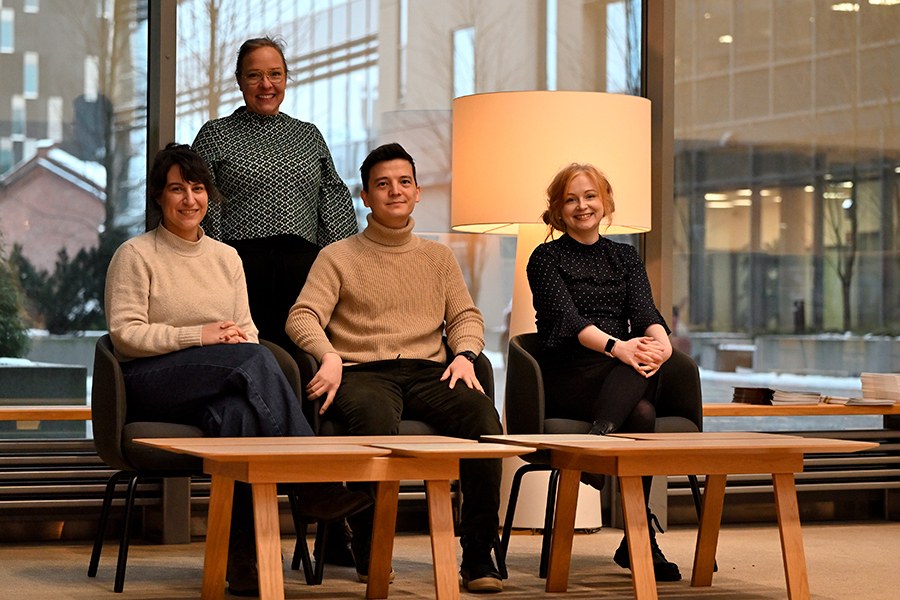
Proof of Concept funding is intended for researchers who have previously received ERC funding. In 2020, Eeva Puumala was awarded a €1.8-million ERC Starting Grant. The EmergentCommunity project examines local and everyday forms of conflict and peace. The researchers were interested in the relations between communities and the way belonging and participation are negotiated.
A concept that provides tools for urban planning
The new funding provides an opportunity to use the EmergentCommunity project results. VR-Sense aims to advance the broader societal impact and applicability of social scientific knowledge.
“Social sciences can play a significant role in the societal application of technology as it explores how technology is used and what it is applied to. This opens new forms and areas of use when technological interfaces are viewed from different starting points,” Puumala says.
The current digital transformation is highly technology-driven, so VR-Sense seeks to give it a societal core. This means thinking about technology differently and integrating experiential qualities into the virtual models used in urban development. In this way, the research represents precisely the kind of concept testing that this ERC funding instrument requires.
More impact with a cooperation network
The partners of the new project are the Sitowise smart city company, Deaconess Foundation and the City of Tampere.
“A significant part of societal impact comes from dialogue with societal actors,” Puumala points out.
The project brings together a multidisciplinary network of actors and researchers working in urban planning, virtual reality and generative AI.
The TURNS research platform enabled a two-day seminar that brought together experts from different fields, which facilitated the preparation of the new multidisciplinary project. At Tampere University, the research group has also collaborated with eg the HIP laboratory and the MAGICS infrastructure has provided Puumala’s group with insights, equipment and technical support.
“I would not be able to do this alone since human-centred urban development absolutely requires diverse expertise. I am pleased we have such expertise at the multidisciplinary Tampere University,” Puumala says with satisfaction.
***
The European Research Council (ERC) has published the outcomes of the last 2025 round of its Proof of Concept Grants. In this round, 136 grantees will each receive €150 000, supporting them in exploring how their scientific results can move towards practical application or early commercial use. With these awards, the total number of Proof of Concept Grants under the ERC 2025 Work Programme reached 300, representing an overall budget of €45 million.
The scheme is funded under Horizon Europe, the EU’s framework programme for research and innovation.


