Riie Heikkilä gets State Award for Public Information for a critical book on reading trends

Riie Heikkilä, who holds a doctorate in social policy, was awarded a Finnish State Award for Public Information for her recent book on sociological interpretations of the reasons why people have stopped reading (Miksi lakkasimme lukemasta? Sosiologinen tulkinta lukemisen muutoksista. Gaudeamus 2024).
In the award justifications, the Committee for Public Information (TJNK) praised Heikkilä for listening to people who are often spoken about in concerned tones when discussing the decline in reading. Instead of criticising, she gives a voice to those who no longer read. People’s relationship with reading – and with culture more broadly – can be conflicted, indifferent or even hostile.
“The topic of declining reading habits is endless, and it often comes with vague concern especially for the way boys are reading. I wanted to contribute something more concrete to the discussion and conduct research that would help us to understand the phenomenon. I felt there was a need for a sociological perspective because reading is fundamentally about social distinctions and inequality,” Heikkilä notes.
Heikkilä investigates the societal and structural reasons that underlie the apparent decline in reading. Her findings suggest that it is inaccurate to speak of a general decline. Reading is rather becoming increasingly stratified along social distinctions.
In her book, Heikkilä shows that reading is part of hierarchically organised cultural lifestyles and as such a marker of status. As social inequality grows, so too does the divide in reading habits.
“We are also witnessing a rapid growth of inequality in Finnish society as education levels are falling, welfare services are being cut, and income gaps are widening. This trend is clearly linked to the fact that those who are doing well continue to engage in culturally legitimate activities, such as reading. My interviews showed how some people have become disconnected from cultural participation altogether, and with that, from reading,” Heikkilä explains.
Experiencing exclusion may foster a sense of defiance
According to Heikkilä, high education is the strongest predictor of reading habits in Finland.
She also aimed to avoid the common pitfall of cultural sociology: the tendency to frame concepts and choose topics based on middle-class experiences. In Heikkilä’s analysis, reading is about diverging lifestyles.
She sees the defiant, dismissive attitude towards reading as a consequence of the very inequality that she and her fellow researchers have found is shaping cultural engagement. A person who has negative feelings about culture may also feel as though they have fallen outside the structures of society.
“We need to pay serious attention to growing inequality so that income gaps do not widen further and that people’s ability to access culture is not easily eroded. In view of their statutory responsibilities, libraries’ resources are already stretched and when it comes to education, not a single cent should be cut if we want reading to survive,” Heikkilä argues.
Scientific research can be made engaging for the public
In its award justification, the Committee for Public Information highlights Heikkilä’s effective use of both historical statistics and rich interview material gathered specifically for the book. “The result is methodologically robust and emotionally resonant. Solid academic research can indeed be presented in a way that appeals to a broad audience,” TJNK notes.
Heikkilä works as a Senior Research Fellow at the Unit of Social Research which is part of the Faculty of Social Sciences at Tampere University. As an academic, writing the book was a long journey that took her from traditional scholarly presentation to communicating complex ideas clearly, engagingly and with a sense of broader relevance. The book is grounded in Heikkilä’s three-year Research Council of Finland fellowship project. Heikkilä has also published an English-language book on people who do not participate in cultural life. (See Understanding Cultural Non-Participation in an Egalitarian Context. London: Palgrave 2022. Open Access version).
“When I began writing my first book in Finnish, I saw reading as central to cultural disengagement which is a phenomenon that ignites social debate. I do not think I could have written the book as well as I did without the foundation of my academic work,” she says.
Heikkilä feels a strong sense of accomplishment in having reached a broad audience. She wanted to write a book that went beyond a purely sociological readership; something that would speak to teachers, librarians and policymakers involved in education issues.
“Receiving the State Award is very rewarding. I feel like I have stepped outside the academic ivory tower into society, doing work that has brought people both joy and insight into their lives. Scientific research also progresses when it does not stay confined to theoretical concepts but has real societal impact,” Heikkilä reflects.
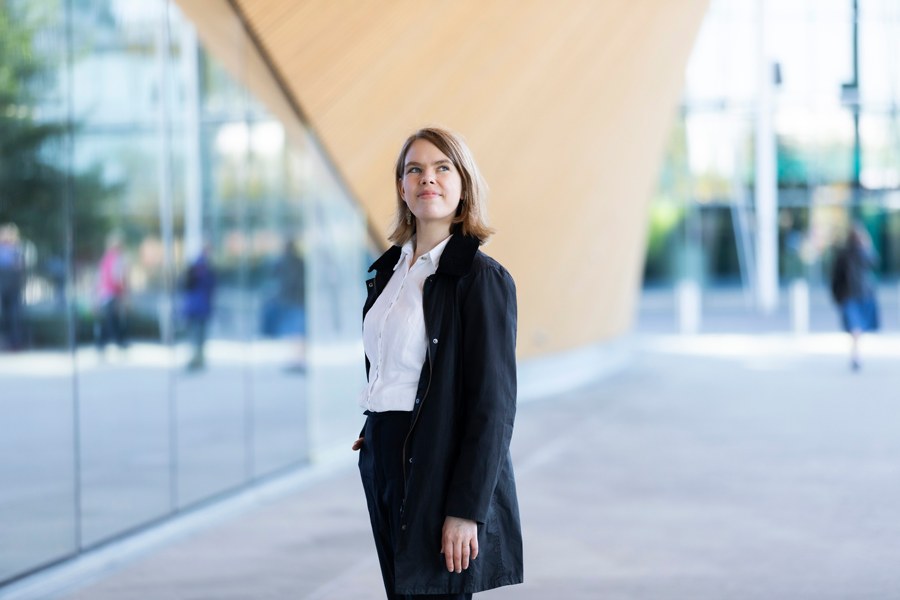 Photo: Laura Oja
“Reading is always worth it”
Since publishing her book, Heikkilä has been invited to speak at various events. In discussions with e.g. library professionals, she has helped to foster reflection on why fewer and fewer people are walking through the doors of Finland’s traditionally highly esteemed public libraries to borrow books.
“Today, it is increasingly expected that children will read at home with their parents. However, research shows that this does not always happen or that it is mostly middle-class families who support reading at home. That is why society needs to take a more active role in removing the barriers to reading,” Heikkilä argues.
With a master’s degree in literary studies and a doctorate in sociology, Heikkilä lays out a strong case for the value of reading: it expands vocabulary and other cognitive skills.
It also fosters empathy and the ability to see the world from another person’s perspective.
“Thankfully, we are now more open-minded about what counts as reading because reading materials can also mean manga or comics. The main thing is that children and young people are reading during their school years. We know from research that all reading is beneficial. Reading at school increases the likelihood that people will continue to read in later life.”
In a research project funded by the Kone Foundation, Heikkilä is researching how algorithm-based data management affects what people are borrowing from libraries. Her new study explores how libraries are providing people with cultural capital.
“Libraries are in a tough spot caught between the mission to support reading and austerity measures. They are expected to preserve cultural capital while also proving to policymakers that their operations are efficient. This tension is also reflected in public attitudes. Libraries are the last bastion of reading and, for adults, the primary provider of cultural capital. It would be unthinkable to cut library funding further, or worse, to consider phasing them out altogether in the future,” Heikkilä says.
***
The Ministry of Education and Culture grants the State Awards for Public Information annually on the proposal of the Committee for Public Information. The awards celebrate excellence and timeliness in publishing significant scientific, artistic or technological information that has raised awareness and inspired the public debate.
The awards are the highest public information grants in Finland first awarded in 1968.


