Mathematics is rewarding, explains Lassi Paunonen

Professor of Mathematics Lassi Paunonen studies the mathematics behind dynamic phenomena, especially waves and vibrations, elasticity, and fluid flows.
His Systems Theory Research Group studies the properties of mathematical models and the methods for controlling their behaviour. This area of mathematics develops theory which can be applied, for instance, to improving the energy-efficiency of buildings or the development of self-driving cars.
“The cruise control of a car maintains constant speed whether you are driving uphill or downhill. In my research group, we are developing comparable automatic control methods, but we are trying to control a mathematical model instead of a car,” Paunonen describes his research.
“In our research, the control methods are typically expressed as mathematical formulas, and their functionality and efficiency are demonstrated using mathematical proofs,” he continues.
The group’s theoretical research is also connected to the field of control engineering, and mathematical systems theory offers a solid foundation for applying the theoretical results to technological applications.
According to Paunonen, researchers in the field are developing new mathematical methods to support the progress of modern technologies, such as soft robotics and renewable energy production.
He mentions that mathematical models describing waves and vibrations are particularly challenging.
“The investigation of these models and the development of control methods require very detailed analysis and novel mathematical techniques, which my research group both uses and develops,” Paunonen says.
New research centre combines theoretical and applied mathematics
The focus of Paunonen’s research shifts periodically, sometimes moving closer to engineering problems and sometimes towards more abstract topics.
“Nevertheless, we are typically at the mathematical end of this spectrum and advance science from the theoretical perspective,” he says.
Paunonen does not consider practical applications to be essential for his research.
“Mathematics is inherently beautiful. However, the applicability of my research area is a very nice added value and a source of inspiration,” he points out.
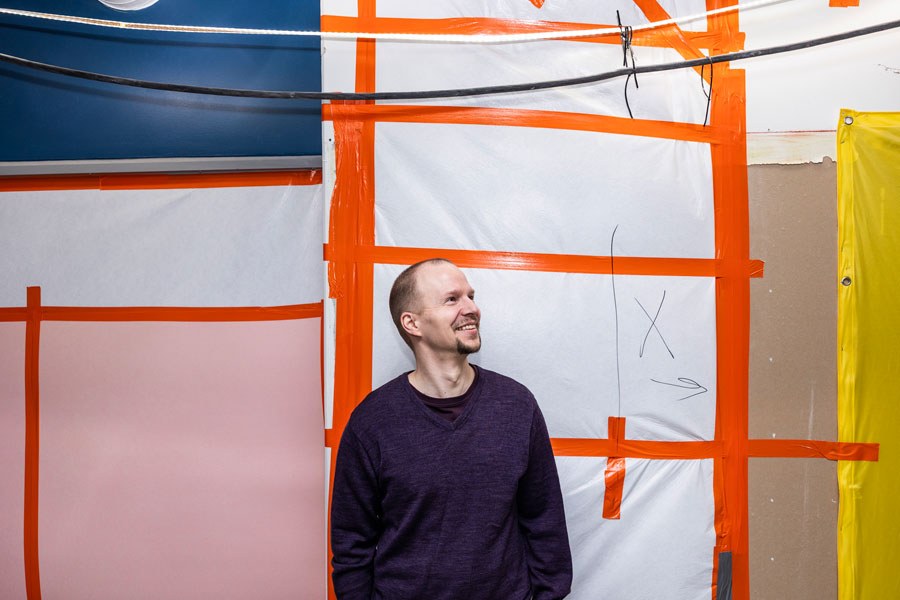 Photo: Jonne Renvall / Tampere University
Paunonen leads the new Mathematics Research Centre, established at the Faculty of Information Technology and Communication Sciences (ITC) in October 2024. The goal of the centre is to strengthen the community of mathematicians in Tampere and to enhance the visibility of mathematics research both at the University and beyond.
The research centre embraces both theoretical and applied research. Applied mathematics most typically focuses on the development of new mathematical methods to solve problems in other disciplines. At Tampere University, researchers specialising in applied mathematics address problems in diverse areas ranging, for example, from brain imaging to the explainability of artificial intelligence and the modelling of forests.
The groups in the new research centre work on both theoretical and applied mathematics, and some of them combine the two disciplines with great success.
In addition to supporting research groups, the centre aims to help young researchers.
“The centre offers support especially for doctoral students and post-doctoral researchers in networking and career advancement,” Paunonen says.
Captivated by mathematical challenges
Lassi Paunonen began studying mathematical analysis and control theory while writing his master’s thesis at the former Tampere University of Technology (TUT) and continued to explore these topics in his doctoral dissertation.
As a post-doctoral researcher, Paunonen spent a good amount of time abroad, including a year at the University of Oxford in England.
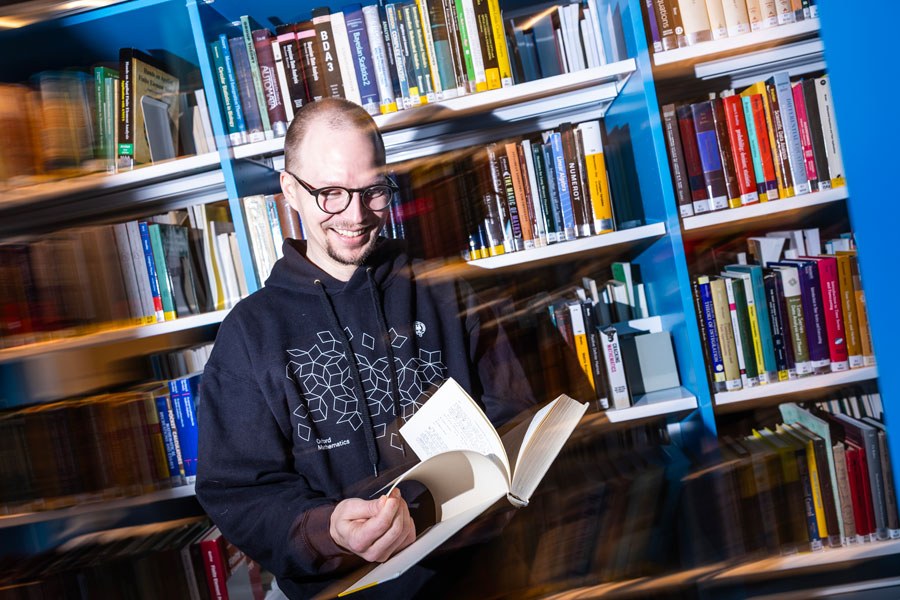 Photo: Jonne Renvall / Tampere University
He joined TUT in 2016 as an Assistant Professor (tenure track) and began to build his own research group and expand his research vision. In November 2024 he was promoted to full professor at Tampere University.
Paunonen became fascinated by the possibilities of working in mathematics research while working on his master’s thesis. He is especially motivated by the process of solving mathematical problems and mixing different mathematical techniques.
“Tackling challenging mathematical problems is at the heart of mathematical research, and I still find it both captivating and rewarding,” he says.
Learning mathematics takes practice
Paunonen did not originally plan to pursue a career in mathematics. Although his interest in the subject began during upper secondary school and was strengthened by his university studies, he was hesitant to make this career choice because of the ‘genius myth’ – a misconception he is now eager to dispel.
“There are so many ways you can study mathematics and be a mathematician. It is a skill that is always acquired through practice. Similarly to an artist using paints or a builder using bricks, we mathematicians learn to create new mathematics starting from relatively simple parts. In our case, these just happen to be mathematical building blocks and materials. Once you understand these building blocks, you can decide whether you want to build something simple or something complicated based on your own goals. However, all these constructions are ultimately mathematics,” Paunonen says.
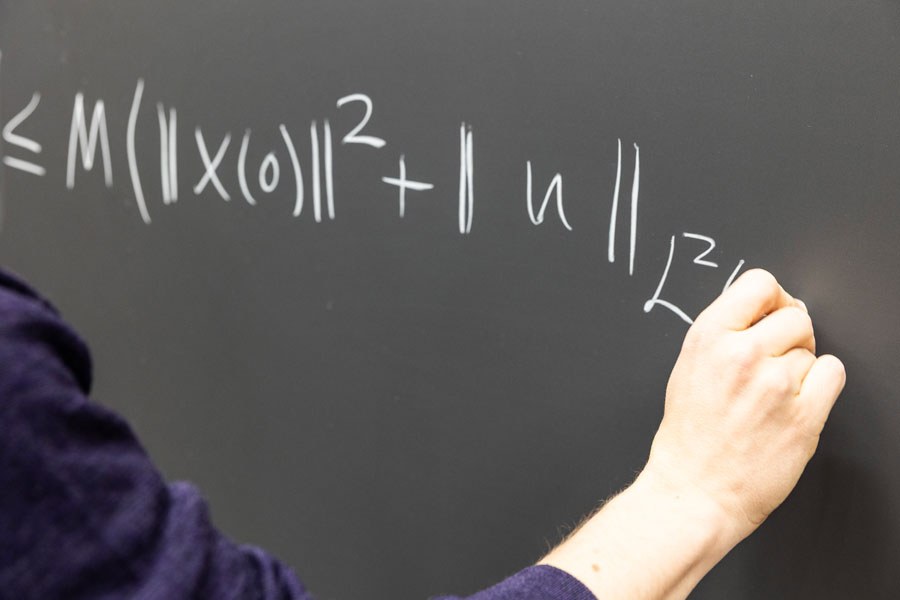 Photo: Jonne Renvall / Tampere University
He explains that mathematics is meant to be challenging and sometimes even difficult, but the challenges should not be a source of discouragement or disappointments.
“I definitely encourage all children and young people to explore mathematics! Mathematics offers puzzles at all levels of difficulty, and that is why it is important to find the ones that suit you the best. It is clear that too difficult problems will be frustrating, and the too easy ones will feel boring. However, between these two extremes, you will be able to find a great number of problems that will be very rewarding for you to solve,” Paunonen notes.
Professorship helps in advancing research vision
Paunonen believes that his recent appointment as a full professor will allow him to advance his research vision on a larger scale in his research group.
He views artificial intelligence as a potential future collaboration partner, which can be very useful in distilling and finding information and perhaps even in mathematical brainstorming.
“I am looking forward to seeing what kind of roles AI will assume in mathematical research in the future,” he says.
New research topics can emerge, for instance, from us humans: Paunonen is interested in how the brain functions, especially the mathematical models of neurons and their communication.
In addition, there are several old mathematical mysteries still waiting to be unravelled.
“Solving certain problems in mathematics may require years of thinking. In many cases, it is possible to predict at an early stage that the problem can be solved as long as you keep working on it. On the other hand, sometimes the most intriguing problems are the ones where even the possibility of the solution is a mystery.”
Lassi Paunonen
- Professor of Mathematics at the Faculty of Information Technology and Communication Sciences (ITC) at Tampere University.
- Leader of the Systems Theory Research Group and the newly established Mathematics Research Centre.
- Has worked in Tampere throughout his academic career, from doctoral researcher to full professor.
- Outside of work, spends time with music and climbing.

Author: Elina Kirvesniemi


