Professor Matti Mäntysalo develops printable and energy-efficient electronics

At the core of Mäntysalo’s work are printed electronics, novel materials, and energy-efficient manufacturing methods. For him, the focus is not only on individual technical innovations, but on changing the entire mindset of the electronics industry.
“We make electronics, but we constantly ask: could it be done using fewer natural resources, more energy-efficiently, and without materials that are harmful to the environment?” he summarizes.
At Tampere University, research on sustainable electronics advances in close cooperation with companies so that new solutions can actually be manufactured, scaled, and introduced into society. For Mäntysalo, industry is the bridge between research and real-world impact.
Everything Starts with the Manufacturing Method
Traditional electronics are produced at high temperatures using chemically intensive processes. Mäntysalo’s group is moving in the opposite direction: printed, additive manufacturing, where material is added only where it is needed.
In printed electronics, familiar printing techniques such as screen printing, inkjet printing, and roll-to-roll production are used. By printing layers sequentially, functional electronic structures can be built—conductors, sensors, capacitors, and even transistors—without traditional metal etching.
“We add material only where it is needed. That way, we avoid a large share of chemicals and save enormous amounts of energy.”
This so-called additive manufacturing approach significantly reduces material waste and chemical use compared to conventional printed circuit board manufacturing.
Lowering manufacturing temperatures is, according to Mäntysalo, one of the key factors in sustainability.
"When the temperature goes down, manufacturing consumes less energy. When less energy is used, CO₂ emissions decrease. The chain is very direct.”
At the same time, lower temperatures enable the use of entirely new materials.
“At low temperatures, we can introduce bio-based or even biodegradable materials that simply would not survive traditional electronics manufacturing processes.”
 Photo: Harri Hinkka
Electronics Without Critical Raw Materials?
“If we talk about batteries, they use a lot of critical and environmentally harmful materials. We are studying alternatives such as supercapacitors, which can be made without critical raw materials.”
The research extends even to everyday materials.
“In a basic cell, we have carbon, water, salt, paper, a bit of plastic, and aluminum—essentially the same materials found in juice cartons. In principle, electronics could function using materials similar to a children’s juice box.”
Mäntysalo emphasizes that the goal is not to replace the entire electronics world.
“Not every application requires the highest possible performance. In many cases, much lower requirements are sufficient. These solutions should not be seen as replacements but as complementary.”
This will not replace high-performance microchips. This is complementary technology: the right solution for the right place.
Matti Mäntysalo
When Electronics Decompose in Nature
Perhaps the most radical aspect of the research concerns biodegradable electronics. The idea may sound contradictory: why make electronics that decompose?
“We are going to have billions, even trillions, of sensors in the world. Some of them will inevitably be single-use. For example, sensors used to measure human health cannot be reused.”
In such cases, recycling alone is not enough.
“Could some electronics be designed to safely decompose in nature or go directly into paper or plastic recycling? So that the materials return to nature’s own cycle?”
One application area is digital agriculture and environmental monitoring. In the joint SOIL project with VTT (Sustainable Organics and metal oxide ICT via biodegradable, high-performance flexible Low-voltage electronics, 2023–2025), Mäntysalo and his team have studied the development of biodegradable electronic components. High-frequency components and electronic circuits needed for wireless data transmission in sensors are developed using materials typically found in soil, utilizing additive manufacturing methods. In addition, energy-saving manufacturing processes are developed using low-temperature thin-film coating techniques.
"Sensors could be placed in the soil to measure conditions and then simply decompose there without altering the soil’s composition.”
Healthcare That Comes Home
Sustainable electronics is not only about environmental protection but also social sustainability. Healthcare, in particular, is an area where inexpensive and easily manufactured electronics could make a major difference.
“If we can produce affordable home diagnostic devices, care can become better and more efficient while saving significant societal resources.”
Various wearable sensors will enable remote monitoring at home, allowing tests to be carried out before hospital procedures and enabling follow-up after discharge—saving healthcare resources. Sensors can measure, for example, respiratory rate, oxygen saturation, heart rate, temperature, and cardiac function. Measurement data are transmitted to a system that analyzes them, provides monitoring information, and issues alerts when necessary.
This would open new possibilities for sparsely populated regions—in Finland and globally.
“Services could truly be delivered even to areas that hospitals cannot easily reach.”
Finland as a Global Leader in Printed Electronics
Although the field is global, Finland’s position is exceptionally strong.
“In terms of publication volume, Finland is the seventh largest country in the world in printed electronics. Relative to population, we are at the very top.”
According to Mäntysalo, this is due to a long industrial continuum: the forest industry, coating expertise, electronics, and Nokia’s legacy.
A key research partner is VTT, with which several joint development and research projects are underway. One example is the EU-funded Sustronics project, involving a Finnish consortium of VTT, Tampere University, and companies including Canatu, Movesense, Screentec, Tervakoski, UpCode, and UPM Raflatac. VTT acts as the national coordinator, and Finnish partners receive part of their funding from Business Finland. The full consortium includes 46 partners from 11 countries.
“The goal of Sustronics is to build an ecosystem for the electronics industry to address sustainability challenges. Pilot projects aim to redesign existing electronic products or create entirely new ones.”
Industry collaboration is a central part of Mäntysalo’s group’s work.
“Working with industry is our path to societal impact. Without it, research easily remains in the laboratory.”
Companies also bring realism.
“They tell us what can actually be manufactured, what can be scaled, and what cannot.”
Mäntysalo also emphasizes the importance of collaboration within the university.
“Tampere University’s multidisciplinary nature provides an excellent foundation for research in this field. Collaboration takes place across disciplinary and faculty boundaries.”
A Clear Message to Students: A Broad Foundation Carries You in Microelectronics
Mäntysalo’s message to students is concrete: early over-specialization is not the key.
Basic physics, chemistry, and mathematics provide the tools to understand the world. Electronics is application.
Matti Mäntysalo
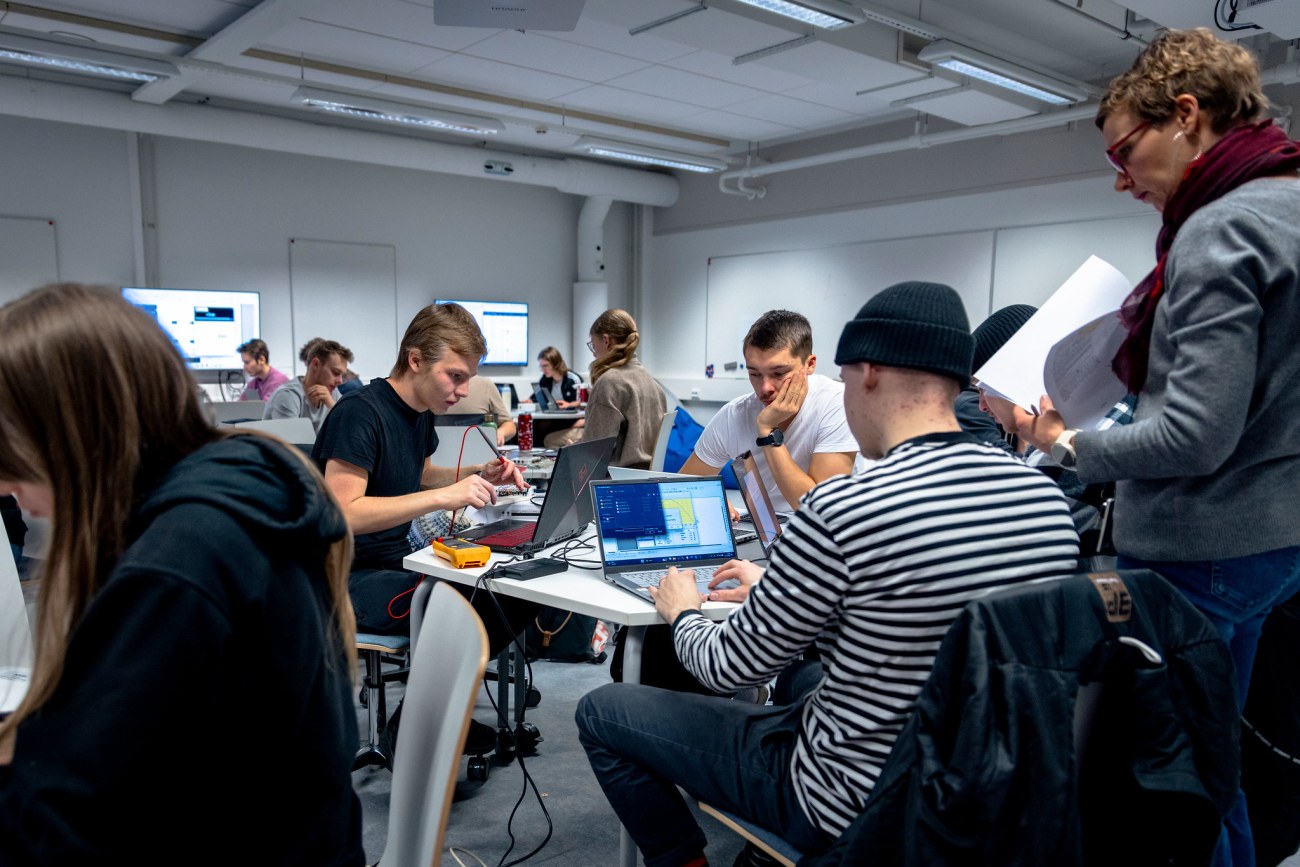 Photo: Karu Films
Mäntysalo is involved in developing doctoral education in microelectronics. Across Europe, efforts are underway to increase the number of doctoral-level experts in electronics. Funded by the EU’s Horizon Europe research and innovation program, the FERNS doctoral network focuses on sustainable electronics and circular economy principles.
“We need more doctoral-level microelectronics experts in Finland and in Europe in general,” Mäntysalo states.
“FERNS is a significant European doctoral training network. Its idea is simple: to train a new generation of electronics experts who can think in terms of circular economy, bio-based materials, and low-energy processes.”
The network trains experts in developing low-energy and environmentally friendly components and systems. Through the network, Tampere University will host two doctoral researchers—one supervised by Mäntysalo and the other by Associate Professor Ulla Saari from the Faculty of Management and Business, whose research focuses on the development and management of environmentally friendly and sustainable technologies and innovations.
Tampere University also participates in the Finnish MIELi doctoral pilot funded by the Ministry of Education and Culture. The aim is to accelerate and develop doctoral education in microelectronics through close collaboration with industry. Doctoral candidates work on practical, industrially relevant research topics, with the goal of graduating in three years and moving directly into industry. In addition to Tampere, the project involves Aalto University, the University of Oulu, and VTT.
Electronics of the Future
Matti Mäntysalo’s research focus evolves as the field advances. When research results are transferred to companies and production, it is also time for the university—and the researcher—to move forward.
“In Japan in the early 2000s, we saw that certain ideas mature in ten years. Now everyone is doing what we tried back then. So I have already moved on.”
He summarizes his motivation as follows:
“For me, the university is a place of freedom to create. The sandbox never gets smaller. You can jump from one idea to another and build a world that does not yet exist.”
Matti Mäntysalo
Professor of Electronics
Core Research Areas
- New materials and manufacturing techniques for electronics
- Additive manufacturing technologies and heterogeneous integration
- Flexible, adaptive, and stretchable electronics
- Self-powered electronics
- Thin-film components and processes
Key Research Environments
Key Partners
- VTT
- Numerous Finnish and European technology companies
Examples of Research Projects
ARMS (Horizon Europe) – Atomic layer-coated graphene electrodes for micro-flexible and structural supercapacitors, 2023-2027. (ARMS-project site, Tampere University)
SUSTRONICS Sustainable and green electronics for circular economy, 2023-2026
Other Roles and Links
- Deputy Director, PHOTO-ELEC profiling area
https://www.tuni.fi/fi/ajankohtaista/profilaatioalat-esittelyssa-photo-elec-yhdistaa-fotoniikan-ja-mikroelektroniikan - Director of the Electronics Research Centre (ERC), Tampere University
https://research.tuni.fi/erc/
ERC Research Centre video
Author: Riitta Yrjönen


