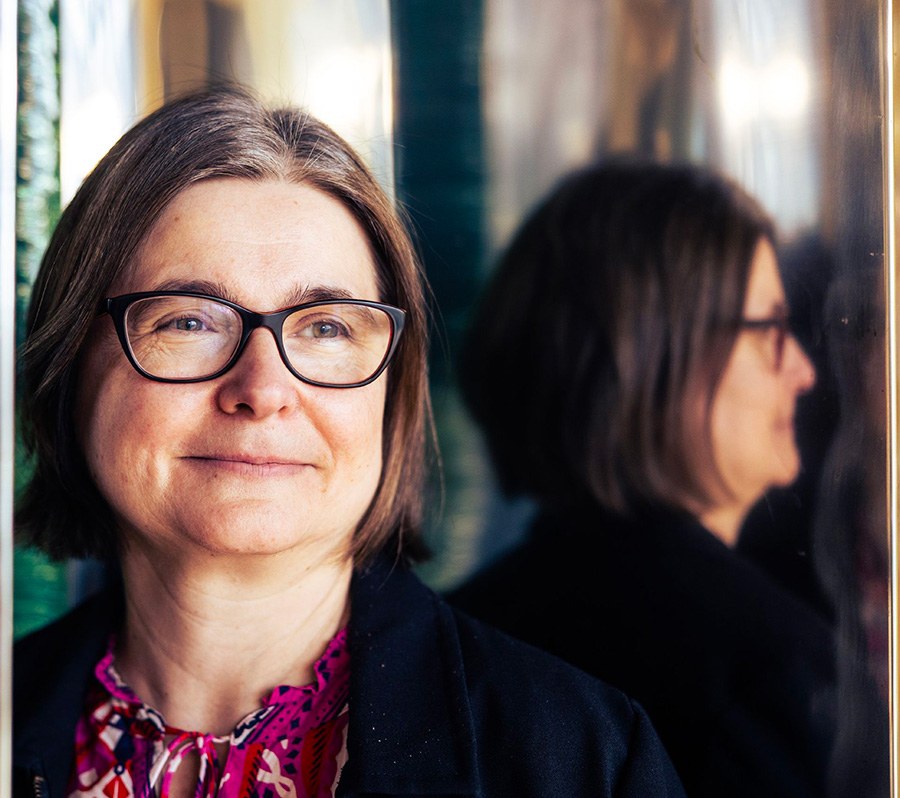
Ivana Kholová finds it important to study things that bring quick benefits to diagnostics and clinical practice

What are your main research interests?
Pathology, the study of disease, is a broad field covering the human body from head to toe. In my research, I focus on cardiovascular pathology and cytopathology.
In cardiovascular pathology, I study especially the aorta which is the largest artery in the human body. To some extent I also study the morphology of atrial fibrillation. In this work, I examine the structures, tissue changes and biomarkers in the pulmonary veins, the caval veins and the atrium of the heart, and how they relate to diagnostics, prognosis and aetiology.
Cytopathology – or more generally cytology – refers to the study of cell samples taken with a fine needle aspiration or a brush. The aim is to determine the diagnosis to guide treatment.
What makes your research significant?
It is the pathologist who gives many diseases their names and determines the diagnosis. Personalised treatment requires detailed knowledge of certain characteristics and biomarkers of a patient’s tumour to target the therapy correctly. That is largely based on what the pathologist examines and identifies in the samples. Research in pathology also plays a major role in developing the diagnostic methods used in the field.
Where do you draw inspiration for your work as a professor?
I sometimes think that I have achieved exactly what I always hoped for. I have a truly variable job as every day is different. As a professor, I am responsible for both undergraduate medical education and the training of specialist doctors. It is wonderful to work with young, intelligent people and to think things through together. In research too, many projects are carried out jointly with students.
I enjoy teaching because one learns best by teaching others. Here in Tampere, we emphasise problem-based learning. For that reason, we have fewer lectures and more interactive small group teaching where students are not just passive recipients of information. I try to incorporate activating methods also in my lectures.
In addition to teaching and research, clinical professors also hold secondary positions outside the university working as chief physicians. In practice, this means we also have a small number of real patient samples to review.
What does it mean for your discipline that you were appointed a professor?
I find it important to keep my feet firmly on the ground and to maintain my expertise as a clinical pathologist. As regards supervising doctors in specialist training, I believe it is essential that I know what is happening in the field of pathology. And when new developments emerge, it is important to incorporate them into basic teaching in a timely manner. Some things have been the same for a hundred years, and their foundations do not change in teaching. But, for example, when it comes to new precision therapies and new information becomes available, it is crucial to keep up with the developments.
What I find significant is studying matters that can be seen in diagnostics relatively quickly and that tangibly advance things in clinical practice. That suits me better than studying a single specific molecule which might, perhaps decades later, become a biomarker.
What do you do in your free time?
My children always say that their mother’s hobby is research. I enjoy art, visit exhibitions and make art myself, mainly drawings. I also like photography, and I photograph architecture quite a lot. I often use a photograph I have taken of a beautiful building as a model and create a drawing based on it using oil pastels. In winter, skiing is also a rather nice hobby.
Ivana Kholová
- Completed her Doctor of Medicine (MUDr.) at Charles University, Czech Republic, in 1998.
- Completed her Doctor of Philosophy (PhD) in pathology at Charles University, Czech Republic, in 2002.
- Worked as a Postdoctoral Researcher at the University of Kuopio from 2003 to 2009.
- Served as a clinical lecturer and resident in pathology at the University of Kuopio and Kuopio University Hospital from 2006 to 2008.
- Completed medical specialist training in pathology in 2008.
- Appointed adjunct professor (docent) of experimental pathology at the University of Kuopio in 2008.
- A specialist in pathology and deputy chief physician at Fimlab Laboratories from 2009, a chief physician since 1 October 2025.
- Appointed adjunct professor (docent) of pathology at Tampere University in 2016.
- Appointed clinical instructor at Tampere University in 2017.
- Worked as a part-time chief physician at Kuopio University Hospital from 1 January 2025 to 30 September 2025.
- Worked as a professor of pathology at the University of Eastern Finland from 1 January 2025 to 30 September 2025.
- Appointed professor of pathology at Tampere University on 1 October 2025.
- Became Associate Editor of the Cancer Cytopathology journal in 2026.
- President of the Finnish Society for Clinical Cytology since 2015.
- Scientific Committee Chair at the European Federation of Cytological Societies since 2022.
- Chair of the International Academy of Cytology Webinar and E-learning Committee since 2025.
- Secretary-treasurer of the Association for European Cardiovascular Pathology 2018-2025, treasurer since 2026.


