International Relations can be found in many places

Historically, the discipline was strongly present in Tampere University’s predecessor, Civic College. The first Rector of the College, Yrjö Ruutu (1887–1956), exemplified early dedication to the field. Having studied international law, he proposed establishing a degree in diplomacy following WWI and Finland’s Civil War. (Rasila 1973, p. 118).
The first professorship in international relations was established in 1945 – again, in the aftermath of a global conflict. At Tampere University, the chair was later reinstated. The longest-serving professor Osmo Apunen (1938–2022) had a university career that spanned three decades. If anything remains from the early pedagogical vision, it is the persistent relevance of war as a shaping force in the discipline.
“Finland was, in a sense, ahead of the curve as it was among the first in the academic history of International Relations globally. Today, we are one of the most popular fields in Finnish higher education, and global crises have only increased popularity,” says Professor Tuomas Forsberg.
Conflict and peace, war and security, remain at the core of International Relations. At Tampere University, the research agenda is notably multi-thematic and interdisciplinary. As the world changes, so do research topics, which now encompass climate change, migration, and energy transitions.
“Even though crises persist, our research covers much more. International Relations include superpower relations and governance systems, but they can also be explored locally, for example, in urban spaces. If I were to define the Tampere tradition, it would be that international relations can be found in many places,” says Associate Professor Anni Kangas.
Understanding global events is in demand in public and private sectors
As an academic discipline, International Relations seeks to explain and understand global phenomena. At Tampere University, the curriculum places particular emphasis on Finnish foreign policy and Northern Europe.
“This focus has been maintained since the 1960s. In Tampere, the tradition has remained most clearly intact,” Forsberg notes.
Both Kangas and Forsberg highlight the societal impact of educating experts in international relations. One such expert is Dr. Saara Särmä, who earned her doctorate at Tampere University and gained international recognition for creating the viral phenomenon Congrats! You have an all-male panel!
Dr. Tarja Seppä has had a long career at Tampere University as a teacher and researcher in International Relations, peace and conflict research, and human rights. Another notable alum is Dr. Mika Aaltola, who completed his doctorate in Tampere in 1999. Recognised as the University’s Alumnus of the Year, he was elected to the European Parliament in 2024.
The students explore power dynamics in their studies. As alums, they pursue careers in the Foreign Service, politics, NGOs and international organisations. Teachers have recently observed a growing trend that graduates are increasingly employed in the private sector.
The ability to understand global diversity is clearly recognised as a key skill in today’s working life.
“In addition to decision-making, our alums maintain connections with civil society actors and NGOs,” Kangas notes.
One such alum is Tero Mustonen, who was awarded the Goldman Environmental Prize – often referred to as the Green Nobel – in April 2023. Tampere University’s alums also hold prominent positions in Finnish media, such as Erja Yläjärvi, Editor-in-Chief of the biggest Finnish newspaper Helsingin Sanomat, and Riikka Räisänen, Editor-in-Chief of News and Sports at Finland’s public service media company Yle.
Critical literacy at the core of teaching
In social sciences and humanities, students develop an ability to grasp and synthesise complex global issues, which is an essential skill for politics experts who may need to recap information quickly.
“Of course, we cannot aim to teach every fact about the world since facts are constantly changing. Instead, we focus on the ability to generate new knowledge and draw relevant conclusions”, Forsberg explains.
The centenary celebration of International Relations at Tampere University will take place on 21 October, in conjunction with the Leadership Symposium. The event will bring together alums from across generations, with Editor-in-Chief Erja Yläjärvi delivering the keynote speech.
“The significance of the celebration lies in the growing need for knowledge and research-based understanding in today’s world. It is essential for sustaining the democratic and international community,” Forsberg reflects.
“As educators, we believe that as university teaching is grounded in research, we teachers must continue to advance research. We would otherwise run the risk that teaching becomes anachronistic,” Kangas adds.
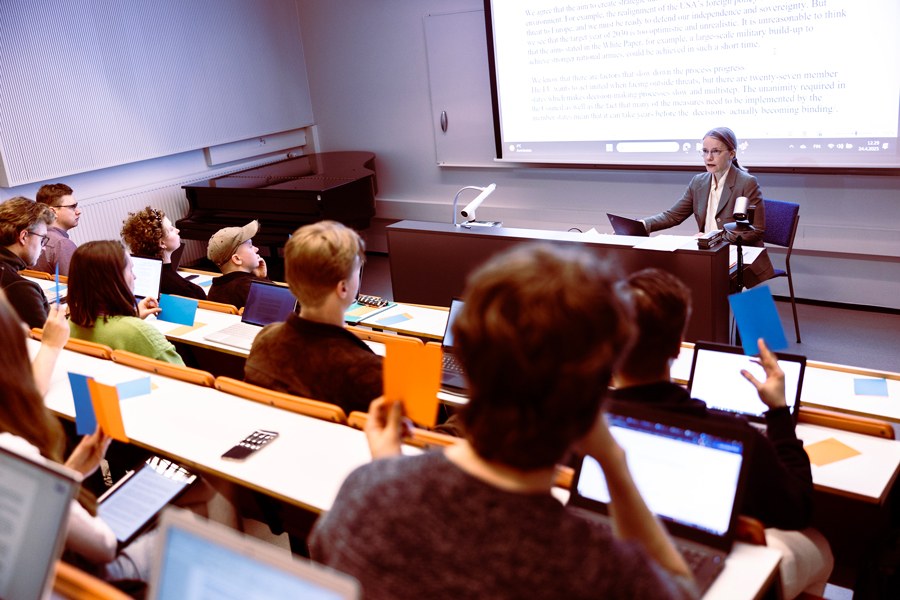
Over the years, teaching in International Relations at Tampere University has become increasingly diverse. In addition to traditional lecture-based courses, students now engage in simulations and practice-oriented modules that foster applied and practical skills. For example, in spring 2025, Hanna Ojanen’s course developed a joint position paper on European defence, based on the EU’s White Paper for European Defence – Readiness 2030. The final version was submitted to the European Commission at the conclusion of the course.
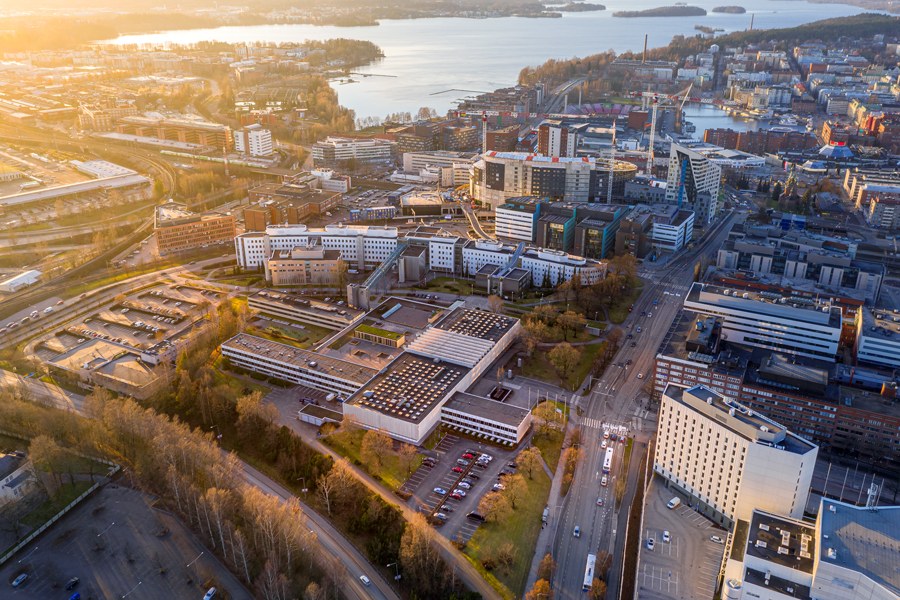 Photo: Marko Kallio / Skyfox / Tampere University
The sources used for this article are: Viljo Rasila (1973), Yhteiskunnallinen korkeakoulu 1925–1966 and Mervi Kaarninen (2000), Murros ja mielikuva Tampere University 1960–2000.
Contact person
Tuomas Forsberg
Professor, International RelationsInternational Relations at Tampere University
- As of 2025, the discipline is represented by three professors, one associate professor, and a team of teaching and research staff:
Professor Tuomas Forsberg, Professor Pami Aalto, Professor Emilian Kavalski, Associate Professor Anni Kangas, University Lecturer and Head of Degree Programme Tapio Juntunen, Research Director Hanna Ojanen, University Lecturer Eero Palmujoki and University Lecturer Hannes Peltonen. - The Unit of Politics hosts Finland’s most comprehensive degree programme in politics. The broad-based bachelor’s programme integrates core content from political science and International Relations. At the master’s level, students choose to specialise in one of the subjects.
- The centenary of International Relations in Finland is traced back to the founding of the Civic College in Helsinki in 1925. The institution was soon renamed the School of Social Sciences, which relocated to Tampere in 1960.
- Yrjö Ruutu taught history, political science, and International Relations at the College. The first professorship in the field was established in 1945.
- At Tampere University, a new professorship was created in 1966, with Professor Klaus Törnudd serving from 1967 to 1971 before transitioning to a diplomatic career at the Ministry for Foreign Affairs.
- Professor Osmo Apunen held the position from 1973 to 2003.
- The transfer of expertise from academia to public administration is also exemplified by Hiski Haukkala, whose career spans from professor to Chief of Staff at the Cabinet of the President of Finland and later to Director of the Finnish Institute of International Affairs.
Author: Mikko Korhonen


