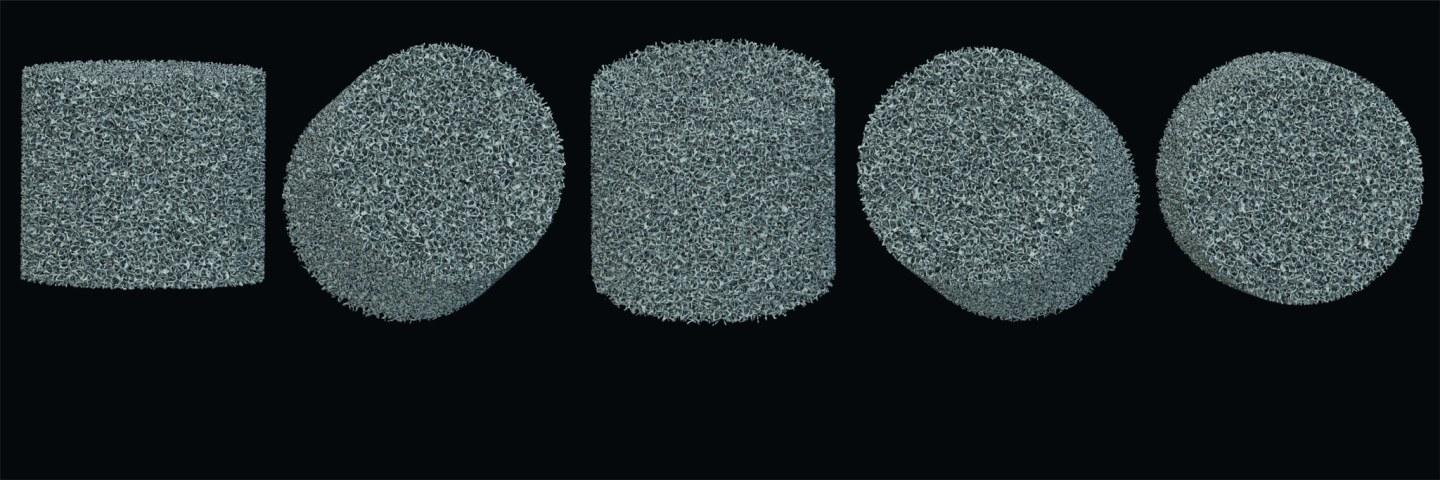
Tutkijatohtori Antonia Ressler tutkii luun tukirakenteita, jotka on 3D-tulostettu käyttämällä kalsiumfosfaattimateriaalia, joka on substituoitu useilla ioneilla (strontium, magnesium ja sinkki), jotka ovat ratkaisevan tärkeitä luun tehokkaan uudistumisen kannalta. Projektissa tullaan käyttämään 3D tulostustekniikkana stereolitografiaa tarkkojen, huokoisten, kalsiumfosfaatteihin perustuvien tukirakenteiden tulostamiseen yhteistyössä Lithoz-yrityksen kanssa. Tukirakenteita ajatellaan käytettävän luun korjausta vaativissa lääketieteen sovelluksissa.
Tulostettujen tukirakenteiden fysikaalis-kemiallisten ominaisuuksien yksityiskohtaisen analyysin jälkeen mitataan tulostetun materiaalin in vitro ja in vivo biologiset ominaisuudet, joilla määritetään tukirakenteen osteogeeniset ominaisuudet ja substituoitujen ionien vaikutus luun regeneraatioon käyttämällä nais- ja miespuolisilta luovuttajilta saatuja ihmisen kantasoluja sekä naaras- ja urosrotilta saatuja kantasoluja. Lisäksi yhteistyössä Planmeca Oy:n kanssa, projektissa käytetään todellisenkaltaisia potilastapauksia joissa tulostetut luun tukirakenteet on räätälöity potilaan monimutkaiseen leukaluun alueen luupuutoksen korjaamiseen.
AffordBoneS-projekti vaatii korkeatasoista tieteidenvälistä yhteistyötä ja hanke on suunniteltu pitäen mielessä, että luun luonnollisen regeneraation tukeminen perustuu eri alojen asiantuntijoiden yhteistyöhön, joista esimerkkeinä materiaalit, biologia, kliinikot, kirurgit ja alueella toimivat yritykset.
Tavoite ja tehtävät
AfforBoneS projekti tähtää edullisen ja massoittain räätälöitävän ratkaisun löytämiseen tapauksissa, joissa tarvitaan toimenpiteitä potilaan leukaluun alueen luupuutosten korjaamiseksi. Tukirakenne ja siihen kasvava potilaan oma luu on välttämätön hammasimplanttien kohdalla, kun potilaalla ei ole tarpeeksi luuta, jotta siihen voitaisiin implantoida kanta, johon hammasproteesi lopulta kiinnitetään. AffordBoneS-projektin tarkoituksena on hoitaa näitä potilaita luontoa matkivilla luun tukirakenteilla, jotka on valmistettu käyttämällä 3D-tulostettua kalsiumfosfaattia, joka on lisäaineistettu useilla eri ioneilla ja joka näin edistää potilaan oman luun kasvua puutosalueelle.
Vaikuttavuus
Maailman terveysjärjestön (WHO) mukaan alle puolet maailman väestöstä on välttämättömien terveydenhuoltopalvelujen piirissä, ja kohtuuhintaisten ratkaisujen kehittämisessä tarvitaan edistystä. AffordBoneS-projektin tavoitteena on tarjota henkilökohtaisia ja edullisia tukirakenteita luun augmentaatiotoimenpiteisiin, jotta suurempi väestö voi saada näitä hoitoja ja parantaa heidän elämänlaatuaan. On arvioitu, että pelkästään Euroopassa tehdään 1,5 miljoonaa luun korjausmenettelyä vuosittain.
Tutkimusrahoitus
Horisontti Euroopan Marie Skłodowska-Curie -toimet
Antonia Ressler, Setareh Zakeri, Piie Konnunaho, Martin Schwentenwein, Erkki Levänen, Erkka J. Frankberg, Cleaning strategies for 3D-printed porous scaffolds used for bone regeneration fabricated via ceramic vat photopolymerization, Ceramics International 50 (2024) 53107-53119.https://www.sciencedirect.com/science/article/pii/S0272884224046741
Vat photopolymerization has gained prominence in bone tissue engineering owing to its capability to fabricate intricate structures that closely mimic the natural bone tissue. Thorough cleaning of uncured ceramic slurry from the as-printed structures is essential, as the presence of residue within the structure can obstruct pores during sintering. Given the limitations of conventional spray cleaning for these structures, this study seeks to investigate alternative cleaning approaches. Specifically, the efficacy of dibasic ester (DBE) and LithaSol 80, coupled with ultrasonic and soaking methods, is examined to identify optimal strategies for the thorough removal of viscous residual slurry (LithaBone HA 480). To examine the effect of temperature on cleaning ability, printed scaffolds were soaked in the cleaning solutions at 23, 30, 40, and 50 °C for 24 h. Based on the results, 50 °C was chosen as the temperature for further analysis while using both soaking (24, 48, 72 and 96 h) and ultrasonic (5, 15 and 30 min; 1, 2, 3, and 4 h) as the cleaning methods. The cross-sectional image of the scaffolds showed that at least 48 h and 30 min is required for effective cleaning with soaking and ultrasonic, respectively. Microstructure analysis of scaffolds cleaned with LithaSol 80 revealed smoother surfaces, while scaffolds treated with DBE showed visibly contracted pores with peeling effect suggesting that DBE exerts a more aggressive action on the cured slurry in contrast to LithaSol 80. Notably, significant difference in mass loss was observed between scaffolds treated with LithaSol 80 and DBE. The significantly higher mass loss observed with DBE suggests that it not only impacts uncured slurry but also possibly affects cured slurry. Accordingly, the results indicate that DBE is notably more effective in cleaning; however, LithaSol 80 is more appropriate for maintaining structural integrity combined with soaking cleaning method. No significant difference was observed in compressive strength between most sintered scaffolds.
Antonia Ressler, Setareh Zakeri, Joana Dias, Markus Hannula, Jari Hyttinen, Hrvoje Ivanković, Marica Ivanković, Susanna Miettinen, Martin Schwentenwein, Erkki Levänen, Erkka J. Frankberg, Vat photopolymerization of biomimetic bone scaffolds based on Mg, Sr, Zn-substituted hydroxyapatite: Effect of sintering temperature, Ceramics International, Volume 50, Issue 15, 2024, 27403-27415, https://doi.org/10.1016/j.ceramint.2024.05.038. (open access)
In response to the urgent demand for innovative bone regeneration solutions, the focus of this study is to develop and characterize Mg, Sr, Zn-substituted calcium phosphate scaffolds that replicate the trabecular architecture of cancellous bone. Ion substitution represents a promising approach to improve the biological effectiveness of calcium phosphates and composite materials used in bone tissue engineering applications. Porous scaffolds mimicking the natural bone structure were additively manufactured from the photosensitive ceramic suspensions for vat photopolymerization using digital light processing. The impact of the selected trace elements (0, 1 and 5 mol.% substitution) and the sintering temperature (900, 1000, 1100, 1200, and 1300 °C) was investigated in relation to the obtained crystalline phase content, microstructure, elemental distribution, thermal stability, and mechanical properties. After sintering, in addition to hydroxyapatite, β-tricalcium phosphate was detected as a result of the added trace elements in the calcium-deficient hydroxyapatite used as a starting powder. The obtained scaffolds exhibited uniform distribution of the trace elements, and they feature 3D-designed porosity predominantly ranged from 10 to 900 μm in diameter, with an average pore size of 546.25 ± 10.95 μm. The total porosity of scaffolds was 76.24 ± 1.32 vol% and an average wall thickness of 217.03 ± 8.98 μm, closely resembling the morphology of cancellous bone tissue. The mechanical properties of the scaffolds sintered at 1100 °C, 1200 °C, and 1300 °C were in line with those typically observed in trabecular bone. The study demonstrates the feasibility of using custom made bioactive hydroxyapatite powders together with vat photopolymerization to design the porosity and properties of the bone scaffolds on demand, based on the requirements of individual bone defects.
Julkaisuprosessissa
Antonia Resslera, Roope Ohlsbom, Setareh Zakeri, Markus Hannula, Arjen Gebraad, Toni-Karri Pakarinen, Jari Hyttinen, Erkki Levänen, Erkka J. Frankberg, Susanna Miettinen, Effect of porosity, sintering temperature, and trace elements on biomimetic bone scaffolds based on calcium phosphates obtained by ceramic vat polymerization.
Invited oral presentation at The Materials Science & Technology (MS&T) at symposium ACerS-ECerS Joint Symposium: Emerging Leaders in Glass and Ceramics, Pittsburgh, Pennsylvania, USA, 6-9 October 2024.