Professor Jarno Vanne is a pioneer of future video technologies and an advocate of open science

Digital video is estimated to constitute as much as 80% of all current internet traffic. This massive surge in video traffic is reaching the limits of existing data transfer and storage technologies. Professor Jarno Vanne leads the Ultra Video Group (UVG), which aims to manage and control growing data volumes by developing innovative solutions for digital video compression, streaming and processing.
Our society is becoming increasingly video-centric. According to Vanne, this shift can be attributed to several factors: the dramatic growth in effective media devices and the way media applications entice users into continuous and diverse consumption of visual data. In addition, media content is designed to provide an ever more immersive user experience.
“The rise of video content is fuelled by younger generations, who prefer visual communication through platforms such as Snapchat and TikTok to textual content and phone calls.”
Vanne notes that advertising is another area that is increasingly reliant on personalised visual content. Video consumption is even expanding beyond human audiences.
“A growing volume of visual data is now being utilised by machines.”
Championing open science
Over the years, the Ultra Video Group led by Vanne has established itself as the premier academic video research group in Finland and one of the largest in Europe.
This multinational group comprises around 20 specialists in video coding, processing and streaming. They tackle industry-driven research problems related to media processing applications.
“UVG’s mission is to meet the demands of our video-centric society by implementing media processing solutions across various platforms, from low-power embedded devices to distributed edge computing environments. We conduct research that addresses practical problems in close collaboration with Finnish and European companies and research organisations,” Vanne says.
Vanne’s group has developed an internationally renowned open-source library of media technologies, providing both the scientific community and commercial operators with multimedia tools for high-performance, affordable and energy-efficient compression, streaming and processing of visual data.
“The scientific community can leverage UVG’s tools as they are, contribute to their development and support their widespread adoption. Industrial partners can also utilise our solutions as reference and proof-of-concept implementations for their commercial products and standardisation activities,” Vanne explains.
Vanne says that UVG’s identity is deeply rooted in open-source culture. In recognition of these efforts, the group received Tampere University’s Open Source Promoter Award in 2024.
Video technology enhances traffic safety and realism in virtual meetings
In addition to video compression, UVG develops several video-based intelligent systems.
The group’s video compression technology, guided by machine vision, makes the implementation of remote control and monitoring more financially attractive. This technology improves the management, cost-effectiveness and quality of industrial manufacturing.
In addition, the group is working on video-based driver assistance systems for vehicles. Comprehensive monitoring of the surrounding environment holds promise for enhancing the safety and predictability of future traffic.
The group also develops volumetric video delivery for real-time communication. This technology enables more realistic virtual meetings and experiences, helping to minimise unnecessary travel and reduce carbon footprints.
“By transcending the boundaries of the physical world through video technologies, we can promote social interactions and bridge the digital divide while also fostering economic growth and sustainable development,” Vanne says.
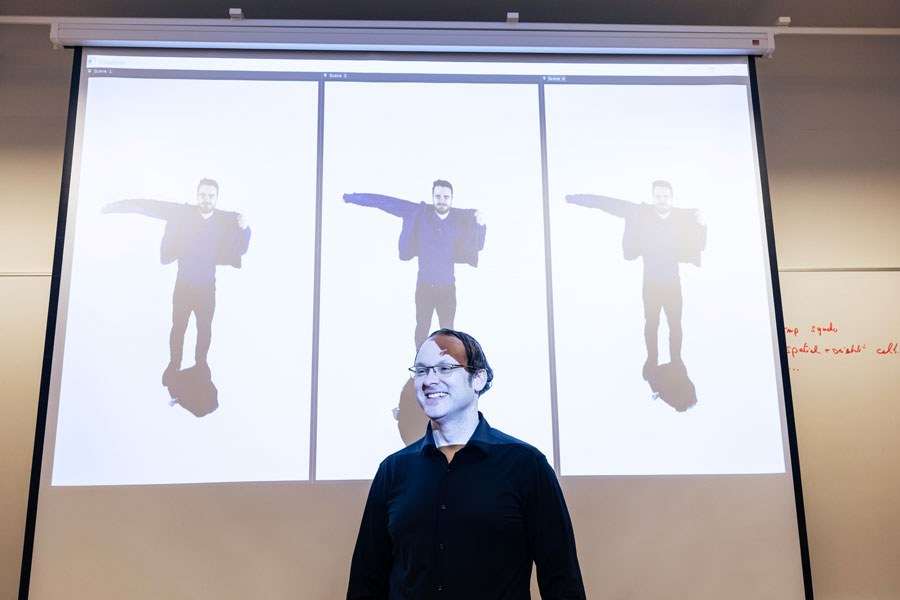 Photo: Jonne Renvall / Tampereen yliopisto
Alumnus of Tampere University
Professor Jarno Vanne is a proud alumnus of Tampere University. In the mid-1990s, he enrolled at the then-Tampere University of Technology (TUT) to study civil engineering, but his interest in technology led him to switch to a degree programme in electronics.
“In 1999, I received a job offer from the Digital and Computer Systems Laboratory at TUT and have not looked back since. I have gradually advanced through the academic ranks, starting as a research assistant and ultimately becoming a professor.
From a young age, Vanne has been captivated by the wonders of science, research and innovation. However, his interest in digital technology and computer science was not sparked until he enrolled at TUT.
Working as a research assistant allowed the budding scientist to delve into video research. After completing his doctoral degree, Vanne established his own research group, initially consisting of only two members. As their external research funding increased, the group gradually expanded.
Vanne was appointed as an assistant professor in 2016 and has steadily progressed along the tenure track at Tampere University, culminating in his promotion to full professor in the summer of 2024.
Reflecting on his academic career, Vanne believes that his appointment to a full professorship will lend more weight and credibility to his research group both within the University and beyond.
“It will also provide a solid foundation for the continuity of our research in the future.”
Vanne highlights the importance of social skills in the scientific community.
“After more than 20 years of academic experience, I firmly believe that the development of social skills alongside technical expertise is the key to successfully managing a research group and securing funding,” he says.
Aiming to build a national hub of expertise in visual media technologies
In recent years, Vanne has invested in expanding UVG’s international dimension and building science capital. Through internal growth and external recruitment, the group has established a strong profile as a community of post-docs and doctoral researchers.
Vanne is seeking to build a robust national cluster of expertise in visual media technologies. He envisions the cluster’s collaboration encompassing not only technology development but also the allocation of human resources. This approach would allow specialists to seamlessly transition to companies after graduation and later return to the University to continue their studies.
Vanne believes this type of cooperation would increase national and international research funding, bolster the growth of Finnish companies, and support the steady increase in investments in Finland and abroad.
“With the support of a strong collaboration network involving national and European partners, I believe UVG has the potential to become an academic pioneer in the development of future media technologies. This would advance my broader goal of creating a leading, open and independent European ecosystem around these open technologies,” Vanne concludes.
Welcome to the inaugural lectures of the new professors on 15 May 2025
Jarno Vanne
- Professor of Computing Sciences at Tampere University.
- Vanne leads the Ultra Video Group (UVG), which comprises over 20 members and has published more than 100 scientific papers on video research.
- He has worked as a visiting professor at INSA Rennes, France.
- He is the lecturer of the new Video Compression Course starting in the spring of 2025.
- His hobbies include cycling, running and going to the gym. In recent years, his newly built home in Kangasala has taken up much of his free time.
- He originally hails from Pori, Finland, and is a devoted fan of the ice-hockey team Porin Ässät.


