Doctoral researcher Tomi Salminen: “Emergency centre operator’s correct risk assessment is of paramount importance to the prehospital emergency medical services"

"The Finnish emergency response centre is an interesting field to study because it is so exceptional," says Salminen.
No other country has a separate authority whose sole task is to operate the emergency response centre, i.e., to carry out risk assessments and forward tasks to all authorities. Based on risk assessment, the task is assigned with a dispatch category and a dispatch priority.
In other countries, the system is often differentiated: first, a general assessment of the situation is made, and then the call is forwarded to the police, fire department, or emergency medical services. This is also how the pan-European emergency number 112 works. Previously, authorities in Finland also had their own emergency numbers, and this is still the prevailing model in most parts of the world.
If the emergency response centre’s risk assessment determines that the priority of the task is higher than the situation requires, it places a burden on emergency medical services.
Among other things, Salminen is investigating the differences between the urgency assessments made by emergency centre operators and paramedics. He is also interested in the factors that lead to an overestimation of the urgency of medical emergency calls, and the factors that cause challenges in risk assessment during these calls.
Salminen also aims to provide new information to support the development of the Emergency Response Centre.
From paramedics to lecturer and researcher
Tomi Salminen had a career as an entrepreneur until he got his Bachelor’s degree from emergency care at TAMK in 2014. During his studies, he worked as a paramedic. Salminen then graduated with a Master's degree in Health Sciences from Tampere University in 2021.
"While studying for my Master’s degree I worked as a lecturer at TAMK and as a paramedic in the emergency medical services, so it was pretty hectic”, he recalls.
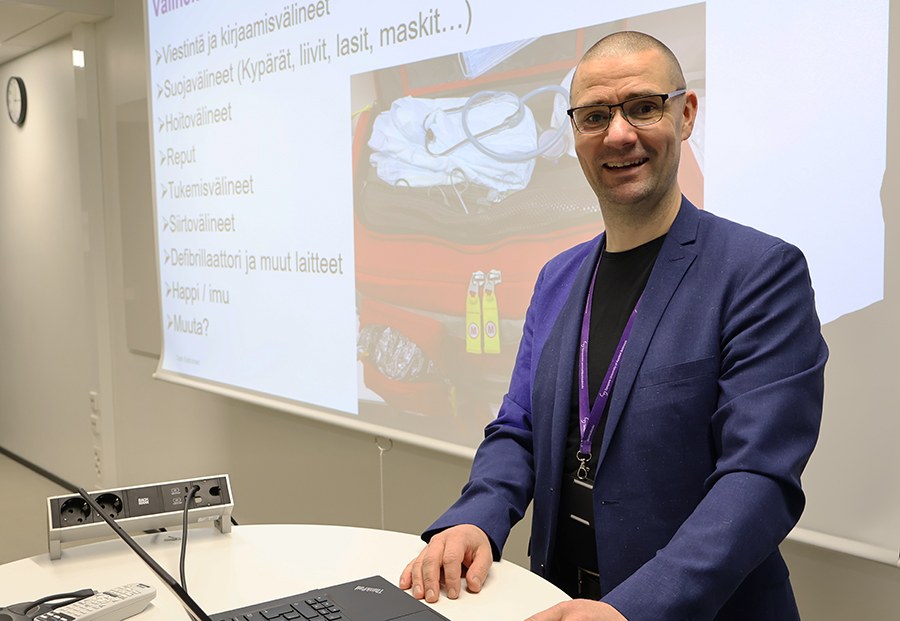
The best part of being a paramedic is the variety
Salminen describes the work of a paramedic as quite different from how it is portrayed in the media or on TV. Emergencies and life-threatening situations are only a small part of the job.
“The thrill of being a paramedic is that you never know what will happen. Even though the basic work is very similar, you may encounter strange and sudden situations. In practice, the basic work involves assessing how elderly people with underlying health conditions are coping at home: whether they have sufficient support and how they can be helped. Another large group are substance abuse and mental health clients”, he says.
According to Salminen, people are attracted to prehospital medical emergency care because of its diversity. He is grateful for the four-year training he received at TAMK, which led to him being recruited immediately after his first internship.
The training gave me surprisingly good skills and confidence to work in the field. I was in an excellent position because I worked as a paramedic while studying. Nowadays, it is difficult for students to find work as paramedics during their studies.
The field attracts people of all ages, both young people and those changing careers. TAMK's paramedic degree program is one of the most attractive and competitive degrees year after year.
"We were the eleventh most attractive degree nationwide, including all university degrees. Mathematically, it is easier to get into medical school than to become a paramedic at TAMK when you consider how many applicants there are per available intake”, Salminen notes.
A perfect thesis topic and curiosity paved the way for a career in research
Salminen wrote both his thesis on the same topic that he is now working on for his doctoral dissertation. The motivation for his career as a doctoral researcher was his Master's thesis, part of which was published in an international journal. Salminen felt that he had only scratched the surface, so he became enthusiastic about researching the topic further.
"When I was little, I wanted to be an archaeologist. In a way, this is the same idea: instead of digging in the ground, I dig into the world of emergency medical care. I want to understand things thoroughly so that they can be developed. It is meaningful, and I have been digging into the same topic for several years now.”
The topic of the dissertation stems from the practical work of a paramedic
Paramedics often feel that emergency response centre operators tend to overestimate situations, i.e., they assess them more critical than they are while underestimating the emergencies is rare.
In my work as a paramedic, I often found myself thinking about how the emergency response centre had come to a certain risk assessment. I wanted to better understand the challenges involved in the work of an emergency response centre operator: how you assess the situation on the phone in less than 60 seconds, and how the process then continues. I also wanted to find out more thoroughly whether the perception of the paramedics corresponds to reality.
The role of the operators has changed over the years. The previous version of the emergency response centre system was rigid. The change made in November 2023 expanded the role of the operators and gave them more discretion. One of the goals of the system is to make risk assessments more consistent.
"If we had unlimited prehospital emergency care resources, there would be no problem. When someone calls the emergency centre, they know they will receive the best possible help and care. The problem is that if the best care is sent to everyone, resources will run out very quickly. That is why it is important to be able to identify real emergencies.”
Salminen gives an example.
"I used to work in an ambulance in Kangasala, and the area was really large. If a unit was sent to Kuhmalahti at night for an urgent call that turned out not to be urgent, the whole Kangasala was without an ambulance for that time. Calls overlap, so you must be able to choose the order in which they are handled.”
Calls that do not belong to the emergency centre have increased, which puts a strain on emergency centre operators and further stretches the entire system. According to Salminen, calls used to be more common sense based. Younger people are more likely to call the emergency centre, while older people do not call for minor reasons. However, there is a huge number of calls in total, and only some of them are urgent.
The knowledge of risk assessment process benefits emergency medical service and the emergency response centre agency
Salminen's study consists of four sub-studies and a summary section. The purpose of the summary is to create an overall picture and describe the process of events using a few scenarios.
In practice, I describe what happens when a task ends with an overestimate, underestimate, or successful estimate. What factors influence this and what happens along the way? The goal is to create a model that, among other things, describes paramedics, how complex the model is, and what factors affect risk assessment. At the system level, I aim to provide information on areas for development and issues that cause difficulties.
He adds that a partial goal is also to develop the quality assessment of the Emergency Response Centre Agency. Currently, the agency only evaluates the speed of responding to emergency calls and the speed of handling tasks. According to Salminen, the number of calls that can be handled per minute or the number of seconds it takes to respond are not the best indicators of quality.
"We should also evaluate and measure when the operator makes a successful assessment. Although this study is mainly quantitative, the human aspect behind it is also important."
Emergency medical service parties work closely together in Tampere area
The supervisor of Salminen's doctoral dissertation is Eija Paavilainen, Professor of Nursing Science at Tampere University. At TAMK, the ties are close to the university's Kauppi campus.
"Tampere has a surprisingly active research community, largely thanks to Sanna Hoppu, Chief Physician of Emergency Care at the Wellbeing Services County of Pirkanmaa. She is also a member of my dissertation's monitoring group. The doctors and paramedics involved in the group focus both on research and constant development. It is quite unique that regional emergency care cooperation is so productive: several articles and dissertations are published each year”, says Salminen.
The dissertation is halfway through – TAMK's new doctoral path accelerates research work
Salminen has been working on his dissertation for a couple of years now. The work is progressing well, but the analysis and the methodological studies included in the doctoral program require more time. Obtaining funding is difficult, as there are few suitable funding instruments available. That is why Salminen is particularly pleased to have been accepted into TAMK's doctoral path.
"The doctoral path is a fantastic and concrete addition to the higher education community. It is a wonderful opportunity that, to my knowledge, is not available anywhere else. Since I graduated from Tampere University, I am writing my dissertation there and working at TAMK, so it is brilliant to be able to take advantage of both, and I would not want to choose between the two. The doctoral pathway is a great example of how it is possible to navigate between working life and the academic world within a community.”
Additional information:
Tomi Salminen
Senior Lecturer | Social Services and Health Care
Tampere University of Applied Sciences
tomi.salminen [at] tuni.fi (tomi[dot]salminen[at]tuni[dot]fi), +358 50 441 8055
Author: Hanna Ylli


