Antti Vehkaoja promotes health through data and business collaboration

Imagine if, during surgery, a scalpel could identify whether the surgeon is cutting into cancerous tissue so precisely that all the tissue is removed, minimising the risk of recurring cancer and the need for more surgeries.
This is no longer science fiction.
The identification is enabled by two existing inventions whose names are quite a mouthful: the diathermy knife and the differential mobility spectrometry method (DMS).
The diathermy knife cuts tissue using an electric arc and turns the tissue into smoke that is known as diathermy smoke, making it possible to identify tissue molecule types from the smoke. This is where the DMS method comes into play, which is one of Professor Antti Vehkaoja's focuses in research.
“The method removes impurities, ionises the molecules, and separates them based on their shape, size and charge. The device also differentiates between molecules by their mobility using a high-frequency electric field. Cancerous tissue has a different molecular composition than healthy tissue. For example, if the lipid content of the smoke increases, it shows that cancerous tissue has been excised,” Vehkaoja explains.
While the device is performing the analysis, it produces a spectral curve and converts it into data by a machine-learning algorithm, which can be viewed directly on a screen during the surgery.
This would be a significant advancement from the traditional method as the sufficient margins of tumour removal are currently assessed mainly by eye and touch during surgery and by analysing processed tissue samples microscopically afterwards.
Wearable system monitors bedridden patients
There is a good reason for calling Vehkaoja an active collaborator with businesses. In developing the DMS method, he is working closely with Olfactomics Oy whose long-term goal is to bring the surgical smoke analysis method to market.
Vehkaoja’s network also includes a company called PulseOn. It has developed a wrist-worn measuring device used for diagnosing atrial fibrillation. Since one of Vehkaoja's areas of expertise is methods for measuring people’s physiological signals, a company developing such measuring devices is a logical partner.
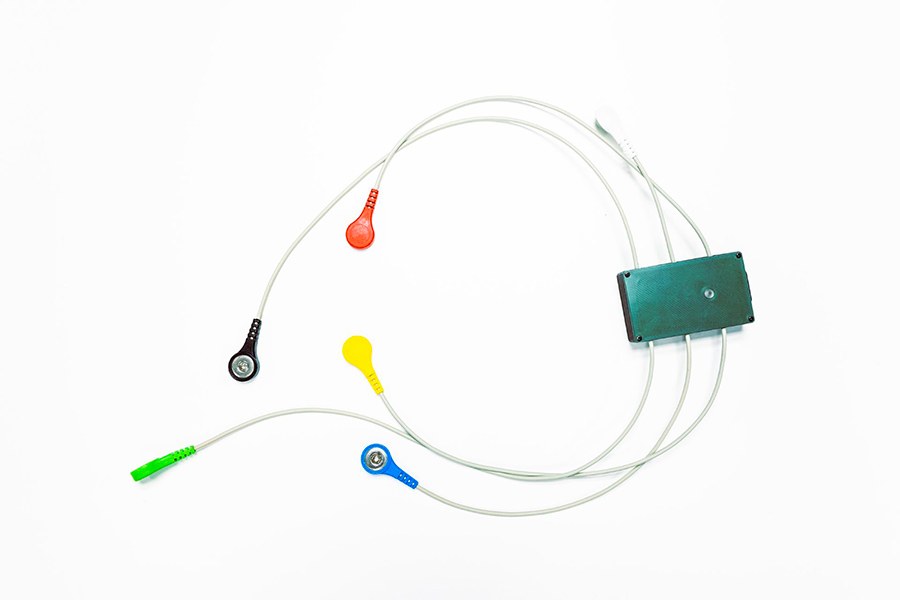
Vehkaoja was also involved in the Business Finland-funded Research to Business project, which ended in the summer of 2024, where a wearable patient monitoring system was developed for hospital wards. The project resulted in spin-off company Brecas. A wearable system might conjure up the image of clothing, but it is actually a small device attached to the chest.
“In addition to heart function, the device measures oxygen saturation, respiration and movements. It detects arrhythmias and ischemia, which is a lack of oxygen in the heart muscle. We particularly want to identify early on if a patient is developing respiratory depression, which can cause brain damage or even death. The risk of respiratory depression is significant in surgical patients who receive opioid-based pain medication,” Vehkaoja says.
Such a device is not yet used at regular hospital wards. However, Vehkaoja says that there are signs that we are moving in that direction. Monitoring just needs to become sufficiently reliable and affordable, which would make it feasible overall. No one wants false alarms and devices beeping unnecessarily in every room, draining resources.
The latest collaboration Vehkaoja is contributing to is the Tomorrow’s Sports and Health Campus project in the Hakametsä area of Tampere. The goal of the project is to build a network with companies and stakeholders to promote health and preventive services. An important aim is to accelerate the commercialisation of research results and the creation of service and technology innovations. The project is coordinated by Tampere University and it involves the City of Tampere, the Wellbeing Services County of Pirkanmaa, Varala Sports Institute and the UKK Institute for Health Promotion Research.
Applications for our furry friends
In addition to people, Vehkaoja’s expertise also benefits pets. He has previously conducted Business Finland-funded research where measurement methods developed for humans were applied to animals.
“The owners do not always know what their pet wants and needs or what it does during the day when they are away. For example, a dog may experience stress when left alone. To address these questions, we developed methods to improve interaction between the owner and the pet," Vehkaoja explains.
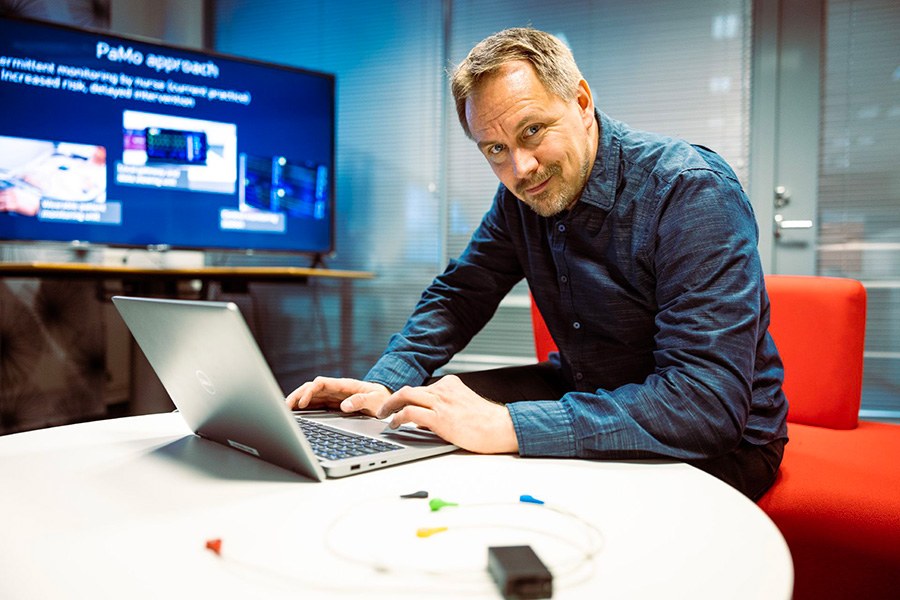
KUVA Collaboration between the University and businesses is important to Vehkaoja. One aspect of this is commissioned research, which he and his research group have conducted for companies for a long time. Vehkaoja hopes that the University’s research infrastructure would be better utilised for the benefit of businesses.
Pets were also monitored on a general level. For this purpose, a series of tests was conducted with the Faculty of Veterinary Medicine at the University of Helsinki.
“We fitted ‘dog volunteers’ with motion sensors. Using the sensors, we collected a dataset to which annotations, explanations and comments were added to indicate what the dog was doing in each situation. We trained machine learning models to automatically classify movements based on that data,” Vehkaoja says.
The biggest question Vehkaoja wants to solve continues to be the broader and more comprehensive utilisation of data collected from people to promote health. There is a vast amount of data, but it does not always flow between different stakeholders and systems in a way that would maximise its utilisation. There is also still work to be done in improving the reliability of measurement methods.
"Activities are fortunately underway around this issue. The Act on the Secondary Use of Health and Social Data is being revised, and the EU is developing the European Health Data Space Regulation to create a common framework for the use of electronic health data. Solutions are also more generally being sought on how to integrate the data people collect with their own wellness devices into various systems,” Vehkaoja notes.
In the future, data collected by one’s smart device could automatically be recorded in, for example, the MyKanta online health data service. In this way, doctors would have access to comprehensive long-term monitoring data that they could use to find the best treatment to meet their patients’ needs.
Antti Vehkaoja
- Originally from Tampere, lives in Nokia.
- Graduated as Master of Science in electrical engineering in 2004.
- Worked as visiting researcher at UC Berkeley, California, in 2007.
- Completed his doctorate in technology at Tampere University of Technology in 2015.
- Appointed as a docent and assistant professor at Tampere University of Technology in 2017.
- Appointed an associate professor at Tampere University in 2021.
- Promoted to full professor of sensor technology and biomeasurements at Tampere University in 2025.
- Enjoys circuit motorcycling, enduro, and kiteboarding.

Author: Sari Laapotti


