A new drug screening method could bring a solution to drug delivery and efficacy issues

The study led by Professor Tero Järvinen at Tampere University has developed a new drug screening method. The method enables the screening of billions of molecules and helps to solve problems related to drug delivery in the body. The study was published in the journal Life Science Alliance on 11 February 2025.
The screening method is based on combining phage display and microdialysis performed in a living organism with modern high throughput sequencing technologies.
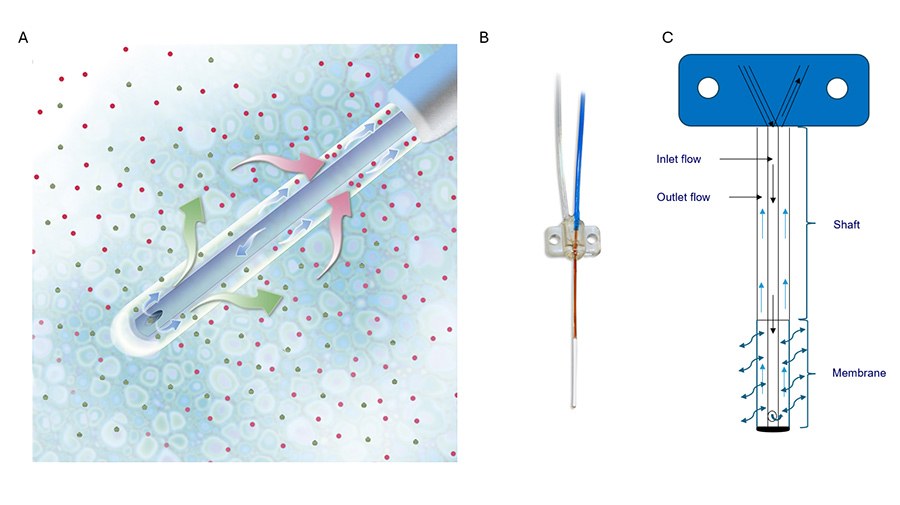
Phage display is a true ‘golden goose’ of drug development. It is a laboratory technique whose development earned its inventor a Nobel Prize and has been used to discover most of the top 100 best-selling drugs in the world. In phage display, billions of protein fragments, or peptides, can be screened based on their desired characteristics. Such a property could be, for example, their ability to bind to a specific receptor or cell type. Microdialysis, on the other hand, is a method that can collect and analyse small molecules from tissue fluid, for example, directly from diseased tissue. The novelty in the new screening method is that the microdialysis catheter can be used to capture bacteriophages expressing the screened peptides. The authors demonstrate that the additional selection step introduced by the microdialysis probe allows the identification of novel homing peptide sequences capable of target tissue homing and tissue penetration.
“For 20 years, my research group and I have been interested in peptides that target specific tissues or tissue injuries via the bloodstream. With the new technique we have developed, we aim to find peptides with an additional functional property, the ability to pass through cells. This would ensure that the drug truly accumulates where the actual disease is active," Järvinen explains.
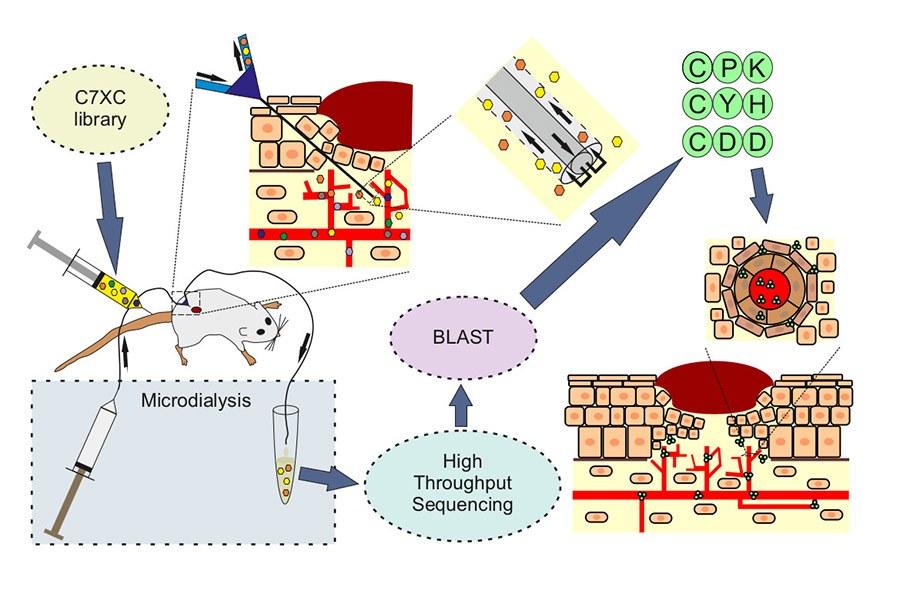
There are entry barriers for efficient drug accumulation in the human body. For example, the blood-brain barrier protects the brain from harmful substances but also prevents drugs from effectively reaching the brain tissue. A similar problem is caused by the high pressure of cancer tissue. Since the peptides sought in the new screening method behave like viruses and can enter cells, these barriers can be bypassed by attaching the drugs to such a peptide.
The newly developed screening method was able to find a few biologically highly active molecules among billions of potential drug candidates. These molecules specifically target the desired tissue and can accumulate in the intercellular space of the target tissue by passing through cells.
“We believe that the method we have developed will hopefully lead to the discovery of new, tissue-selective drugs and potentially solve major medical problems related to drug delivery to the brain or cancer tissue. Our goal is also to establish a biotechnology company around this invention,” says Järvinen.
The next step is to test the research method more broadly with partners.
The research team included, in addition to Tero Järvinen, Toini Pemmari, Stuart Prince, Niklas Wiss, Ulrike May, Fernanda Munoz Caro, and Soili Lehtonen from the Faculty of Medicine and Health Technology at Tampere University. Chief Physician Hannele Uusitalo-Järvinen from Tays Eye Hospital and the research group of Professor Tambet Teesalu from the University of Tartu, Estonia, were also involved in the project.
Read the research article online
Toini Pemmari, Stuart Prince, Niklas Wiss, Kuldar Kõiv, Ulrike May, Tarmo Mölder, Aleksander Sudakov, Fernanda Munoz Caro, Soili Lehtonen, Hannele Uusitalo-Järvinen, Tambet Teesalu, Tero AH Järvinen: Screening of homing and tissue-penetrating peptides by microdialysis and in vivo phage display. Life Science Alliance Feb 2025, 8 (5) e202201490: DOI:10.26508/lsa.202201490.
More information
Tero Järvinen
+358 44 285 4620
tero.jarvinen [at] tuni.fi (tero[dot]jarvinen[at]tuni[dot]fi)


