Mobile laboratory detects airport particle emissions surprisingly far away – data improves air quality monitoring

Research in aerosol physics at Tampere University shows that Helsinki Airport is a significant source of ultrafine particle emissions.
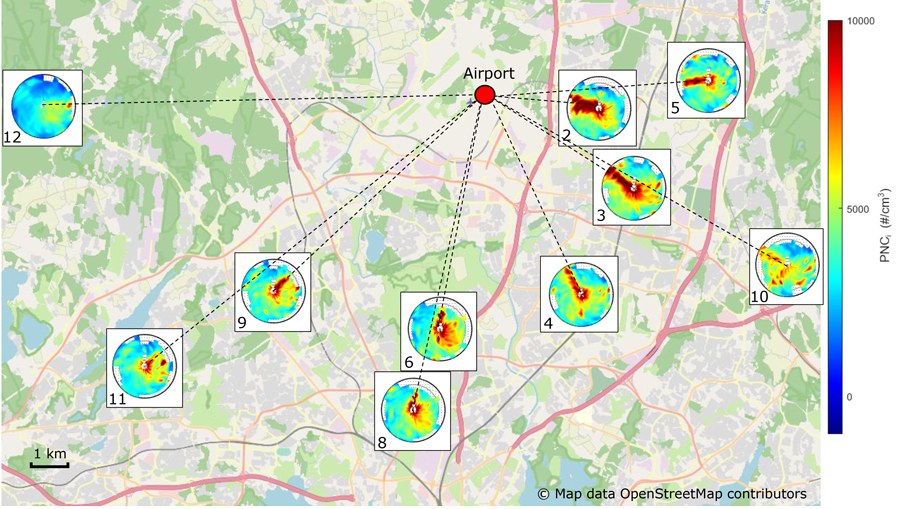
The study demonstrated that ultrafine particles originating from the airport can be carried by wind as far as 15 kilometres. The WHO’s threshold for a ‘high concentration’ (20,000 #/cm³) was exceeded around four kilometres downwind from the airport. In the prevailing wind direction, annual particle concentrations at a similar distance are estimated to be 30–50% higher than in typical urban air. Closer to the airport, concentrations are even twice as high. In Finland, winds most often blow from the west.
Teemu Lepistö, Postdoctoral Research Fellow in aerosol physics at Tampere University, emphasises that the levels measured a few kilometres from the airport are comparable to those on Helsinki’s busy main streets. However, compared with road traffic, the role of airports as a source of air pollution is still not widely recognised.
“Our research provides new information on how far airport particle emissions can travel and how poorly this phenomenon is captured by traditional measurements,” Lepistö says.
He emphasises that the results do not mean that air quality around Helsinki Airport would be exceptionally poor.
“The results indicate especially that ultrafine particles should be taken into account more effectively in air quality monitoring,” he points out.
Current emission limits and air quality monitoring rely on traditional mass-based particle measurements and fixed monitoring stations. In the study conducted by Tampere University, the airport’s particle emissions were measured using a mobile laboratory equipped with technology capable of detecting ultrafine particles (smaller than 0.0001 millimetres). The mobile laboratory enabled collecting more comprehensive data flexibly from multiple locations.
Ultrafine particles are a health risk, but exposure can be reduced
The EU’s new Ambient Air Quality and Cleaner Air Directive and the WHO’s recommendations bring ultrafine particles more clearly under official regulation than before. Although the effects of ultrafine particles on air quality and health are now being studied more extensively, there is still limited measurement data.
Because ultrafine particles are highly localised, it is difficult to assess their health impacts at the population level. Research has linked ultrafine particles to neurological and respiratory diseases. Concentrations can be high near emission sources even in countries where overall particulate levels tend to be low, such as Finland.
Airport emissions can be reduced by introducing cleaner fuels and advanced engine technologies. However, Lepistö points out that this will take time.
“A quicker way is to reduce exposure to emissions in the vicinity of airports. Land use planning can guide the placement of buildings in relation to prevailing winds, and efficient air filters can improve indoor air quality. Vegetation may also have positive effects,” Lepistö explains.
Helsinki Airport findings are also valuable internationally
As air traffic continues to grow globally and residential areas spread ever closer to major airports, the study provides important comparative data for international discussions as well.
“In 2024, Helsinki Airport was the 32nd busiest airport in Europe in terms of commercial flight numbers, so the air quality impacts of aviation are likely to be considerably greater at larger airports. Our measurement method and findings can help improve air quality monitoring and assessment elsewhere in the world,” Lepistö says.
As part of the measurements of airport emissions, the indoor air of a building located near the airport was also examined. The study is a part of the multidisciplinary GIANT research project led by Tampere University, which investigates the effects of outdoor emissions on indoor air quality.
The research article Dispersion of ultrafine particle pollution from an international airport: Characteristics and short- and long-term effects in surrounding areas was published in the Environment International journal in February 2026.
Contact person
Teemu Lepistö
Postdoctoral Research Fellow Teemu Lepistö


