Forest prescription project takes students to the forest where the mind can thrive

In Finland, the forest is always close by. Even TAMK’s campus has a small piece of forest that has been transformed into a teaching space with wooden stools and benches. In addition to the outdoor teaching space, the Improving Young People's Well-being with Forest Prescription (Metsäresepti) project has come up with several varied concepts.
The tools developed in the project aim to improve the wellbeing of young people by exploiting the results of research on the health benefits that nature has to offer. The goal has been to improve student satisfaction and progress in their studies by building and promoting a lasting relationship with nature. Supporting the wellbeing of young people is an investment in the future.
Nature makes students from different fields speak the same language
For two years now, students and teachers have been promoting students' welfare through forest concepts in the Metsäresepti project, funded by the Finnish Innovation Fund Sitra. For the project leader, Ulla Häggblom, both students’ wellbeing and the forest are subjects close to her heart. Häggblom praises the team of fifteen student developers.
“Nature makes students from different disciplines speak the same language. At campus, a small wooded space called Metsälämpäre (a piece of forest) has been popular based on premises booking calendar; it is here to stay. It is a favourite place for students and staff to meet and have coffee.
Making nature an important part of young people's lives
The project developed the popular Mesikerho, a mind and nature related club for all TAMK students. The multidisciplinary club organises forest excursions and nature activities inspiring students to be in nature. The forest calms down the student life hustle and bustle. The Mesikerho club cross-pollinates students from different disciplines.
Any student interested in nature and hiking in the forest can join the Mesikerho club, whether you study at TAMK to become an engineer, a nurse or a media expert. We do have lively programmes in different degree student associations, but cross-disciplinary club activities are something new. The club has more than 70 active members already. Nature is also great because you don't always have do something there. You can just go to nature to be present, observe and enjoy.
Ulla Häggblom
Häggblom also cites the curriculum reform as an important issue. It will help to make the forest more widely part of students' everyday lives.
“Thanks to the curriculum reform, all degree programmes will have ten common one-credit courses of which students must choose at least one. The functional and independent Metsäresepti course is one of these and it was built for us by a trainee recruited for the project. It is such a great course! It guides and inspires you to get out into nature and observe the effects of nature on your wellbeing through facts and questions.”
The course has attracted many people. Häggblom hopes that as many students as possible will choose it and get inspired about nature, if it has not already been part of their daily lives.
Nature is accessible to all
The feedback from the funding institution Sitra has been very encouraging and positive as the project has progressed and is now in its final stages.
“We took a five-person Sitra delegation to the forest in line with the project's lessons learned. We wanted to show in a concrete way that students' mental wellbeing can be promoted in a bold and innovative way. A follow-up project is already being planned, because this must not remain just a pilot and a fun experiment.”
Integrating nature into education is very much a matter of the teacher's attitude. The model can be easily scaled up and adopted by other universities and educational institutions in Finland and internationally.
“Nature does not always have to be a forest. In central Europe, for example, parks can serve as local nature reserves. Oftentimes it is enough to go outdoors to breathe fresh air, listen, see, smell and feel the presence of nature. Nature is accessible to all, if you want it.”
Anxiety and headache were left in the forest
The project's many successes are gained thanks to the students and an enthusiastic multidisciplinary project team. In addition to Häggblom, the team includes lecturers Toni Männistö and Marja-Leena Lähteenmäki as well as Hannastiina Ruismäki from the Tamko Student Association, which has provided a direct link to the students. The project steering group has also been supportive and active.
“The idea for the project came about three years ago, when my colleague Marja-Leena and I were considering whether students' anxiety could be reduced or prevented with the help of nature.”
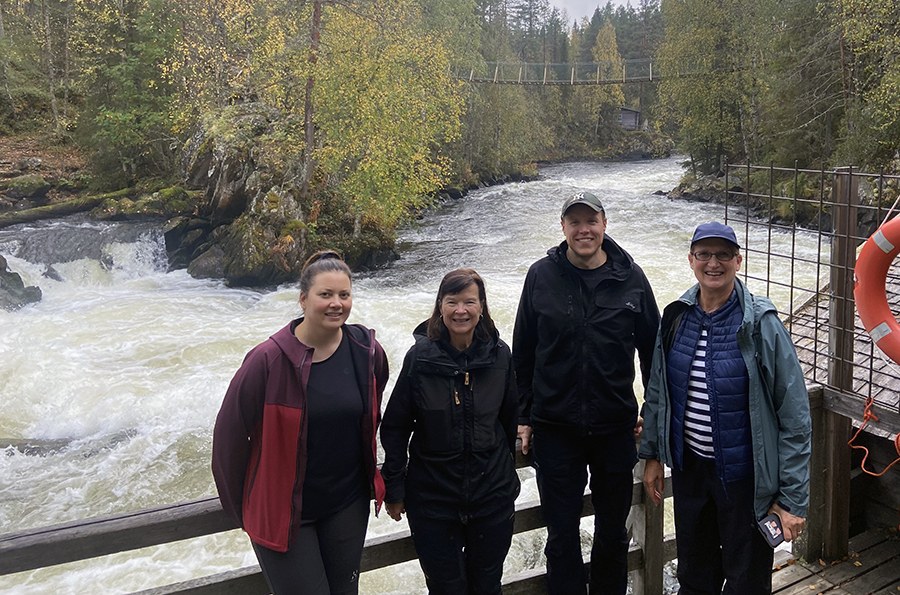
For many students, getting out into nature can be a big step to take. Some students who have taken the step and enjoyed the forest have afterwards wondered where their anxiety or headaches disappeared. When teachers have taken students outside and integrated lessons in a nature, the feedback has been positive from both students and teachers themselves.
Towards a personal relationship with nature
Häggblom, who cares about students in many ways, hopes that the forest experience will not be a one-off.
If only students would get excited and see the value and importance of nature for their mental wellbeing! Ideally, each student would develop a relationship with nature that would last a lifetime. I also see a social impact as our students would graduate whilst feeling well and that they would be able to cope with work and life in general. The interest in forest also has a multiplier effect, meaning that they can take the wooded recipes to their own communities.”
Ulla Häggblom
The project has also had an impact on Häggblom's own relationship with nature. Having worked in the forestry industry, she long saw the forest mainly as a valuable raw material for paper and packaging products. Now, in addition to the industrial and economic picture, her view is much wider.
“I appreciate nature and its diversity: trees, plants, animals, clean water and fresh air. We in Finland can be happy and proud of our forests, which we must cherish for future generations.”
The project, which will end at the end of this year, has had a wide-ranging impact. Ulla Häggblom is convinced that there will be continuity when universities and educational institutions are given clear instructions on how to implement the forest into students’ wellbeing. The forest can accommodate people and has a recipe for mental wellbeing that works well.
Improving Young People's Well-being with Forest Prescription project
Young people have experienced an increase in mental health problems and loneliness, as well as exclusion from education and employment. The aim of the project "Improving Young People's Well-being with Forest Prescription" is to promote students’ wellbeing, improve their happiness, academic progress and form a lasting relationship with nature. Tampere University of Applied Sciences' project aims to bring nature into the everyday lives of young people. The project is funded by The Finnish Innovation Fund Sitra. The project will run for two years, ending at the end of 2024.
Visit the project Finnish website Metsäresepti-hanke | Tampereen korkeakouluyhteisö (tuni.fi)
Author: Hanna Ylli


