
TAMK annual review 2024: Research, development and innovation activities
Innovation and development – TAMK’s RDIC activities contribute to regional growth
TAMK continued on a path of active development and revitalisation in 2024. Our research, development, innovation and competence (RDIC) activities facilitated progress on regional, national and international level. During its first year of operation, the Applied Research Center built up TAMK’s RDIC profile, highlighting its multi-competence, productivity, internationality and service ability. The centre aims to not only strategically increase nationally and internationally competed funding but also to efficiently utilise it to support business life and to boost the impact of project and publication activities. Our RDIC operating model has been used to identify and verify our multi-competences and to submit project applications for international instruments.
TAMK improved its personnel’s RDIC competences in several different ways. To develop project activities, we launched efforts such as a pilot training programme, and we will continue to implement and advance it in the future. TAMK’s inclusion in a European alliance for higher education institutions was one of the most significant achievements of the year. This important international goal was achieved when TAMK received funding for the Uninovis Data for L.I.F.E. alliance. In the future, the alliance will provide support for the development of new international projects, and education cooperation in particular. Furthermore, TAMK established new service paths which help in the planning and implementation of new projects. Internally, RDIC awareness was increased with communication campaign efforts in our intranet and at various events, among others.
In 2024, projects supported by the European Regional Development Fund were the primary external funding sources for our RDIC activities, but we also actively utilised other sources of funding, such as Business Finland and Erasmus+. Successful projects included, among others, KNOT - All Young Participants in the Future, MULTIGINATION and YOUROPE. In 2024, we also created and published the Coalition of Advancing Research Assessment (CoARA) action plan (pdf) which defines how our organisation views, evaluates and develops our internal research assessment policies.
TAMK has taken an active role in various international networks, such as the ENoLL (European Network of Living Labs). We have also expanded our international partner network to e.g. Southeast Asia in cooperation with the universities of Chulalongkorn and Kasetsart. What’s more, our partnership with the Hague Network, specifically with the Hague University of Applied Sciences, has expanded significantly after the school became an associate partner in the Uninovis Alliance.
Our domestic continuing education yielded excellent results in 2024. Our offerings in the social services and health care sector were particularly popular, as traditionally has been the case. 170 TAMK employees worked in continuing education, and the average feedback score for our continuing education offerings stood at 8.8. More than 1,000 people completed TAMK’s continuing education offerings. We further improved our customer management and granted 440 continuing education certificates during the year. For the first time in 2024, we offered a forensic nurse programme as well as a programme for wireless systems and antennas, developed and implemented together with various companies.
We finished the partnership model developed for companies, and we will pilot it and develop it further in 2025. In terms of international education, the development of our diploma training has progressed successfully in cooperation with TAMK’s schools. The diploma products offered in our education export portfolio continued to attract high international interest. In addition, we improved our short-term study options, particularly focusing on setting up new international short-term courses based on our domestic offerings. TAMK has continued to map out new areas, looking for global growth of its business in the future as well.
Our team of communications experts was bolstered further. TAMK released about 100 news articles during the year. We attracted well-deserved media attention for events such as the recruitment of our new president, for the Christmas concert of all times and for the award given to the cleaning industry influencer of the year, our Senior Lecturer Leila Kakko. Social media visibility improved markedly this year as well, with the number of positive mentions increasing by 380% compared to the previous year. TAMK also joined Tampere University in making a critical decision to leave X, the social media channel.
In joint application, TAMK was again the second most popular university of applied sciences in Finland, in both brand appeal and applicant numbers. In marketing to applicants, we focused heavily on visibility in the domestic market with both outdoor advertising and digital platforms. We also strengthened our connection to working life with our slogan ‘Matkalla töihin’ (On the way to work).
It was TAMK’s turn to organise the national UAS Days together with Polamk. In April, nearly 300 experts from the world of universities of applied sciences convened at the Tampere Hall to discuss the topical theme of smart preparation (‘Varaudutaan viisaasti’).
During the year, some of our most impactful communications projects included the multi-competence E3 Pandemic Response and Enterprise Solutions, the Silver Entrepreneurs – Entrepreneurship Simulation Program for Silver Economy in Central Baltic and the Producer Centre Living Lab. BioPak (sustainable food packaging in circular bioeconomy) and the Kuvata project (a new working/earning domain for visual artists) in particular attracted high visibility in social media. TAMK’s experts produced approximately 400 publications related to these and other projects.
Radiographer Turkka Lehtonen was our Alumnus of the Year 2024. As usual, the nomination was celebrated in October. Internally, we advanced the improvement of our employer image, the visual upgrade of our learning environments and our website development.

RDI key figures

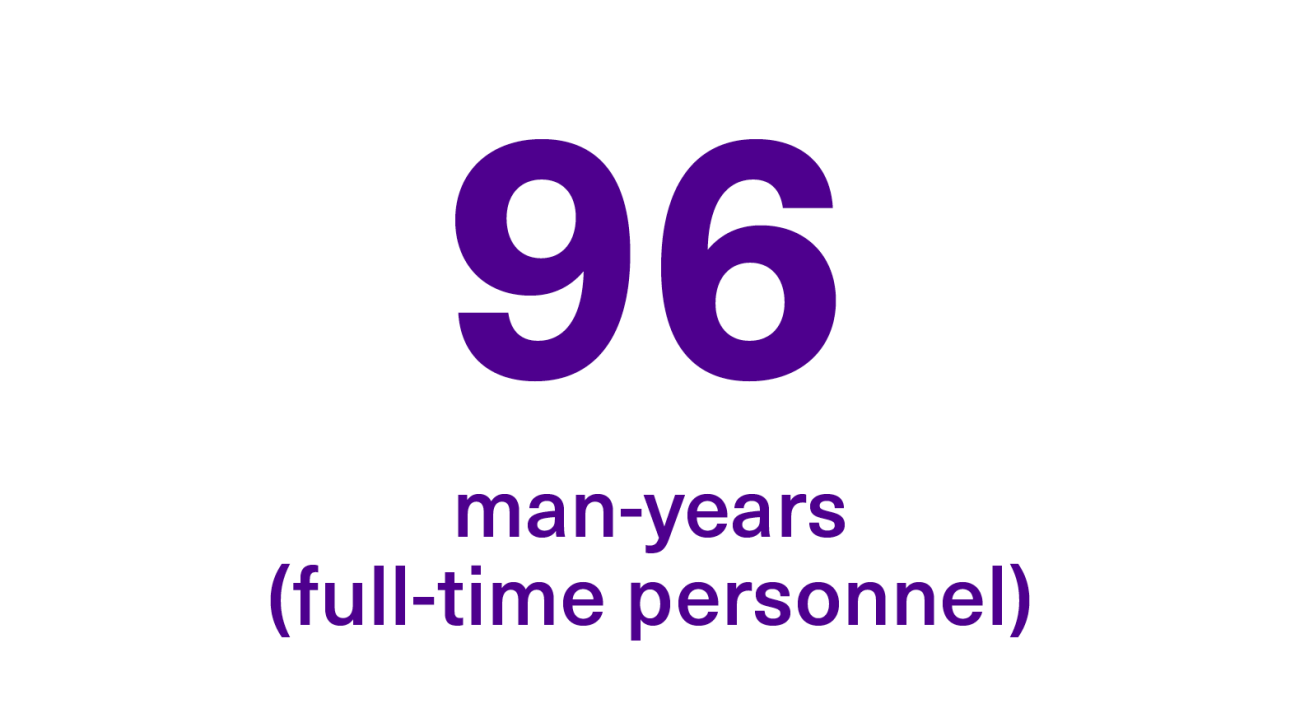

In 2024, we had approximately 130 ongoing projects. During 2024, full-time personnel used 96 man-years for research, development and innovation, corresponding to 14.4% of the entire staff’s total working hours. Teaching and RDI staff used 74.4 man-years for RDI activities, constituting 17.9% of their working hours. The biggest RDI funding providers were the European Social Fund (ESF) and the European Regional Development Fund (ERDF).
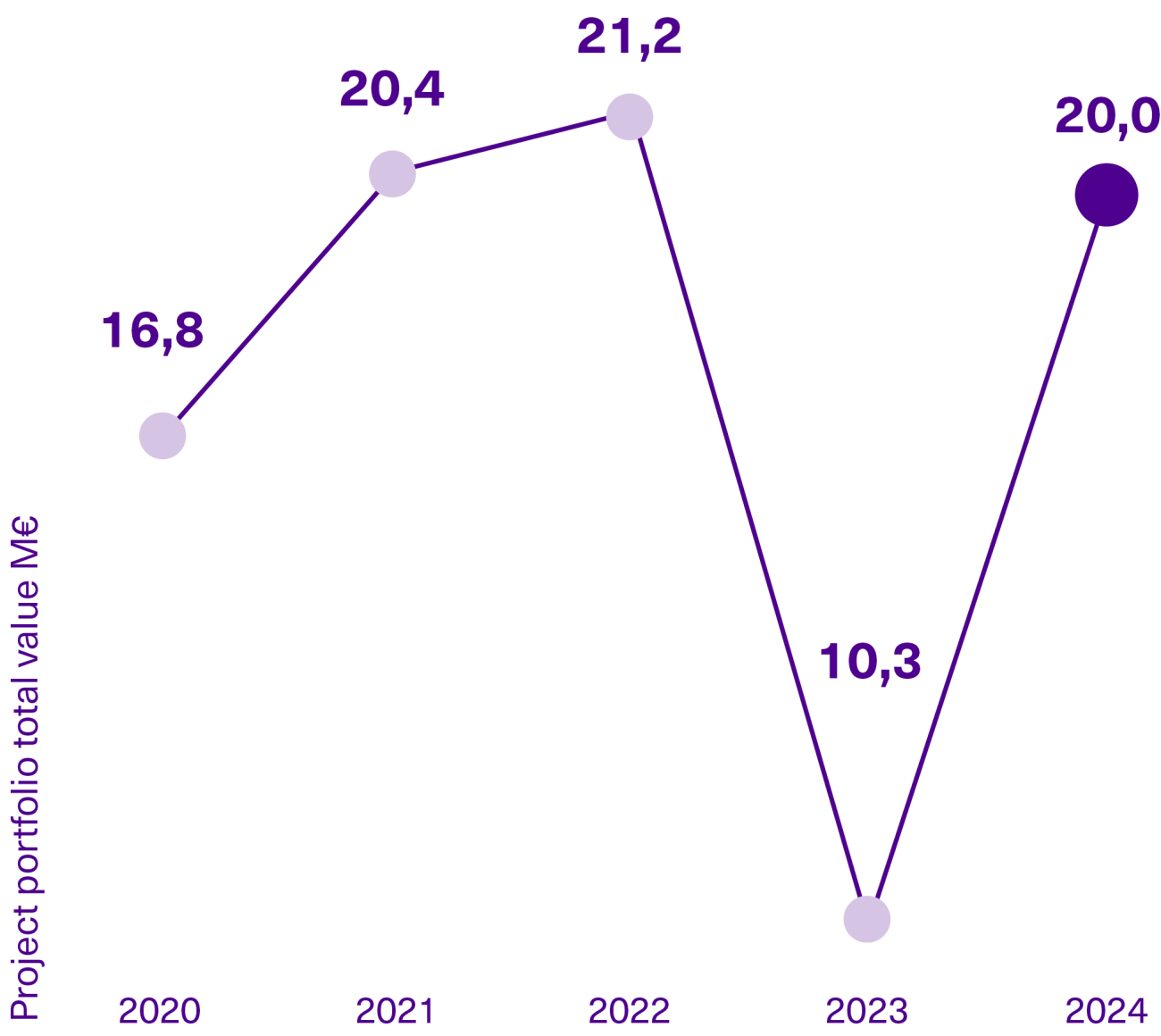
Project portfolio total value, million euros
2024: 20,0 M€
2023: 10,3 M€
2022: 21,2 M€
2021: 20,4 M€
2020: 16,8 M€
Source: Project management system Proti
RDI highlights of the year 2024


