New Brain-Inspired Chip Brings “Intelligence Everywhere” by Bypassing Energy-Expensive Cloud

Researchers at Tampere University and the University of Massachusetts Amherst have made a breakthrough in computing that could revolutionize internet-of-things (IoT) devices. The team has developed a new analog neuromorphic (lit. “brain-modeled”) system that allows devices to process information locally and efficiently, significantly reducing the need for constant battery-draining connections to cloud platforms.
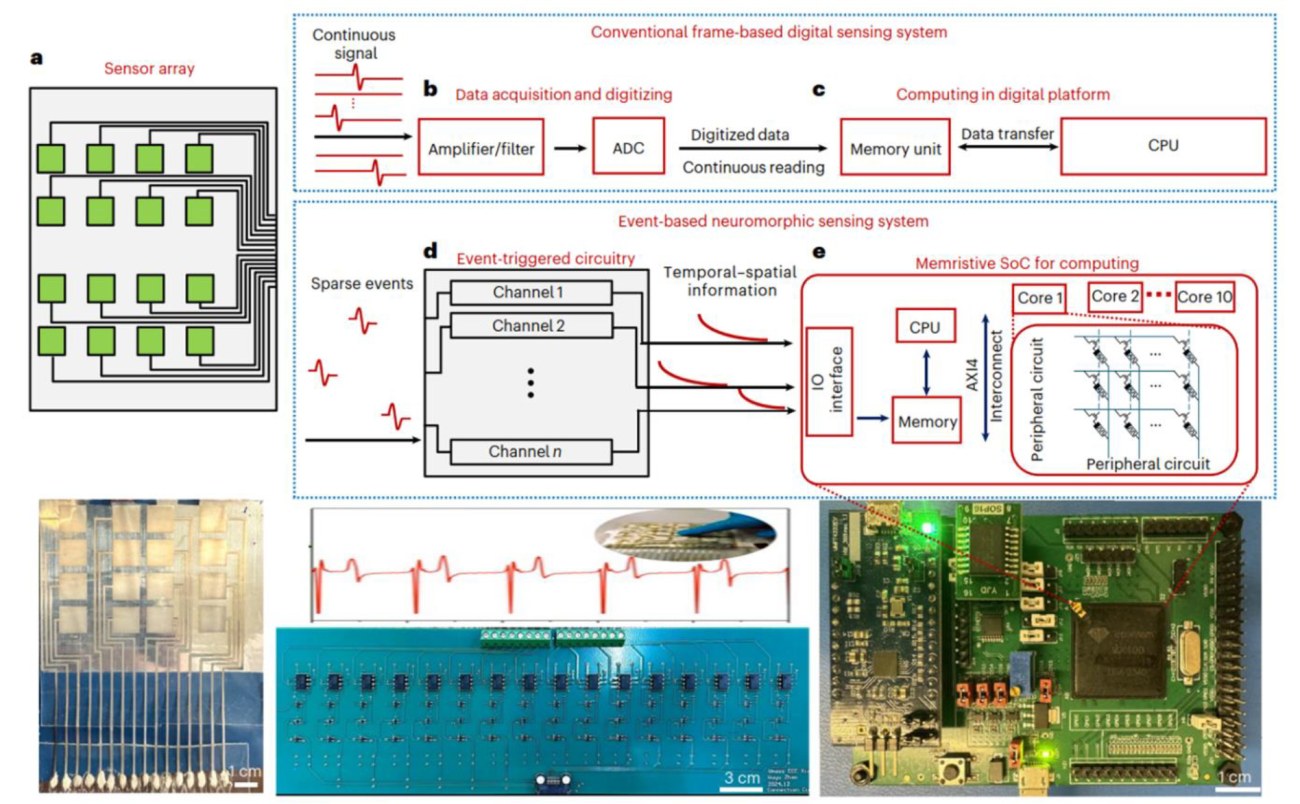
The rapid development of wearable health technology, autonomous cars, and smart robotics has considerably increased the number of sensor nodes in use, generating an enormous volume of data. In conventional systems, analog sensors collect this data and send it to a central cloud server to be processed. However, converting these signals to digital and transmitting them consumes massive amounts of energy and causes delays, restricting real-time decision-making.
Sayani Majumdar, leader of the research team from Tampere University, explains that this traditional method is highly inefficient. “Most of the sensor data sent to cloud is redundant and not used for any computing purposes,” says Majumdar. “It just consumes energy and communication bandwidth since there has been no way to make event-based, low power data processing at the sensor location. But we have now changed that.”
How the technology works
To address these challenges, the team joined forces under the IntelliSense project, funded by the Research Council of Finland and the U.S. National Science Foundation. They developed a novel hardware solution designed to mimic biological intelligence.
The system utilizes a flexible piezoelectric sensor array that generates discrete spike signals only when detecting a dynamic change in pressure. This is paired with a memristive system-on-chip (SoC) containing ten vector matrix multiplication computing cores, one RISC-V CPU, and essential peripheral digital circuits to classify these signals locally at the sensor node.
Results/future impact
Because the system relies on event-triggered circuitry rather than continuous reading, it is incredibly efficient.
“Implementing this time-surface-based approach, our system achieved a pattern recognition of 87–92%, with an estimated inference energy-delay product more than 17 times lower than that of conventional digital computing,” adds Majumdar. “Thus, we establish the viability of memristive SoCs for low-latency, low-power edge processing of asynchronous sensor data.”
This result makes highly integrated, low-power wearable systems an immediate reality. Further developments are presently underway to apply this technology toward safer autonomous vehicles, improved healthcare, and low-power unmanned surveillance systems.
Details are available in Nature Sensors paper, and from the authors (sayani.majumdar [at] tuni.fi (sayani[dot]majumdar[at]tuni[dot]fi))
“New Brain-Inspired Chip Brings Intelligence Everywhere"
Sayani Majumdar
Associate Professor, Thin Film Electronics
Fields of expertise: Micro and Nanoscale Solid-state Electronic Device design and fabrication; Characterization; Modelling; and Neuromorphic Computing.
Research topics:
- Neuromorphic Computing and Adaptive Sensing for Extreme Edge devices
- Low-thermal budget ferroelectric memories
- Atomic Layer Deposited (ALD) thin film devices
Author: Sujatro Majumdar


