Interpreters witness the richness of human life, says Anu Viljanmaa

From an early age, Anu Viljanmaa knew she wanted to pursue a career involving languages and intercultural communication, but she did not want to become a teacher. However, her career took an unexpected direction, and today she is a university lecturer in German language, culture and translation and oversees teaching in interpreting within the Master’s Programme in Multilingual Communication and Translation Studies (Moviko) at Tampere University.
Having lived in Germany from the age of eight until her late teens, Viljanmaa had an excellent command of German, alongside French and English. After upper secondary school, she was planning to spend a gap year working as an au pair in Brussels. One of the prospective host parents was an interpreter. Curious about the profession, she began looking into it.
“I quickly realised it was exactly what I wanted to do. I cancelled my au pair plans and applied for a degree programme in translation studies.”
What appealed to Viljanmaa about interpreting then, and continues to do so today, is the opportunity to facilitate communication between people and gain access to a remarkable variety of situations and environments. Interpreters’ work can take them from international meetings and delegation visits to hospital delivery wards and parents’ evenings at day-care centres.
“Interpreters gain a unique insight into how our society functions. Public service interpreters, in particular, come into close contact with the richness of human life. Seeing the challenges people face and how they overcome them helps to put one’s own problems into perspective. At the same time, interpreters have a front-row seat to the way society and its structures operate at the grass-roots level.”
After completing her bachelor’s and master’s degrees, Viljanmaa continued her studies in the European Master’s in Conference Interpreting (EMCI) programme, which was available in Turku at the time but is not currently offered anywhere in Finland. Plans are underway to launch the programme at Tampere University in the autumn of 2028.
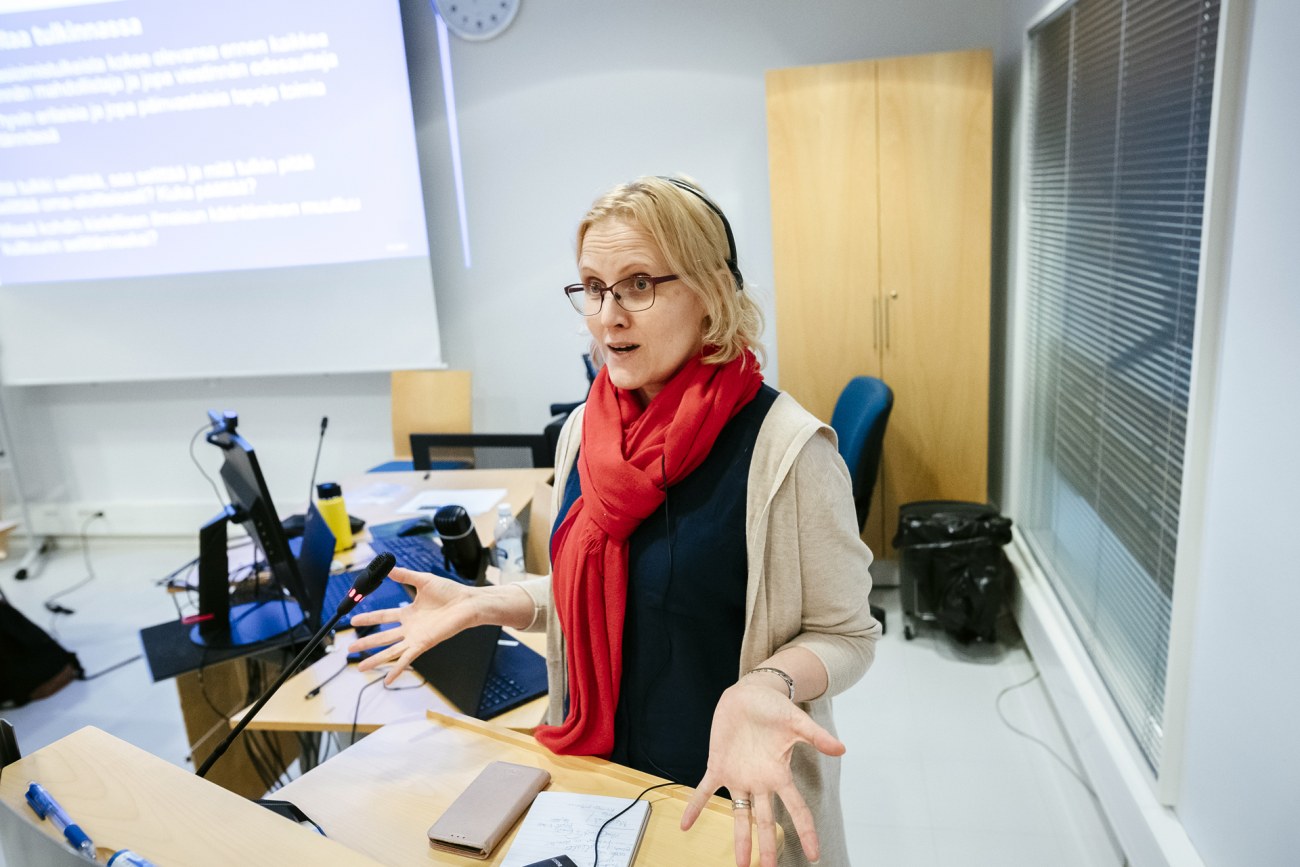 Photo: Antti Yrjönen
From assignments sent by post to on-demand interpreting
After graduating, Viljanmaa worked as a freelance interpreter while also serving as a project coordinator at a translation agency. Her career at Tampere University began when an hourly paid teaching position in interpreting became available.
“I was on maternity leave with my first child when a former fellow student asked whether I would be interested in co-teaching an interpreting course in English after she left the position. I thought teaching once a week would provide the perfect counterbalance to being on maternity leave.”
When the course ended, Viljanmaa was immediately offered another teaching assignment. One day at a campus restaurant, she ran into her former teachers in German translation and interpreting. One of them was approaching retirement, and Viljanmaa ended up stepping in as a substitute. She was appointed to a permanent position as a university instructor in 2013 and to the position of university lecturer in 2025.
Viljanmaa became a teacher after all, despite having once ruled out the profession. In fact, she finds great satisfaction in observing how her students’ minds work and seeing them grow into professionals.
“Some students immediately display a natural talent for interpreting: they are quick-thinking, articulate and able to remain calm under pressure. Others may not stand out to begin with and may struggle with nerves but still go on to build highly successful careers.”
Viljanmaa continues to work as an interpreter whenever she finds the time. She believes it is important to remain active as a practising interpreter so as not to lose touch with the realities of the profession. Keeping pace with developments in the field is equally important. While the interpreter’s primary task is to relay messages between people, languages continue to evolve and the contexts in which interpreters work are constantly changing. The official procedures that require interpreting also evolve over time, and technology plays an increasingly important role as remote interpreting and platform-based services become more widespread.
“Interpreters used to receive assignments by post, with details of where they were needed and for whom they would be interpreting. Now, interpreters can be booked through mobile applications for on-demand remote interpreting with no advance notice. The use of artificial intelligence (AI) in interpreting is also being piloted and tested.”
Interpreting is learned through practice
Interpreting students complete a wide range of practical assignments, as interpreting is a profession best learned through hands-on experience. In addition to mastering interpreting techniques, students must develop strong listening skills and observational skills.
“Interpreters cannot stop to think if they encounter an unfamiliar word. They have to stay focused and keep listening to what the speaker is saying. That is why students learn from the outset how to prepare for assignments and gather background information so that they can familiarise themselves with specialist terminology and anticipate the topics that are likely to come up. Interpreters are often very good at Trivial Pursuit because their work exposes them to such a broad range of subjects!”
Students specialising in English also gain practical experience by providing interpreting services at internal events at Tampere University. While these opportunities were initially limited to their own faculty, students are now increasingly being called upon to provide services across the University.
“I am very proud that our students are given real paid assignments at the University. They are so skilled that sometimes I have to remind clients that they are still students.”
Viljanmaa is pleased that there are plans to launch the European Master’s in Conference Interpreting (EMCI) programme at Tampere University in 2028. This intensive one-year programme will be open to graduates with a master’s degree and will prepare participants for careers as freelance interpreters working for organisations such as the EU institutions.
“The programme combines extensive practical training with theoretical studies focusing, for example, on the workings of the EU. For me, the EMCI programme in Turku was the incentive that drove me to finish my master’s thesis, as a master’s degree was a prerequisite for admission. Who knows, I might still be polishing my thesis had I not been so determined to join the programme.”
Self-reflection is an essential quality for interpreters
Viljanmaa never set out to become a teacher, nor did she imagine pursuing a doctorate or a career in research. However, while working at Tampere University, the idea of pursuing a doctorate came up regularly, and she eventually found a research topic that inspired her. Viljanmaa completed her doctoral dissertation, which examined the professional listening competence of dialogue interpreters, in 2020.
“I chose listening competence as my research topic because I believe interpreters influence the situations in which interpretation takes place. People often assume that interpreting can be practised through simulations that are based on prepared scripts. However, my experience as an interpreter had shown me that this is not the case, because the way an interpreter conveys a message affects the speaker’s response.”
Interpreting requires not only excellent listening and interpreting skills but also a commitment to high ethical standards and to earning the trust of clients. Interpreters hold considerable power, and part of their professional expertise is the ability to reflect critically on their own actions and question their understanding of a situation.
“Interpreters have a duty to convey what the speaker is actually saying, not what they think the speaker intends to say. They must actively set aside their own preconceptions.”
Today, Viljanmaa describes herself as an interpreting teacher with a special interest in listening and as a researcher of interpreting. Since completing her doctorate, she has explored topics such as interpreters’ experiences of working remotely through mobile applications.
Although applications and AI are reshaping the profession, Viljanmaa does not believe they will ever fully replace human interpreters.
“In complex situations, such as social work settings, it may be easier to communicate face to face through a human interpreter than remotely via an application. AI can work well in simple situations that are not emotionally charged, but it cannot listen in the same way as a human interpreter,” says Viljanmaa.
“I hope research will shed more light on everything that actually happens during interpreting and on the many factors that shape this intricate process. How are understanding and meaning constructed in the human mind during interpreting? Perhaps this will become an increasingly important area of research now that applications and AI are creating greater distance between human interpreters and the situations in which interpreting takes place.”
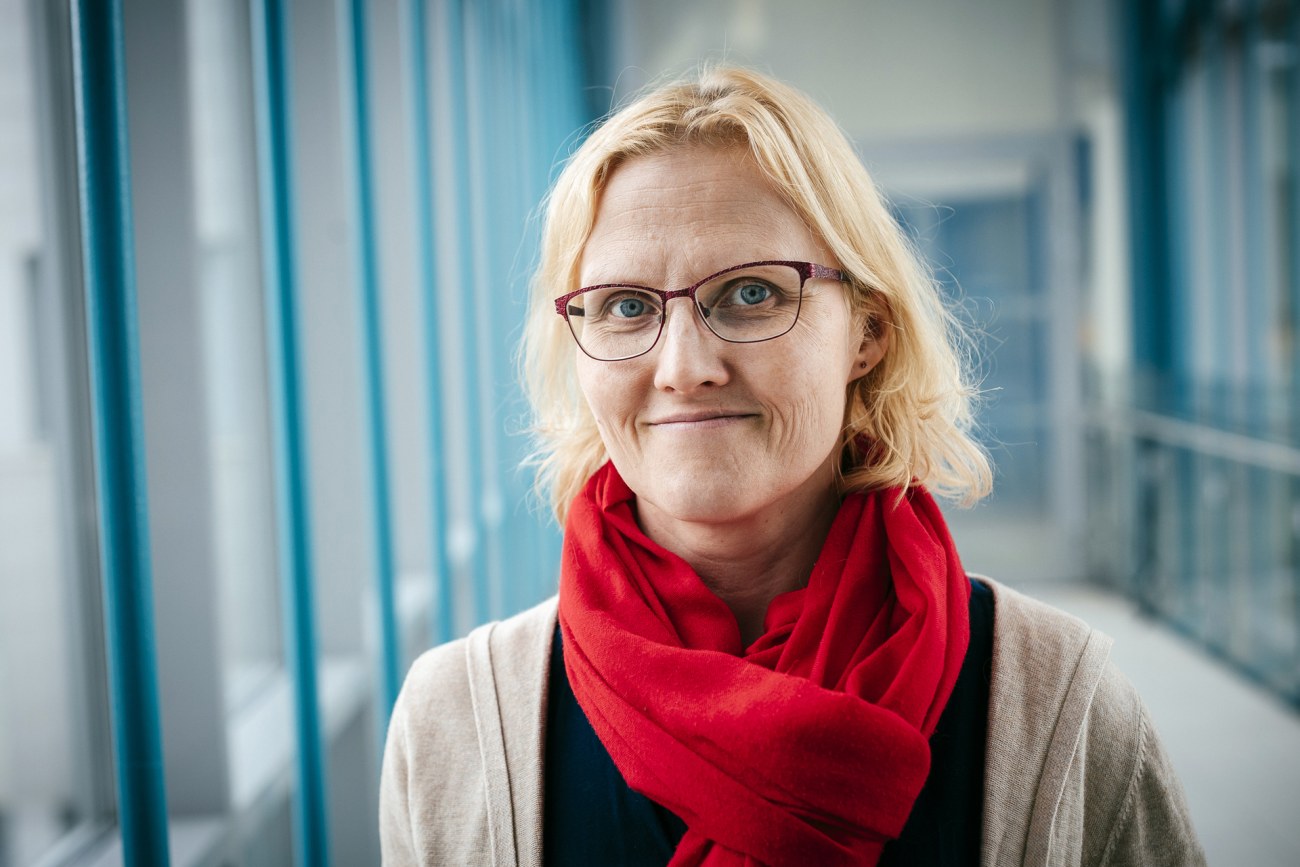 Photo: Antti Yrjönen
Anu Viljanmaa
Anu Viljanmaa has been teaching German and English interpreting at the University of Tampere, Finland since autumn 2009 and has been a full-time University Instructor since 2013. She defended her doctoral dissertation on the dialogue interpreter's professional listening competence in December 2020 (Viljanmaa 2020). In addition to her academic work she is an active, certified interpreter (EMCI).
Research topics
Elements and dimensions of the dialogue interpreter's professional listening competence.
Interaction in interpreter-mediated communication.
Use of On-Demand interpreting applications in public service settings.
Plural – Multidisciplinary research centre for languages and cultures
Author: Eli Harju


