Following in Epe Helenius’s footsteps toward a new music industry ecosystem

Kari “Epe” Helenius had been listening to music nonstop since the 1960s and had worked as a DJ. Gradually, it became clear to him that a career in music was the right path for him. He was about to turn 22 when he founded Epe’s Music Shop in Tampere. With London’s music culture as his guiding star, Helenius brought rock to Finland – at a time when, in London, you could actually help pack records for mailing yourself. The Tampere store wasn’t profitable for a long time, but mail-order ads in Musa magazine (later Soundi) kept the business afloat.
In 1977, Helenius founded Poko Rekords, a record label that produced punk music. In addition to punk, they sometimes produced other genres as well, whenever the mood struck them. One of the label’s early artists was the rockabilly band Teddy and The Tigers. While pop music was mainstream in Finland, rock remained at the heart of both the record store and Poko Rekords’ operations.
– The rock scene back then was under the radar. We did our own thing; we weren’t interested in what others were doing, Helenius explains.
Alongside Poko Rekords, Helenius founded Poko International in the early 1980s to bring foreign artists to Finland. Licensing agreements were handled quite differently back then than they are today: back then, you might go to London to ring managers’ doorbells and ask for a deal. Helenius brought bands like Twisted Sister, the Dead Kennedys, and Metallica to Finland. He even served as the Dead Kennedys’ stage manager for their first gig in Finland.
– By the end of the show, I was a total mess – that was just part of punk culture, Helenius chuckles.
Epe Helenius also played a key role in the creation of the Music x Media event. The event was produced for years on a volunteer basis before it became profitable.
– Those aiming to enter the industry need to network, keep their antennae up, communicate, and be interested in what others are doing. Opportunities for collaboration emerge over time as you get to know people. Ultimately, a lot also depends on chance and personal chemistry. Openness can lead to invaluable partnerships, says Helenius.
Strength through collaboration in the music industry
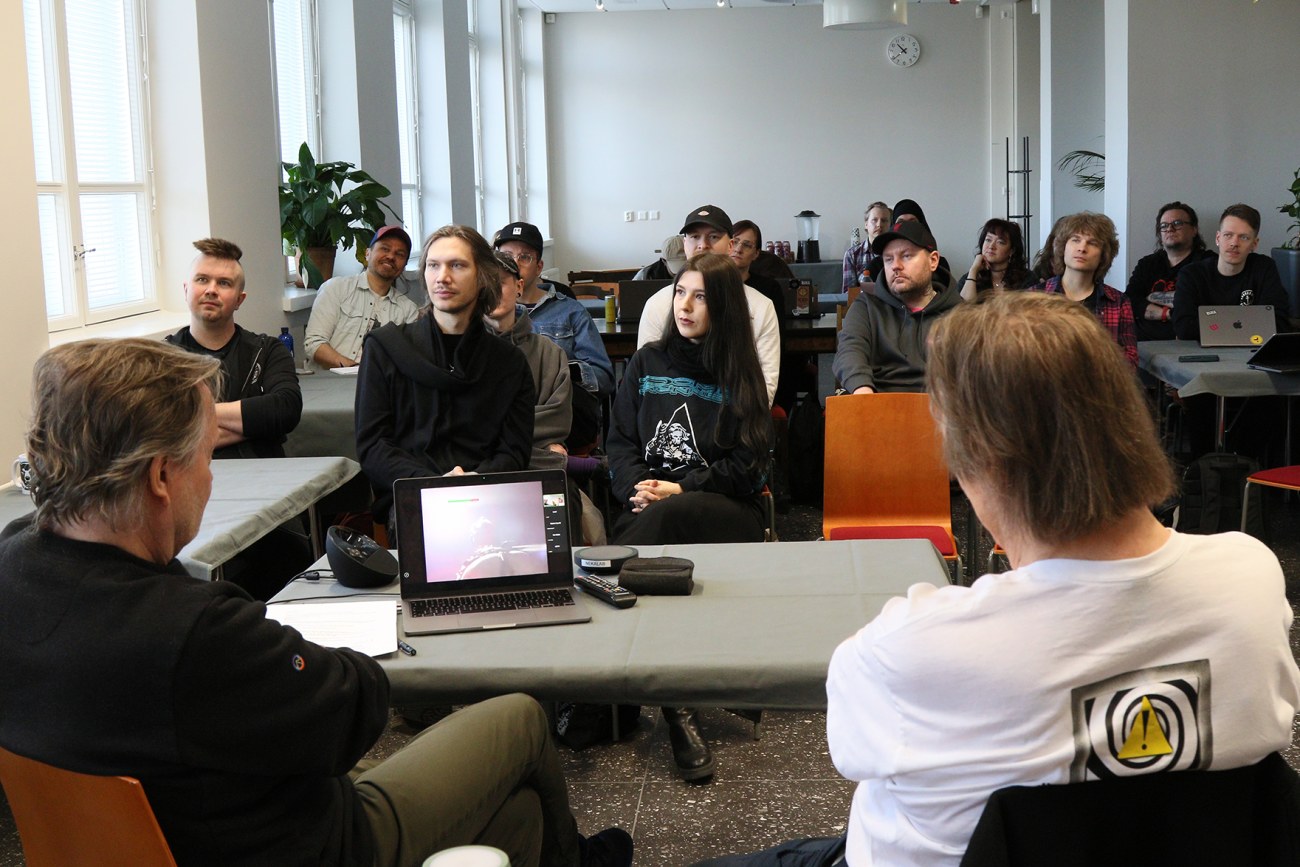
Helenius spoke about the history of the music industry in Tampere to an attentive audience at the Nekalab Cultural Center. The audience consisted of participants in the Distrec – Viistokatu Back project, people from the music industry who want to network and create a new kind of ecosystem for the sector. Harri Karvinen, a senior lecturer at Tampere University of Applied Sciences, interviewed Helenius, and the participants also had plenty of questions for the veteran, who has been retired for about five years.
The name of the training project has a connection to the history of rock music in Tampere.
– Back in the day, musicians from Tampere would gather at Tillikka restaurant, and as evening fell, they would head to the Yo-talo on Kauppakatu, walking right down Viistokatu, Karvinen explains.
The training program was designed by mapping the participants’ needs in collaboration with Pauliina Airaksinen and Carolina Pajula.
– We were already aware of most of the field’s needs during the project’s application phase. People working in the creative sector often need peer support to develop their professional identity. I strongly believe that if we, the trainers, are excited about this, that enthusiasm will rub off on the participants – and vice versa, of course. When you enjoy your work, you get the best possible results, Karvinen says.
According to Karvinen, the music market – especially for mainstream pop music – is quite closed off, and it’s difficult to break into it, even if you’re already active and have a track record.
– In a situation like this, a regional ecosystem that collaborates closely can create its own market niche. In November, we’ll be looking to Gothenburg for inspiration, where the local ecosystem has boosted artists’ opportunities both locally and internationally and brought an interesting number of music industry startups to the city. At the same time, the City of Tampere is participating in the Sonic project, which aims for similar goals. The ultimate goal could be for Business Tampere to take local rock music under its wing alongside the film and gaming industries.
Peer support, networks, and collaboration
One of the program participants, Turkka Vuorinen, became fascinated with keyboard instruments after seeing Europe’s music video for “The Final Countdown.” His first band formed back in elementary school during music class.
– I gradually started making my own music and recording it. Eventually, I ended up studying music production at PIRAMK University of Applied Sciences and became a professional in the field. My main job these days is composing music and doing sound design for TV shows. I was born in Tampere and am deeply attached to my hometown.
Vuorinen regularly participates in various training programs to update his skills.
– Since I’m also actively working as an indie artist, the training offers insights into the music business from both industry influencers and fellow students. It’s nice to be inspired by what others are doing and to get ideas for my own projects. I also find expanding my networks important and want to get to know local players. Perhaps in the future, collaborations and joint projects will emerge with these new contacts.
Music has always been important to Veera Kolehmainen. However, it only became a part of her professional life when she helped establish a new event space in Savonlinna, in an old movie theater. At Savonlinna’s Kulttuurikellari, she served as executive director, a volunteer, and on the board for nearly ten years.
– My life has long been surrounded by music creators and musicians, who from time to time also ask for my help. My background is in the visual arts, and at heart I am a creative problem-solver. This spring, I completed my studies in music management at SASKY and decided to pursue a more professional career in the music industry. I currently live in Helsinki and am participating in the Distrec project from there.
Kolehmainen believes Distrec offers the kind of support she needs at this stage of her career: networks, peer support, new ideas, and insights into current trends in the industry.
– I expect the training to strengthen my sense of belonging to the industry community. I also hope that my understanding of the field will grow even further, and that this will lead to more practical job opportunities.
Maria Mäenpää also hopes that the training will involve sharing challenges, seeking solutions, and moving forward together.
– It would be nice to find songwriting partners and a producer with whom I could grow together.
Mäenpää wants to be involved in developing the music scene in Pirkanmaa.
– I graduated in December 2024 from the songwriting program in Ikaalinen (SASKY), and I make my own music under the name Myyni. In my youth, I played the piano and sang. I’ve taken many different courses related to music-making and have made music with a few artists. I am interested in developing the field and fostering collaboration among music creators in the Pirkanmaa region.
Believe in your own thing
For today’s practitioners it is important to understand the twists and turns of history in order to comprehend the current world. The winds of change have been blowing strongly in the music industry in recent decades, and in music distribution, for example, there has been a shift from physical products to mostly digital ones.
Some phenomena from past decades are also making a comeback, as the course of history is not linear. A good example of this was the lively discussion about vinyl records that took place at the event. There were strong advocates for vinyl among the participants. The way music is packaged matters a lot to them: as a mood-setter, a grounding element, and a visually beautiful object.
Even though the industry is changing, one thing will not change, according to Epe Helenius:
– You have to do your own thing and believe in it. You shouldn’t run after anyone else. If you change your own thing to find a bigger audience, that’s the beginning of the end.
Distrec – Viistokatu Back
An ESF+ continuing education project co-funded by the EU, running from spring 2026 to spring 2027. The project is coordinated and implemented by Tampere University of Applied Sciences. Approximately 40 participants.
The project trains music industry professionals and aspiring professionals to operate in the national and international music business environment, such as in the production and distribution of recordings, music publishing, artist management, and various media publications focused on the music industry. The project’s concept can be applied across Finland, particularly in larger cities. The project is based on the Music Agent training program (2024–2025).
The project will result in a report on the development needs of the music industry ecosystem and a piloted continuing education program for industry professionals. The results will be available to all industry professionals and will be disseminated through industry networks, events, and publications.

Author: Emmi Rämö


