

Background
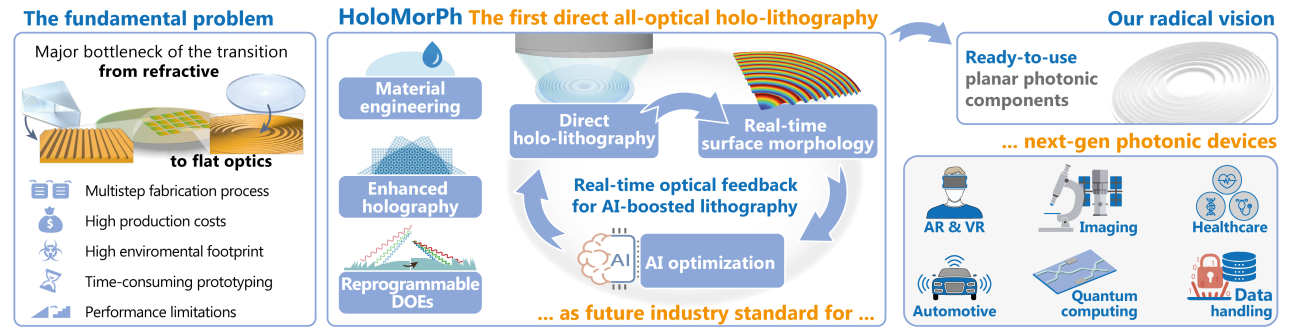
Planar photonic components—or flat optics—promise major advances in miniaturized imaging, displays, and light manipulation. However, their widespread adoption is severely limited by current fabrication methods, which rely on expensive equipment, multistep processes, toxic chemicals, and high energy consumption. Conventional lithography (optical, e‑beam, nanoimprint, DLW) remains costly, environmentally burdensome, and difficult to scale. Additionally, standard fabrication produces static devices with fixed optical functions, preventing real‑time optimization or rapid prototyping of individualized designs. Meanwhile, emerging technologies such as augmented reality, quantum computing, LiDAR, and light‑powered IoT require highly efficient, customizable, and potentially reprogrammable optical elements.
Recent advances in photomorpher materials, capable of reshaping their surface morphology when exposed to structured light, open a pathway to simplified, mask‑free fabrication. Yet existing photomorphers suffer from absorption in the visible range, low refractive index, and limited resolution, while current holographic illumination methods lack the spatial precision and real‑time feedback needed for high‑quality devices. At the same time, AI‑assisted lithography, although increasingly used in microelectronics, has never been applied to dynamically guide all‑optical, surface‑morphing processes. HoloMorPh addresses all these gaps by merging material innovation, vectorial holography, meta‑optics, and cloud‑based AI to enable a fundamentally new fabrication paradigm.
Goal
Funding
Funding source
European Innovation Council (EIC)
Coordinating organisation
University of Naples Federico II - Universita Studi di Napoli, Federico II – UNINA, Naples, Italy
People
Arri Priimägi
Professor Arri Priimägi
Farhad Ghasemzadeh
Doctoral Researcher Farhad Ghasemzadeh
Partners
Tampere University – Tampereen Korkeakoulusaatio sr – TAU, Tampere, Finland
Inesc Microsistemas e Nanotecnologias – Instituto de Engenharia de Sistemas e Computadores Para Os Microsistemas e As Nanotecnologias – INESC MN, Lisbon, Portugal