“We should not overestimate our own abilities in what we know,” says Professor Jarkko Jokihaara

What are your main research interests?
I focus on clinical medicine, that is, patient studies. My field of research is hand surgery, meaning the treatment of disorders in upper extremities. My main areas of interest are particularly peripheral nerve disorders, but also congenital hand anomalies as well as amputation and crush injuries. In surgical research, surgery is often compared with other treatment options, so through this topic I also study non-surgical alternatives. In addition, evidence synthesis is an important part of the work.
What makes your research significant?
For my research to be significant, the research question must be important and require an answer. The question starts with the patient and their condition, and the purpose of the research is to help that person.
Furthermore, the answer – the research result – must be convincing. Since the answer can be anything, the research methods must be good enough for the result to be reliable. The answer will guide future actions, and a wrong answer will lead the work astray.
Clinical research is important only if it benefits patients or works preventively so that becoming a patient can be avoided. Decision-making in clinical practice is difficult because all healthcare interventions involve both benefits and harms or burden. The aim of my research is that its results help both healthcare professionals and patients reach a well-founded mutual understanding about treatment. A great deal of medical research ends up being of little practical use, either because of the topic chosen or the methods applied. I try to avoid that.
What does it mean for your discipline that you were appointed a professor?
In my view, we should not overestimate our own abilities in what we know. As a professor, I want to avoid promoting things about which we do not yet know enough – and there are major gaps in our knowledge and a critical shortage even of basic, essential research findings. Since we do not know enough even about many established matters, this foundation should be strengthened before we start exploring new issues.
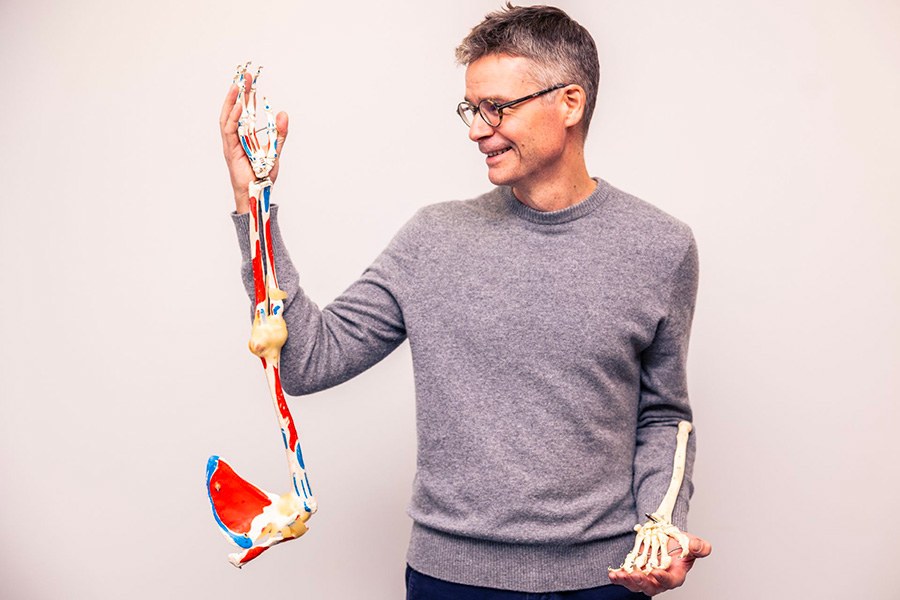
I will probably never invent anything new myself, nor do I try. As a person, I am more lo-tech than hi-tech. However, I am convinced that things must be changed when new knowledge emerges. In medicine, even uncertain knowledge that something is highly beneficial is unfortunately enough to justify starting to do it, and it may become established practice without proper research evidence. We need a better understanding of the intersection of benefits and certainty of knowledge. I think it is important to describe uncertainty by explaining what certain assumptions are based on and how reliable they are.
What would you want to study next and why?
I will continue doing research to improve the treatment of problems in the upper extremity because that is my task.
However, I believe we should also study what patients – and, on the other hand, society at large – expect from the healthcare system, and what factors influence the fulfilment of these expectations. It sounds vague and lofty, but in simple terms this means, for example, finding out whether taxpayers’ views on optimal healthcare change if their close relative becomes a patient. The issue can also be approached by studying how much each person is willing to do or give up to gain health benefits.
If we know what people most expect from healthcare – regardless of traditional boundaries – we can better determine where resources should be allocated to achieve the desired outcome. Traditionally, research that is framed in this way has not been done because it is entirely possible that, as a result, some of the money flowing into the system would justifiably be redirected elsewhere.
What do you do in your free time?
I have been interested in stamps for a long time. I have a collection, but I do not know how many stamps I have because I do not organise them. For me, stamps are above all a pleasant pastime and a counterbalance; nothing special that should be taken too seriously.
Another long-standing hobby of mine is calligraphy. In that, I am an eternal beginner. Perhaps what fascinates me is that you do not have to invent the subject of the art because letters already exist.
Welcome to the inaugural lectures of the new professors on 11 May 2026
Jarkko Jokihaara
- Graduated as Licentiate of Medicine from the University of Tampere in 2005.
- Completed his doctoral thesis at the University of Tampere in 2007.
- Worked as a postdoctoral researcher at the University of British Columbia from 2007 to 2009.
- Qualified as a specialist in hand surgery at the University of Tampere in 2016.
- Appointed as Docent of experimental surgery at the University of Tampere in 2017.
- Completed a degree in clinical epidemiology at McMaster University in 2018.
- Appointed Professor of Hand Surgery at Tampere University on 1 May 2025.


