Taming the energy hogs – Professor Pekka Jääskeläinen develops sustainable computing solutions

What are your main research interests?
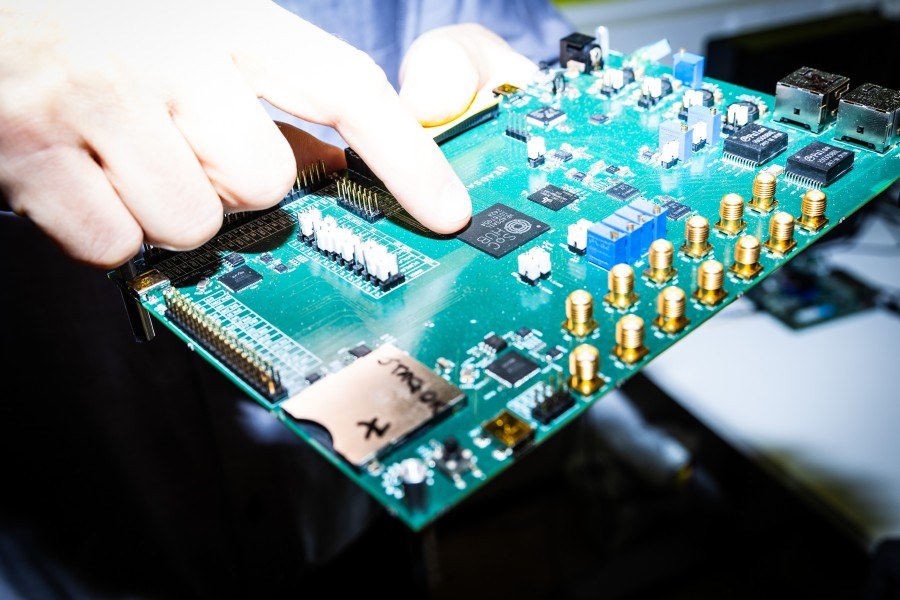
My research area is computer engineering, which focuses on enhancing computational efficiency. In practice, we work to improve application performance and reduce the power consumption of computing systems.
My research group specialises in customised parallel computing, spanning all the layers of the computing system from logic gates and specialised processor architectures to the application level.
What makes your research significant?
Computer engineering underpins nearly every aspect of modern life. Without processors, our daily activities would grind to a halt. Although it may sometimes seem that the most significant research innovations – particularly in processor technologies – occurred between the 1960s and the 1980s and that new breakthroughs are now exceedingly rare, I believe research in this field remains essential, if only to safeguard Finland’s security of supply and preserve national expertise.
Information technology also entails risks and drawbacks that affect our brains, daily routines, democracy and even the future of our planet. From the perspective of environmental preservation and the accelerating pace of climate change, enhancing the energy-efficiency of computing systems and maximising the use of existing computers are key objectives. Current AI algorithms, particularly those that rely on brute-force methods, are notoriously energy-intensive, and their use is expanding rapidly. I hope that by releasing our research results freely into the public domain, we can help to mitigate these drawbacks as much as possible.
Where do you draw inspiration for your work as a professor?
It is a joy to witness and support the professional growth of my enthusiastic and talented students as they progress into MSc graduates, researchers and specialists. Exploring new technical topics together with them through dialogue is, without doubt, the most rewarding aspect of my role.
On a broader level, I am inspired by the thought that I am helping to make Finnish society a better place by conducting original research and educating specialists who go on to ensure that Finland can continue to export more than just low-value, minimally processed bulk goods.
What would you want to study next and why?
My doctoral students and I are exploring potential new research directions, most of which relate to improving the resource efficiency of computing.
The utilisation rate of existing computers can be increased through advances in software technology. In a current dissertation project focused on this topic, we aim to maximise the flexibility, usability and security of this type of volunteer computing, which has already proven useful. In practical terms, this involves harnessing the computing power of idle computers to assist in different tasks, such as identifying new medicinal molecules.
This research could reduce the number of new computers that need to be manufactured, thereby helping to conserve Earth’s depleting mineral resources and ease the geopolitical tensions associated with their extraction. This work has the potential to improve both ecological and economic sustainability on a global scale, while the technology itself offers substantial business potential.
Another example of our current research is the development of open-source computer-aided design software. The vulnerability of the microchip supply chain is a growing concern. My research group participates in an EU-funded project that aims to strengthen Europe’s autonomy and internal capacity in chip design.
The goal of this project is to preserve and strengthen Europe’s capacity to design computing hardware independently of global superpower politics. For us, this means developing government-independent, open-source design software that matches the capabilities of proprietary, closed-source solutions.
What do you do in your free time?
I am almost obsessively committed to meeting my weekly exercise goals, having seen the enormous impact physical activity has on my overall well-being. I mainly exercise by going to the gym, running, skiing and playing badminton. I also enjoy reading, which provides a welcome counterbalance to working at a computer and clearly improves my concentration.
In recent years, ice swimming followed by a hot sauna by Lake Suolijärvi in Hervanta has become one of my favourite ways to relax, sometimes even a couple of times a week.
Welcome to the inaugural lectures of the new professors on 11 May 2026
Pekka Jääskeläinen
- Born in Rovaniemi, Finland.
- Graduated with a master’s degree in technology from the former Tampere University of Technology (TUT) in 2005.
- Completed a doctoral degree in technology at TUT in 2012.
- Holds a docentship at the University of Oulu, awarded in 2017.
- Has worked as a visiting researcher at King Juan Carlos University (Spain) in 2009 and 2010, at Leibniz University Hannover (Germany) in 2017, and at Eindhoven University of Technology (the Netherlands) in 2019.
- Principal Engineer at Intel from 2022 to 2025.
- Joined Tampere University as an Assistant Professor (tenure track) in 2019.
- Leads the Customized Parallel Computing (CPC) research group at Tampere University.
- Was appointed as Professor of Computing Sciences at Tampere University in May 2025.


