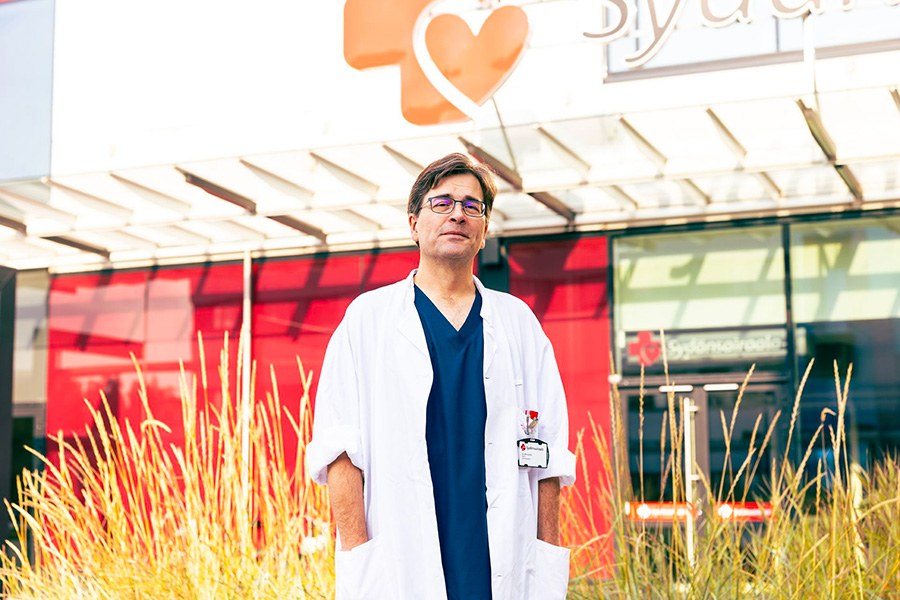
Responsibility arises through participation, says Professor of Cardiothoracic Surgery Ari Mennander

What are your main research interests?
My research focuses on patient safety in cardiothoracic surgery. I examine how surgical procedures affect patients and explore the personal significance of surgery from the patient’s perspective. Another key area of interest for me is tissue research. Since 2006, I have collaborated with pathology professors at Tampere Heart Hospital, which is part of Tampere University Hospital, to study surgically removed tissues. I also conduct experimental research in collaboration with researchers at Tampere University.
What makes your research significant?
Surgical procedures generate data that can be utilised in register-based medical research, both in Finland and internationally. This global perspective expands the patient dataset and enhances the impact of such studies. Tissue research allows for a more precise analysis of a patient’s condition than symptom-based assessments alone. It also supports the identification of the most appropriate surgical and postoperative monitoring strategies to achieve optimal outcomes. Mastery of surgical technique, technical execution, the use of surgical instruments and teamwork in the operating theatre all strive towards perfection, seamless coordination and – above all – a successful outcome.
A surgical operation is not only a form of treatment, but also a means of gaining deeper insights into diseases and their postoperative care. Certain diseases share similar risk factors. This appears to be the case, for instance, with cancers and cardiovascular conditions. When patients are hospitalised with a heart condition, identifying these risk factors enables treatment approaches that support not only their cardiac health but also their overall health. Thus, the benefits of research go beyond improving recovery after surgery, as they also contribute to broader health promotion among patients. Ideally, research helps to prevent unnecessary medical interventions and surgical procedures. The paradox of surgical research is that it often seeks to reduce the need for surgery altogether.
Where do you draw inspiration for your work as a professor?
My inspiration stems from the opportunity to engage in the full spectrum of activities at both Tampere University Hospital and Tampere University, conducting research, providing patient care, and participating in meetings and conferences. Cardiothoracic surgeons do not operate alone, just as researchers rarely work in isolation. Collaboration and teamwork are central to both fields. This is important, as a sense of responsibility often develops through active participation. In my view, professors have a responsibility to foster a sense of community and to recognise the contributions of other team members.
It is also inspiring when students take initiative, for example, by posing thought-provoking questions that may even spark new initiatives or open up fresh research directions.
What would you want to study next and why?
One of the major unanswered questions in cardiothoracic surgery is why some individuals develop an aortic dissection, a tear that extends along the length of the aorta. Aortic diameter, when considered in isolation, is not a particularly reliable predictor of this risk. Despite this, it is widely used as an indicator because ultrasound and CT imaging can easily detect when the aorta exceeds five centimetres in diameter, typically prompting surgical intervention. Still, aortic diameter is not the only risk factor. Additional clues are emerging from individual patient cases, register-based studies and tissue research. While high blood pressure and genetic predisposition are known to increase the risk, they do not tell the whole story. Research on the aorta continues to be an exploration of uncharted territory.
What do you do in your free time?
I actively maintain my well-being. I enjoy jogging and spending time outdoors. I often listen to classical music, as it helps me unwind and recharge after work. I also like to attend concerts at Tampere Hall. Lately, I have been especially drawn to the music of Arvo Pärt, although I also enjoy Shostakovich. Beyond music, one of my favourite pastimes is reading.
Welcome to the inaugural lectures of the new professors on 11 May 2026
Ari Mennander
- Received the Licentiate of Medicine degree from the University of Helsinki in 1992.
- Received the Doctor of Medicine degree from the University of Helsinki in 1993.
- Qualified as a Specialist in General Surgery in 2000.
- Qualified as a Specialist in Cardiothoracic Surgery in 2004.
- Appointed as Docent of Cardiothoracic Surgery at the former University of Tampere in 2006.
- Completed the Graham Fellowship Programme, awarded by the American Association for Thoracic Surgery, at Mayo Clinic in Minnesota, USA, in 2005–2006.
- Appointed as Research Director at Tampere University and Head of Department at Tampere Heart Hospital in 2022.
- Appointed as Professor of Cardiothoracic Surgery at Tampere University on 1 July 2025.


