Professor Roel Pieters wants humans and robots to be better partners

Imagine a modern car factory: The assembly hall is a fascinating blend of technology and precision, with sleek, automated robots moving seamlessly, almost as if they think for themselves. These robots assemble car parts, weld, paint and perform quality checks with incredible accuracy. It is a harmonious dance of machines, where efficiency and innovation come together to create the cars of tomorrow.
Behind this apparent effortlessness lies a significant amount of human effort. Professor Roel Pieters knows that every move a robot makes requires a complex and extraordinary mix of mathematics, mechatronics and programming. For years, his work has been guided by a single goal: to find new ways for humans and robots to work better together.
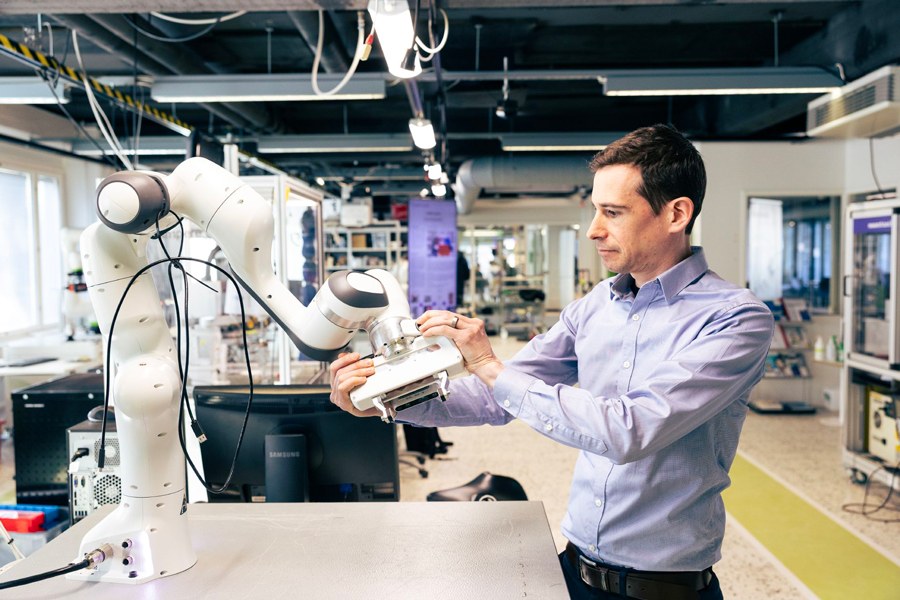
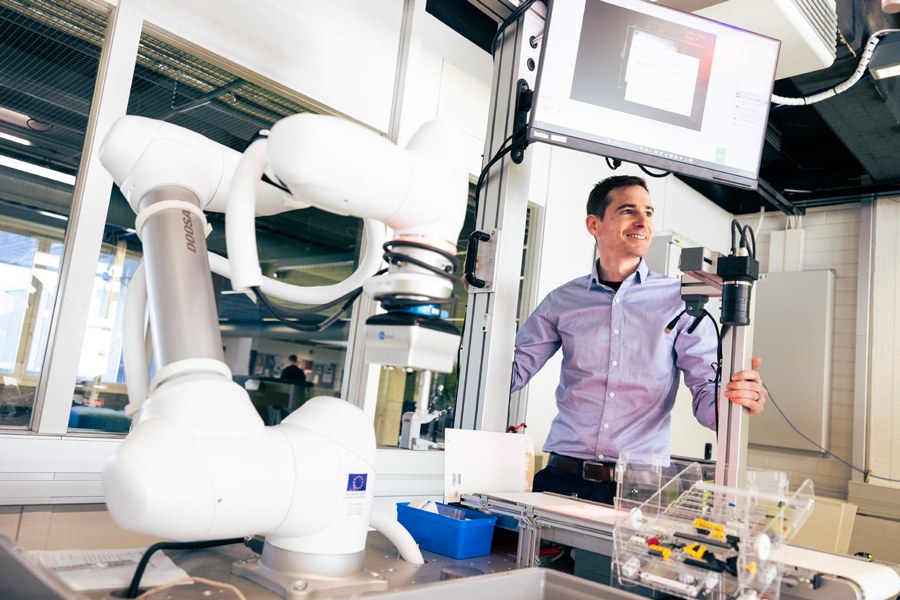
Roel Pieters was recently appointed as a Professor of Intelligent Machines and Robotics at Tampere University. He also leads the Cognitive Robotics research group, which focuses on robotics and AI. The group studies how to equip robots with the skills and cognition to execute tasks and how humans and robots can work together.Their work primarily involves applied research on (AI) algorithms and programming solutions. They also conduct use case demonstrations in manufacturing, inspection and maintenance and for tasks such as picking and placing, assembling and visual inspection.
“We aim to achieve natural interaction and collaboration between humans and robots, so that time-consuming and complicated programming efforts can be avoided and that communication between humans and robots can be as seamless as communication between humans,” he says.
Pieters thinks that the visual-language-action model is the most exciting application. These models integrate images with text or speech to generate robot action commands directly, eliminating the need for extensive manual coding. His research group is exploring the development of such models for industrial use.
“This approach has great potential for enabling robots to interpret and respond to natural human language requests. The challenge that remains is the substantial amount of data and energy needed to develop and train such models.”
Teaching robots to understand speech
In his work, Pieters focuses on trust, cognition and communication between humans and robots, aiming to improve safety. Today, most industrial robots are kept separate from humans in factories for safety reasons.
“We are focused on making human-robot collaboration possible in a safe and effective way by utilising different technologies, such as cameras for visual perception, speech recognition and Augmented Reality. We want humans and robots to work together, with robots serving as assistants to people,” he says.
Recently, robotics research has evolved to include advanced AI techniques such as deep neural networks and large language models (LLMs) that enhance the capabilities of robots in industrial environments.
“Our latest work has shown that LLMs can be used as a tool to program robots using natural language. This means a person can speak to a robot in natural language, instructing it on what to do, and the robot will do it!”
Pieters knows robotics and AI divide people, with fears that AI-driven robots could replace humans. He emphasises that robots are especially useful for dangerous, dirty and unpleasant jobs that humans prefer not to do.
“However, programming robots and ensuring reliable interaction remains challenging. Although AI can assist with perception and decision-making, it still has its limitations. People need to be trained to use these systems, and safety remains the most important factor,” he underlines.
Educating new talents for industry
Pieters is excited about his new role as a professor because it allows him to delve deeply into particular topics. He enjoys combining his research with education and supervising motivated and talented students in their research endeavours. He often involves students in his research, so that they can offer different perspectives and try things out in the lab.
In August 2023, Tampere University became the first university in Finland to offer a master’s programme in robotics. Pieters is part of the coordination group of this degree programme, led by Project Manager Jyrki Latokartano. The studies are carried out in active and close cooperation between two faculties, the Faculty of Engineering and Natural Sciences (ENS) and the Faculty of Information Technology and Communication Sciences (ITC). Two years ago, 40 students enrolled in the degree programme, and the first ones are now about to start their bachelor’s thesis.
“We have got very good, enthusiastic students! From the very beginning, we aim to provide them with hands-on experience using real robots in the laboratory. I guess it is fair to say that our students will be the new talents Finnish industry has been longing for.”
At the faculty level, various collaborative projects and initiatives are underway, such as Sustainable Industry X (SIX) with local industry players. Students benefit from this collaboration through summer jobs and internships.
Pieters also enjoys participating in major European research projects, such as OpenDR and JARVIS. In addition, he contributes to SustAInLivWork, a Centre of Excellence in AI located in Lithuania.
Finding a personal and professional home in Finland
Even as a child, Roel Pieters enjoyed taking things apart and putting them back together, like the Lego Technic series. He has always loved building things that can move. Robotics and automation came along later and completely captivated him.
Pieters began his studies with a bachelor’s degree in robotics at the Zuyd University of Applied Sciences. He then completed his master’s degree and PhD in robotics and robot vision at the Eindhoven University of Technology.
However, that was not enough for him. The more he learned, the more he wanted to know. He decided to take a big leap and head abroad. His first stop was ETH Zurich in Switzerland, where he studied microrobots for medical purposes. Then, in 2016, he ended up in Finland.
“Well, I had a Finnish girlfriend. It was quite likely that we would end up living in Finland at some point,” he says.
In Finland, he spent his first year as a postdoc at Aalto University. He joined the then-Tampere University of Technology in 2017 as an Assistant Professor and started the Cognitive Robotics research group.
Today, he lives in a countryside house with a big garden in Vesilahti with the same Finnish girlfriend, now his wife, and their children, aged 5 and 3.
“The Finnish culture, attitude and lifestyle suit me. Everything here is down-to-earth, modest and nature-based. I probably won’t be moving anywhere from here,” Pieters says with a smile.
Roel Pieters
- Professor of Intelligent Machines and Robotics, Tampere University, 2025–
- Leader of the Cognitive Robotics research group, Tampere University of Technology/Tampere University, 2017–
- Postdoctoral researcher, Aalto University, 2016–2017
- Co-founded spinoffs MagnebotiX AG and OphthoRobotics AG from ETH Zurich, 2014–2016
- Postdoctoral researcher, ETH Zurich, Switzerland, 2013–2016
- PhD in robotics, Eindhoven University of Technology, Netherlands, 2013
- MSc in robotics, Eindhoven University of Technology, Netherlands, 2009
Author: Anna Aatinen


