Professor Paola Vivo pioneers sustainable photovoltaic solutions

Paola Vivo’s interest in solar technology began right after graduation. In 2006, she joined the photochemistry research group at the then Tampere University of Technology as a doctoral researcher, at a time when the group was just starting to focus on low-cost organic photovoltaics. Photovoltaics refers to the technology that converts sunlight directly into electricity using solar cells made of semiconductor materials.
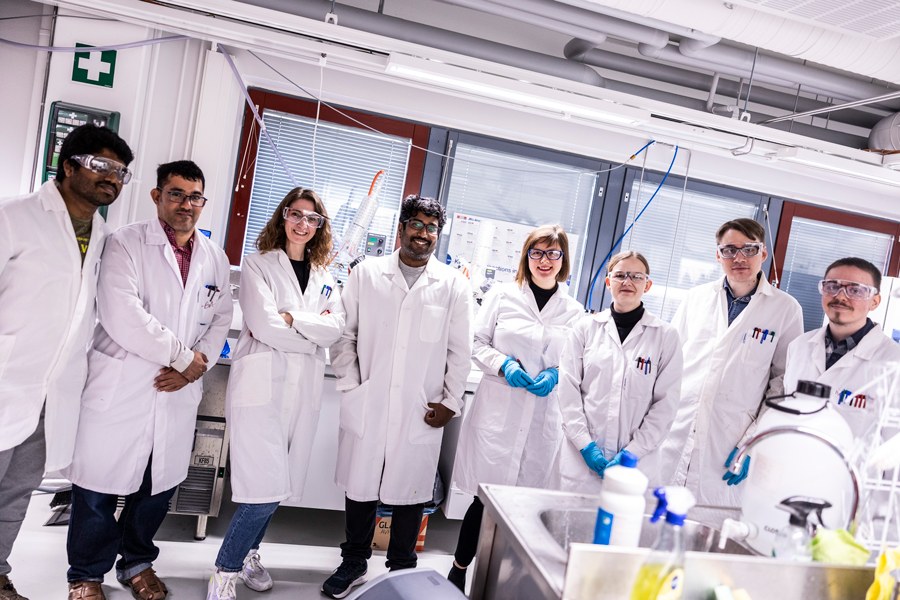
Today, Paola Vivo leads the Hybrid Solar Cells research group comprising nearly 20 researchers at different career stages. The group has access to state-of-the-art facilities, acquired with support from Tampere University, the Flagship for Photonics Research and Innovation (PREIN), and continued external funding.
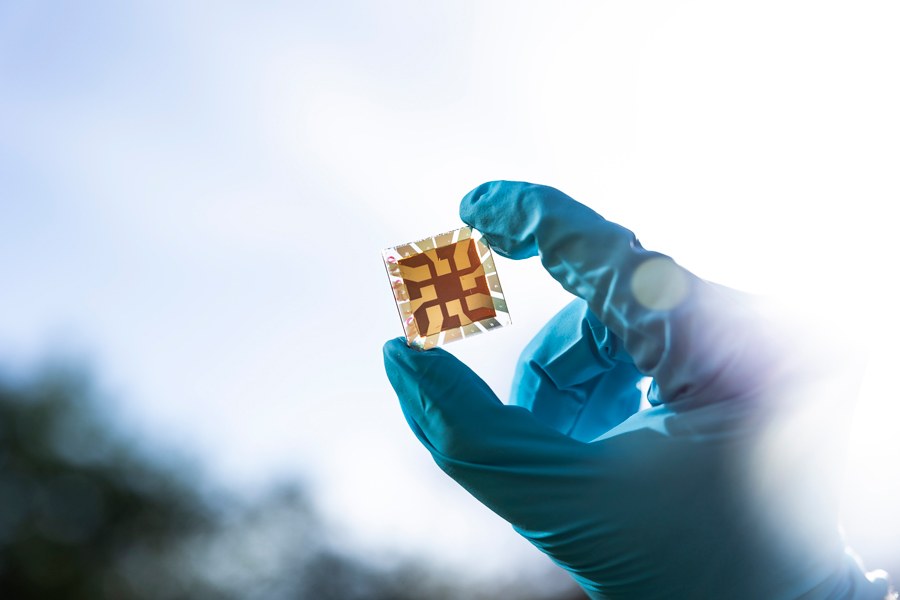
Paola Vivo specialises in innovative solar cells based on halide perovskite semiconductors and their derivatives. Her work combines applied research with fundamental studies to understand materials at the molecular level, aiming to develop efficient, low-cost and non-toxic light-harvesting materials. Vivo believes these new materials have potential beyond solar energy.
“We must keep an open mind and be ready to fine-tune our research directions within our field,” she says.
Creating safe and stable solar cells, even indoors
Solar cells have undergone major advancements in recent years and are already highly efficient. However, Vivo’s team is not pursuing a world record in efficiency but focusing on a deeper understanding of the materials. For example, perovskite solar cells contain lead, which is a toxic material. She says stability and non-toxicity are the most important goals.
“Especially in applications where photovoltaics is close to the user, such as in portable electronic devices like sport watches, having any toxic element in the device is unacceptable.”
A few years ago, the HSC research group embarked on a new line of research focusing on sustainable indoor photovoltaics. The group has made important contributions to the field with numerous publications. Paola Vivo is also the corresponding author of a recently published review in the journal Nature Reviews Clean Technology.
Indoor photovoltaics generate electricity from artificial light, such as LED lights, to power small devices. In the SOL-TECH project, they are intended to power safety bracelets for the elderly, promoting healthy ageing by preventing and monitoring falls at home.
Currently, Vivo is coordinating MENTOR, a European Marie Skłodowska-Curie Action (MSCA) doctoral network on indoor photovoltaics, which brings together some of the world’s leading experts in the field.
Aiming to increase impact through cooperation
Paola Vivo wants her research to have a positive impact on the world. She feels fortunate to lead a talented team of researchers who share the same dream.
“Research is my favourite part of the job. It still inspires me the most! We have the opportunity to redirect and advance research in the field,” she says.
According to her, the research field of perovskites is both dynamic and highly competitive.
“It’s been quite crazy in recent years! You never knew what was going to happen the next day. I’m not sure there is a similarly competitive topic anywhere else. Perovskites have been heavily investigated; at one point, we calculated that 10 papers a day were being published on the subject.”
For Vivo, it is important to interact with other researchers both nationally and internationally. Vivo says her group is eager to share its expertise on material chemistry to solve common problems. The HSC group is actively collaborating with key international partners.
On her bucket list is the wish to establish a national photovoltaic network in Finland to intensify local collaborations. Last year, she chaired their first conference on indoor photovoltaics in Tampere, which brought together approximately 75 people from 13 countries. The next one will be in Italy.
Drawn to Finland by love for Nordic nature
Originally from Italy, Paola Vivo moved to Finland twenty years ago with her Italian husband. Their decision to relocate was driven more by their shared love for the Nordic countries than by professional reasons. However, her husband’s PhD studies in Helsinki and subsequent employment at Nokia also influenced their move.
“We both love the Nordic nature with its beautiful forests and lakes, and the tranquillity. Everything works efficiently here, even the public transport. We both decided to build our careers in Finland, and after so many years, we are still happy with our choice,” says Paola Vivo.
Paola Vivo draws her main inspirations from her two children and music. She recently bought an acoustic piano to revive a childhood passion and now often plays four-hand pieces with her daughter.
Paola Vivo
- Professor, Tampere University, 2024-
- Associate professor (tenure-track) at Tampere University, 2020-2024
- Expert evaluator of project proposals for the European Commission, 2018–
- Member of Editorial boards for journals, e.g., Scientific Reports (Springer)
- Active reviewer for several high-impact journals
- Senior Research Fellow at Tampere University of Technology/ Tampere University, 2017-2020
- Visiting researcher University of Cologne, Germany, 2017
- Visiting researcher ISOF-CNR, Italy, 2015
- D.Sc. (Tech) in Chemistry, Tampere University of Technology, 2010
- M.Sc. in Industrial Chemistry (spec. Materials Science), Universita' degli Studi di Napoli 'Federico II', Italy, 2005
Author: Anna Aatinen


