Erasmus short exchange taught working in international teams

Three countries, four universities of applied sciences, two degree programmes, 40 students and one partner company. These were the ingredients of the Erasmus+ Blended Intensive Programme (BIP) short exchange, which culminated in a week-long intensive period in Tampere in November.
Civil engineering and architecture students from Germany, Finland and the Netherlands got the chance to brainstorm new uses for the environmentally friendly building modules of the partner company Block Solutions. At the same time, they gained unique experience in working in international teams.
– The best part of the course has been working with people from different countries, cultures, and degree programmes. Everyone has brought their own perspective to the work, describes student Anja Barycheva from Hanze University of Applied Sciences in the Netherlands.
Engineering student Natasha Hjelm from TAMK also felt that the best thing about the course was the encounters with students from different cultures, schools and degree programmes.
– It has been fun to work together, come up with ideas together and also try out how the ideas would work in practice, she says.
The students were divided into groups of five, who developed their own ideas for new uses of the building modules.
The course started with a virtual part, where the students met their teams, got to know the building product and started research and innovation with their group. Finally, they gathered for a week-long intensive period in Tampere, on the final day of which the ideas were presented to the whole group and company representatives gave feedback to the students.
Unique study programme
Minna Nyström, Head of Degree Programme of Construction Architecture at TAMK, was responsible for organizing the BIP course in Tampere. According to her, it was a unique study programme in many ways.
– It was a multidisciplinary course that brought together future construction architects and civil engineers from three different countries. The course was attended by no less than 40 students, and there was also a business partner who provided the students with their materials to try out in practice.
Students and teachers from four educational institutions participated: TAMK, Hanze University of Applied Sciences in the Netherlands, and Jade University of Applied Sciences and DHBW Stuttgart in Germany.
The BIP courses are part of the European Union's Erasmus+ programme. Their goal is to encourage the internationalization of students.
– It is really important that students get to know students from different countries and different cultural customs. It is the best thing you can do against prejudice and racism, emphasizes Birgit Remuss, a teacher at Jade University of Applied Sciences in Germany.
Enthusiasm and new ideas
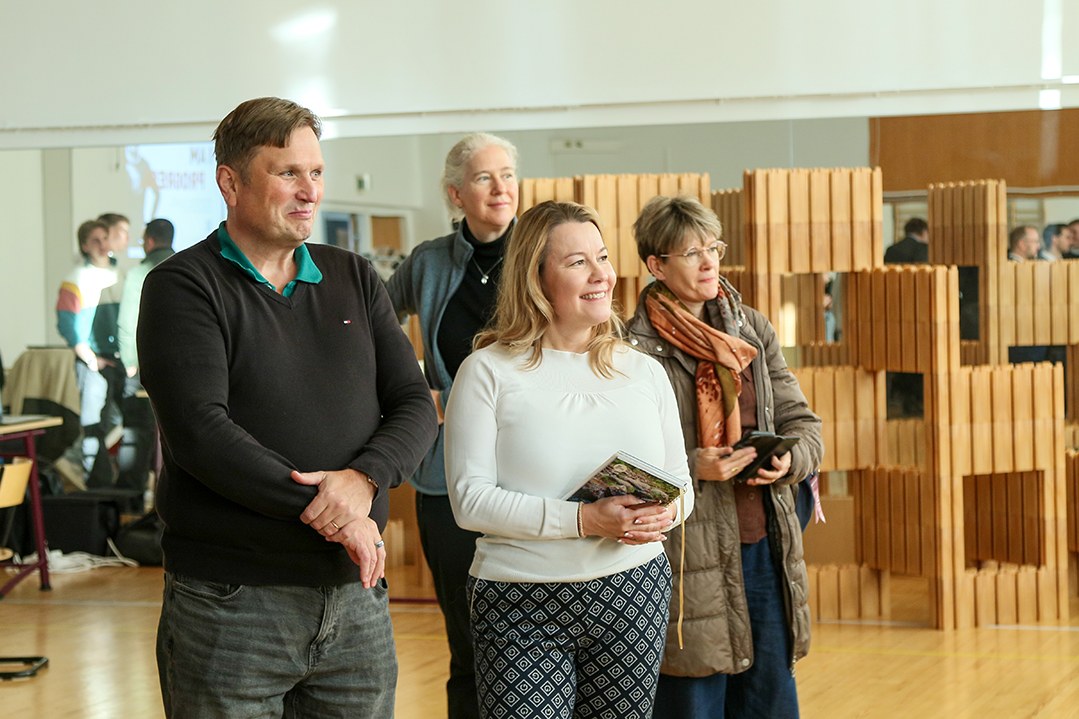
The BIP course's business partner, the Finnish company Block Solutions, manufactures building modules that look like giant Lego bricks.
The modules can be used to build homes, schools and other buildings sustainably and affordably in developing countries, for example in Africa. They are made from ecological biocomposite and recycled plastic.
Entrepreneurs Markus and Sanna Silfverberg say that the cooperation with educational institutions gives them enthusiasm and new ideas.
– Students can come up with ideas which we would not have thought of ourselves. Above all, we want to inform students that alternative materials exist, says Markus Silfverberg.
Sanna Silfverberg points out that construction is still quite traditional: houses are built of brick and concrete, as they have been for decades.
– We need new, sustainable solutions, she summarizes.
Everyone wins in business collaboration
Senior Lecturer Pirre Hyötynen works as one of the account managers for partner companies at TAMK. According to her, the collaboration with Block Solutions is an example of TAMK's living connection to working life.
At its best, everyone wins in business collaboration: the educational institution, the students and the partner company.
– The school receives assignments and project work, visits, guest lectures and thesis topics from companies. Students get direct contact with companies and get to do real-life tasks. Companies, in turn, get contacts with students who can become their future employees, Hyötynen sums up.
Author: Virpi Ekholm


