The EduSTA project has inspired Tredu's teachers and students to act and influence at their workplaces

Lecturer Pia Korhonen teaches in the climate-responsible action unit of qualification. She says that participating in the EduSTA project led by Tampere University of Applied Sciences (TAMK) has made a concrete contribution to sustainability thinking at Tredu.
Korhonen has worked for many years as a lecturer in the restaurant and catering sector and as a sustainability coordinator. She has studied environmental education, quality and environmental management and service business management from a sustainable development perspective.
“I have been involved in sustainable lifestyle strategy work at Tredu and participated in many projects. The EduSTA project's digital open badges have also given me inspiration for my own work in environmental education”, she says.
Korhonen speaks for empowerment: she feels that sustainable development is important and wants to pass this thinking on to her students. The students will be inspired to make a difference and learn how to raise and promote issues.
The theme of this unit of qualification is to influence and to have an impact: how I as a teacher can influence students and how they influence at their workplaces. The work we do sends a strong message to the working life that we teachers are engaged in sustainability and that Tredu's graduates will be able to promote sustainability as a natural and important part of their work.
Pia Korhonen
The completion of the EduSTA digital open badges has encouraged actors
More than 50 open badges of teachers’ sustainability competences were completed at Tredu. It has been a demanding squeeze for some, but many feel that they have become empowered in their own profession. So does Korhonen:
“At the beginning it was difficult for me to get to the heart of teaching, because I have done a lot of development work, innovation and projects. When the path and my own understanding opened up, I was able to synthesise. My own thinking, competence and systemic approach became clearer."
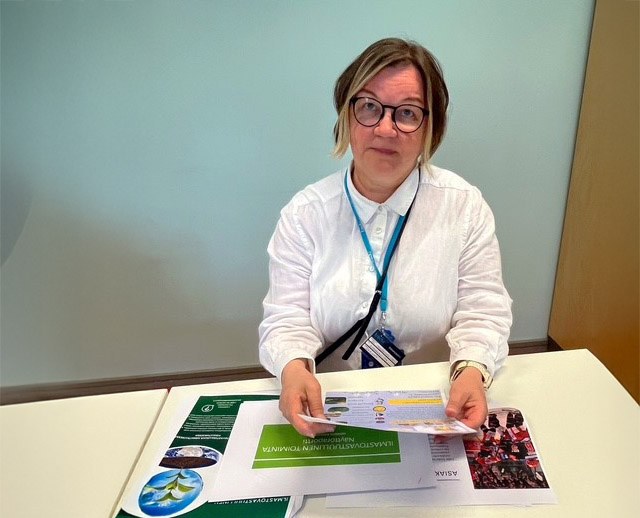
The implementation of the digital open badges has had a lasting impact. Korhonen and her colleague Minna Arvonen have been developing the possibilities of implementing the climate-responsible action unit of qualification from 2021 onwards. Before the EduSTA project, the unit was in limited use. Thanks to the participation in EduSTA, it is now available to all Tredu students.
“We had been drumming up the unit earlier, but we were too cautious. The project gave us courage, trust in our own competence and confidence that we can push this multi-professional online model through for testing in spring 2025”, Korhonen describes.
Eveliina Asikainen, Project Manager of the Erasmus+ Teacher Academies-funded project, is happy to hear that the project has encouraged Tredu's teachers to promote sustainability thinking in a concrete and systemic way.
The project has provided something that has allowed Tredu's teachers to deepen their knowledge on many different levels. Even highly experienced teachers have reported that they have been able to learn new things about their own work. There has also been a regional impact on working life through the students who have been working in companies during their studies related to the climate-responsible action unit of qualification.
Eveliina Asikainen
The climate-responsible action unit of qualification is now multi-professional
15 credit unit focuses on the causes, impacts and ways to combat climate change. Students learn how climate change affects well-being and biodiversity. They will also learn about carbon footprints and the circular economy as activities that can contribute to climate change mitigation.
“We are now trying to get the message across: how important this multi-professional approach is, no matter whether you are in the processing, automotive, social services, business, beauty or even in the restaurant and catering sector. It would have been difficult to make this happen in a single discipline, but now we are offering all students the opportunity”, says Korhonen.
The VET school has a true impact as it has close links with the working life
During their practical training, degree students learn how to take climate change into account in their own professional fields. They will explore how climate responsibility is implemented in the workplace, carry out projects and report on their proposals for improvements in areas such as waste management, customer service, marketing and electricity consumption.
“Students will internalise issues. At the same time, they learn that work-related practices have an impact on the climate and that they too can make a difference. Forty students will be completing the climate-responsible business action unit module, and they have given very positive feedback," says Korhonen.
The students have put a lot of effort into their development activities. Their suggestions are appreciated at the workplaces, and the best projects have remained alive.
“For example, in one supermarket a student's project to reduce waste has become a permanent practice. Same goes to a marketing project for a company selling second-hand ice hockey equipment. This company is also a good example of the reciprocity between our school and working life: we have a teacher who will be doing his practical training there.”
The sustainability community and responsible study paths were born
Korhonen says that thanks to the EduSTA project, a sustainability community was created at Tredu. It networks colleagues working on the same topic. The community discusses sustainability issues, asks for advice and shares information. The aim is to keep the network active in the future.
Tredu has also created responsible study paths, which the EduSTA project has inspired not only on the restaurant and catering sector and on the education and guidance sector, but also on other fields of study. Even if the study path is not yet complete, teachers in the tourism sector, for example, are daring to raise sustainability issues more boldly in the screening discussion.
Korhonen appreciates the cooperation and networks that TAMK offers.
“In the future, we could make more use of each other's work and what we have done together. Even though I have been working with sustainability related topics for years, it has been rewarding to reflect more deeply and bring the results into everyday life. I feel that we have moved forward and refreshed our own thinking. We are no longer green washers, but advanced actors whose work has an impact."
Systemic thinking has also been strengthened. Sustainability and responsibility are baked into the way of doing things and woven into the work, both in schools and at workplaces.
But for Korhonen, the best part are the students:
“How wonderful it is to see the young person or young adult who has graduated from us, succeeding in working life and achieving something amazing. For myself, their happiness and satisfaction are something I draw strength from. Even just supporting one young person on the road to sustainability is worth the effort. Something good always happens on the journey to becoming a sustainability expert.”
Academy for Sustainable Future Educators (EduSTA)
Academy for Sustainable Future Educators (EduSTA) was an Erasmus+-funded, international project which defined practical sustainability competences specifically for vocational teachers. The project designed, built, and piloted a system of digital open badges and supporting competency-based learning, learning environments, and learning materials. The project was led by Tampere University of Applied Sciences (TAMK) and partners were Universidad de Girona, Spain, Göteborgs Universitet, Sweden, Hanze UAS, the Netherlands and University of Life Sciences, Prague, Czech Republic. The project was ongoing from 1 June 2022 to 31 July 2025.
Additional information:
Pia Korhonen
Lecturer | Climate-responsible action
Tampere Vocational School Tredu
pia.korhonen [at] tampere.fi (pia[dot]korhonen[at]tampere[dot]fi), +358 50 441 9015
Eveliina Asikainen
Project Lead | Academy for Sustainable Future Educators project
Tampere University of Applied Sciences
eveliina.asikainen [at] tuni.fi (eveliina[dot]asikainen[at]tuni[dot]fi), +358 50 5958775
Author: Hanna Ylli


