Doctoral researcher Mari Laaksonen: “The ethics of genomic data is an essential part of nursing education”

Senior Lecturer Mari Laaksonen has strong roots in health promotion. She is doing pioneering work in her doctoral dissertation in nursing science, for which she received a research grant from Tamperelaisen tutkimustyön tukisäätiö (Tampere Research Support Foundation). Laaksonen is researching what kind of competence is needed in nursing as the applications of genetics and genomics become increasingly widespread in everyday healthcare. She is particularly interested in ethical perspectives.
Genomics and genetics are often associated with biology and medicine. However, genomic information affects our largest healthcare professional group, nurses, who are trained in large numbers at TAMK. Laaksonen strives to ensure that this professional group does not lag behind.
When genomics applications arrive, the benefits for patients will not be fully realized if nursing professionals are left out of this development. That is why education must be slightly ahead of practice. The arrival of genomic data is one indication that our nursing education and applied research are in tune with the times. It should not be the case that things happen in practice first and then the education sector wakes up, but rather that we are innovative and ahead of the curve.
Mari Laaksonen
From public health nurse to TAMK lecturer and doctoral researcher
After working for 15 years as a public health nurse at a maternity and child health clinic, Laaksonen made a natural transition to the world of higher education. She currently teaches and works as a teacher tutor at TAMK at both the bachelor's and master's levels. Laaksonen is actively involved in developing degrees and projects. Among other things, she is responsible for the Master degree in health promotion together with the Head of Degree Programme.
"I had been interested in the world of education for a long time. Even as a public health nurse, I enjoyed developing my work and training myself. I feel that passing on knowledge is important, and that led me to study for a master's degree in nursing science at Tampere University.
Laaksonen graduated as a nursing teacher in 2012 and, the same year, joined the TAMK public health nursing team. In addition to her work, Laaksonen is currently writing her doctoral dissertation at the Tampere University.
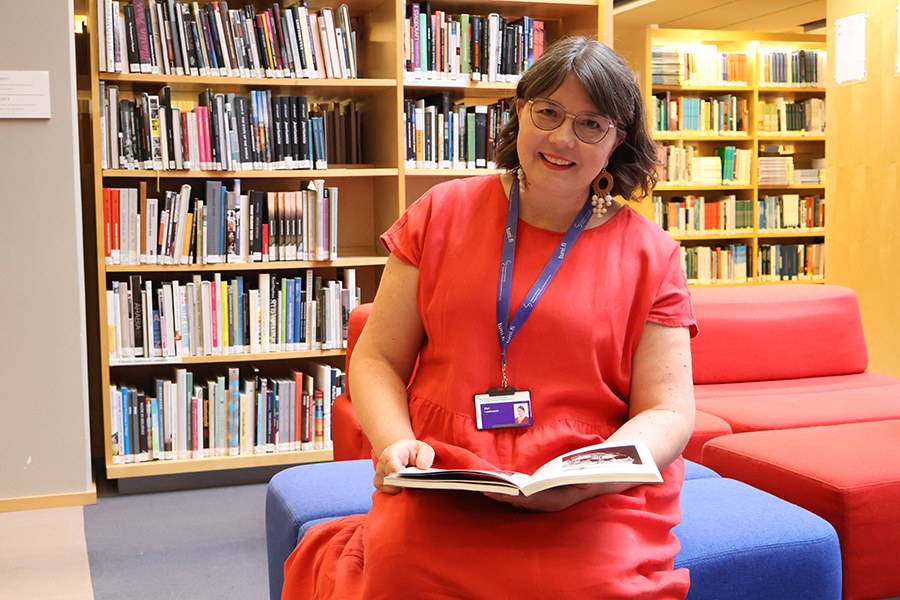
”Profitu project was the initial motivation for my dissertation”
Laaksonen has taken part in domestic and international projects that have developed regional nursing, diabetes care, and the use of genomic data in nursing. She says that project work has greatly increased and maintained her professional expertise.
"We have just received Nordplus funding to develop a Genetic Genomic Counselor degree in the Nordic countries. In this project, TAMK is responsible for the research aspect, in which we already have considerable expertise. The development of genomic data competence will therefore continue.
The first step was the Profitu project, funded by TAMK and the Ministry of Education and Culture in 2019–2021. The project developed the competence of healthcare personnel in utilizing genomic data and incorporating the topic into teaching. This significant project broke new ground in many ways and has had a major impact, resulting in degrees, courses, and continuing education opportunities. This path was continued by the GenoNurse project, which ended in January 2025.
“Profitu was also the initial motivation for my doctoral dissertation. Principal Lecturer, Docent and Project Lead Arja Halkoaho inspired me to conduct this research. She is my second dissertation advisor. My main supervisor, Professor Eija Paavilainen from Tampere University, was already familiar to me; we have worked together to promote maternity and child health clinic work. They made the decision to embark on my dissertation easier.”
However, Laaksonen considered the dissertation for a long time, as the topic is completely new.
"Usually, a dissertation is written on a topic that has already been explored in depth. But this was a leap into something new and pioneering work from the perspective of nursing science”, she says.
The ethics of genomic data is abstract and multidimensional
According to Laaksonen, the ethics of genomic data is an interesting and concretely relevant topic for nursing, but the competence related to it has not been studied that much.
“Ethics is familiar in nursing, and it has already been studied to some extent. But I felt it was important to highlight the ethical competence of genomic data in nursing. Ethics has been left out of research in this field. It is understood internationally as part of genomic information and is mentioned in competency descriptions, but it does not come up in current competency indicators", Laaksonen explains.

“Ethics requires many types of research; a single approach is not sufficient for such an abstract topic. Perhaps that is why it is considered difficult. It is interesting to study whether genomic data brings different emphases to ethics, for example, ethical principles, and how nursing professionals, developers, and educators experience it”, Laaksonen ponders.
In nursing, ethics manifests itself in many ways and affects work on many levels.
Ethics is included in nurses' own being, moral concepts, and how they want to do their job. It also relates to the relationship between the patient and the nurse. In addition, it is present in the patients themselves through their loved ones. Genetic information does not belong solely to the patients but is also related to their families.”
Mari Laaksonen
Additionally, ethics concerns the shared organizational culture of nurses and other healthcare professionals.
“The ethics of nursing culture encompasses society as a whole. How do we act in society, what values do we have, in what direction are we taking healthcare, how does genetic information appear in that prioritization, and how far will individualized healthcare be taken.”
Laaksonen points out that this is a cultural, national, international, and global issue, which is also determined by the nature of research projects: do we only study people of European descent, and how do we bring global perspectives to the fore?
Genomic information is integrated into nursing education at TAMK
TAMK is the only university of applied sciences in Finland where students learn about genomic information in nursing. Following the Profitu project, a separate one-credit course on genomic information was created for university of applied sciences students. In addition, it has been integrated into study modules. Genomic information is relevant in areas such as cancer treatment, pharmacology, midwifery, and public health nursing education.
Furthermore, the Master's degree program in Health Promotion includes two five-credit courses that deal with individualized health promotion and genomic information.
The students have given good feedback on these courses. Although the topic is demanding, they have understood the importance of genomic data and ethical perspectives. It has been exciting to see that they are enthusiastic about writing thesis on the subject and taking new knowledge with them to their workplaces.
Mari Laaksonen
The university of applied science’s course on genomics will also be added to the open university of applied sciences offering, so it can be expanded to other universities of applied sciences.
Up-to-date education requires applied research
Laaksonen appreciates the fact that she has been able to participate in projects that deal with the topic of genomics. The project teams have functioned like research groups to her.
“Arja always says that you shouldn’t say no when asked to do something. Agreeing can lead to great things. I take these dissertation steps as a learning process: projects and research work strengthen my own teaching skills and spread knowledge within the organization”, Laaksonen says.
Cooperation is very important in research. Laaksonen's colleagues Elisa Airikkala and Nina Smolander are also focusing on genome data from different perspectives in their own dissertations.
"This is, in a way, the missing research group. It is important that we meet and discuss things together.”
Laaksonen has been conducting research for five years now. She says that during that time, the value of research has increased at TAMK, and she believes that the research perspective will continue to grow.
Research allows us to determine whether our education and research and development activities are effective and whether we can integrate our operating models into the field. As a university of applied sciences, this is particularly important to us. Our students value their high-quality degrees, and the working life values nursing professionals who are up to date with their training.
Mari Laaksonen
The doctoral researcher is also happy about the research grant she has received, which will enable her to take short study leave to advance her dissertation.
“It is something to be thankful for. The grant demonstrates the appreciation of nursing science and that research and expertise in the ethics of genomic data are considered important. It is great that these issues are being highlighted!”
Additional information:
Mari Laaksonen
Senior Lecturer | Social Services and Health Care
mari.laaksonen [at] tuni.fi (mari[dot]laaksonen[at]tuni[dot]fi), +358 50 432 5951
Doctoral Researcher, Doctoral Programme of Health Sciences, Tampere University
Mari Laaksonen - Tampere University Research Portal
Author: Hanna Ylli


