Doctoral Researcher Arto Koskinen: “People are the ones who live and experience, and that’s where stories come from”

The theme of Koskinen’s doctoral dissertation has grown directly out of everyday teaching. As students presented their first script ideas, he noticed how strongly young creators absorb influences.
“Many film students struggled with originality. Their writing ideas were copies of what they had seen on the big screen or on TV. It was often challenging to teach screenwriting theory while also helping them find originality in their own work,” Koskinen explains.
He challenges the traditional teaching cycle that emphasizes first structure and theory. To him, teaching should begin with students’ own experiences and emotionally charged insights, while structural tools should support the personal core of the story.
Koskinen has worked both as a film director and screenwriter in fictional and documentary films. He graduated in 1993 from the department of film at the University of Art and Design Helsinki (now Aalto University) and has been teaching at TAMK since the late 1990s. Early on, he became interested in directing and applying storytelling skills. This led him to begin doctoral research on screenwriting pedagogy at Aalto University. His research focuses on how students’ personal experiences can be used in learning screenwriting tools and dramaturgy.
Personal story universe is a method that starts writing from within
To address the lack of originality, Koskinen developed a method called an “emotional map,” which he also refers to as a personal story universe. In his teaching, he systematically uses it to convert life turning points and emotional experiences into story ideas that are further developed through autofiction and fiction.
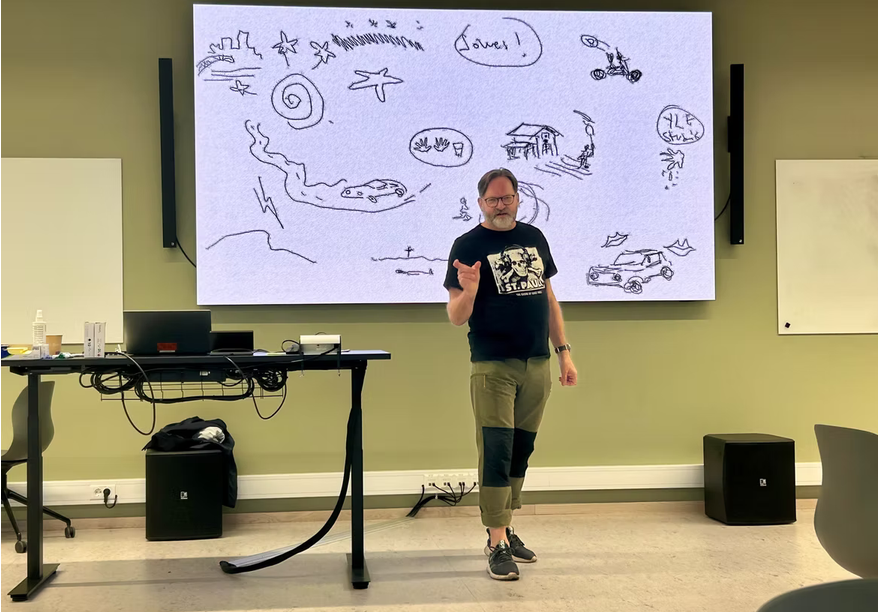
In this method, students map out story seeds: key moments in their lives, places, memories and related emotions. Courses often begin with the teacher drawing his own map on the board, and then the students will create their own. Koskinen emphasizes that even young people have something original and interesting in their lived experiences.
The exercise is based on a simple observation of how memory works.
When we start talking about situations from our own lives, memory becomes activated. One memory leads to another. The strongest emotional experiences inevitably contain story ideas. From those elements, a writer can ask, for example, what if the situation had unfolded differently.
Arto Koskinen
However, the goal is not to remain confined to one’s true story. According to Koskinen, dramaturgical tools help distance the writer from reality and transform experience into a more universal and believable narrative. When personal experience evolves into a theme and statement through autofiction and fiction, the story begins to take on a life of its own.
“With dramaturgy, you can extract what is essential for a fictional story from real experiences. Audiences are very sensitive to authenticity and whether they can believe in and relate to a story, even if it’s science fiction and Luke Skywalker in Star Wars. It’s almost like a mythic journey into the subconscious and experiential world,” Koskinen describes.
Originality can be found close
In his doctoral research, Koskinen seeks ways to support the students’ own voice in screenwriting education and to make dramaturgical tools more understandable and meaningful.
He describes the process of creating a compelling film as complex.
“It’s easy to watch successful films. It’s a bit like in music: I’m not able to create it myself, but I’m very good at listening to it.”
Koskinen crystallizes an idea familiar to many film educators but surprisingly little researched: introspection, i.e. writing from within, which shortens the distance between the writer and the characters and can strengthen the emotional credibility of the story.
The closer the story idea is to the creator personally, the easier it is to enter that world, and the more interesting the story becomes.Arto Koskinen
The method is not only an idea generator but also a pedagogical situation that requires a sense of safety. When people share personal experiences, the moments can be emotional. Every now and then someone cries, and sometimes the whole group is very touched by the story. That is why Koskinen emphasizes voluntariness and respect for boundaries. The map can also remain private.
“I make it clear that everyone shares their experiences voluntarily. If it doesn’t feel right, there’s no need to do it,” he says.
“You are taking five minutes of someone else’s life”
For Koskinen, screenwriting and filmmaking are inherently research-oriented processes.
“Making films and writing scripts are always journeys of exploration into a subject and into people. Especially in documentary filmmaking, you need extensive background work to find a narrative form that resonates with audiences,” he explains.
Ultimately, everything comes down to the audience and the reason why stories are told in the first place. According to Koskinen, the purpose of storytelling is to convey emotions, ideas and values. Therefore, creators have responsibility for the time they take from viewers.
“I emphasize to students that even if you make a five-minute short film, you are taking five minutes of someone else’s life,” Koskinen says.
When this idea clicks, dramaturgical tools are no longer rules for their own sake but ways to engage the audience and communicate something meaningful.
Artificial intelligence as a sparring partner, not as a screenwriter
In his research, Koskinen also examines what happens when artificial intelligence, AI, enters the creative process. His aim is not to replace the writer but to expand the toolkit: when a story gets stuck, AI can help analyze characters, refine themes or test structure.
He describes AI as a sparring partner, a neutral tool that can support ideation and analysis, while the creator evaluates its suggestions. At the same time, he emphasizes critical thinking. AI often produces average answers, but it can sometimes offer surprising ideas beyond the creator’s own experience. Even then, control must remain with the creator.
According to Koskinen, students are still somewhat cautious about using AI. Koskinen says that this is partly healthy. In teaching situations, limitations quickly become evident: if a text is not the student’s own thinking, it is difficult to justify or explain.
“You need to learn the basics yourself before using AI as support. During studies, you cannot rely on AI alone, because in working life your real abilities will be tested,” he stresses.
Articles, peer review and practical experimentation
Koskinen is completing his doctoral degree as an article-based dissertation, which he finds a natural way to proceed: each study focuses on a specific research question. One article has been published, another is under peer review, and a third one is in preparation. The material is based on teaching situations and script workshops that he has led over several years in Finland and Belgium.
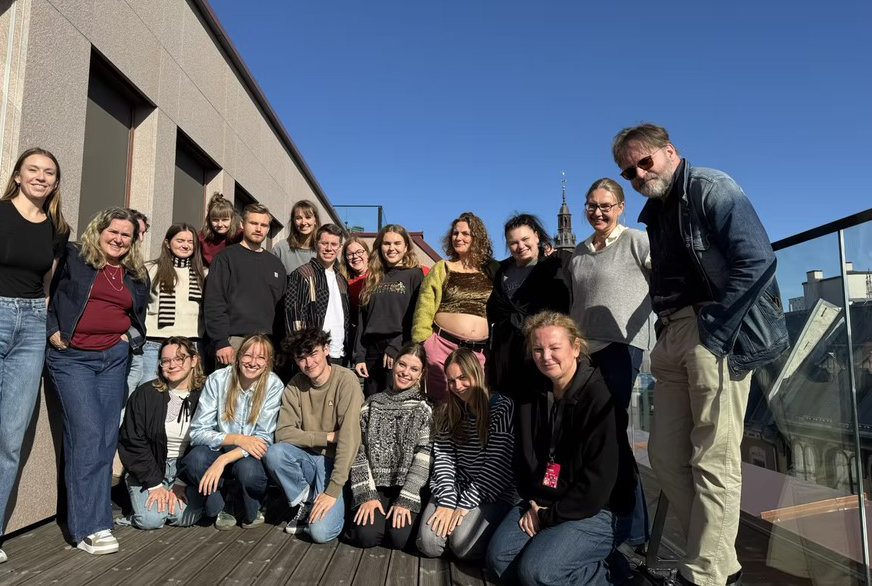
He describes the research environment at TAMK as encouraging.
Doctoral research is a process of self-development. Based on my own learning and work experience, I want to teach in a way that benefits students as much as possible. Deeper research supports teaching. The doctoral title itself is not the main thing but the thought process in writing the articles is.
Arto Koskinen
During course experiments, Koskinen collects student feedback on how writing based on personal experience feels and how the use of AI, if applied, has influenced the process. The aim is to understand not only the pedagogical benefits but also how students build their writer identity.
“One’s own life and experiences are essential elements in the formation of a writer’s identity,” Koskinen says.
Koskinen’s research ultimately returns to the fundamentals: stories emerge from people, experiences and interaction. AI can assist and accelerate but it cannot live on behalf of the creator.
“People are the ones who live and experience, and that’s where stories come from.”
Contact person
Arto Koskinen
Senior LecturerAuthor: Hanna Ylli


