AI-powered tool streamlines energy advisory services for homeowners

What kind of detached house is it? How is it heated? What kinds of energy-related challenges have been identified? Gathering this basic information often takes a significant amount of time in energy advisory services. An AI-based solution developed in the DEAP project, coordinated by Tampere University of Applied Sciences (TAMK), helps collect this information before the consultation even begins.
“We wanted advisors to get straight to the real issues from the start. Homeowners do not always know which pieces of information are relevant for the advisor,” says Rami Kotilainen, Project Engineer from Built Environment and Bioeconomy faculty.
The project developed a large language model-based information collection system that helps both homeowners and energy advisors prepare for consultations in advance. The tool compiles essential information about the house and creates a structured summary to support the advisory process.
The solution has been tested in practice
The DEAP pilot attracted more interest than expected. Over 70 people participated, although the project’s target was 40 participants.
According to the feedback, users found the tool easy to use and helpful for preparing for energy advisory services. In practice, it helps homeowners better understand the factors affecting their home’s energy consumption before meeting an expert.
The greatest benefit from the advisor’s perspective is that participants come to the meeting better prepared, allowing more time for actual guidance and problem-solving.
“Homeowners also seem to engage more actively in the process after reviewing the details of their own house themselves.”
For homeowners, the benefit is that information about their property and potential areas for improvement becomes clearly structured before meeting an expert. At the same time, advisors receive consistent background information, enabling them to focus on solutions rather than gathering data.
Pilot users also provided practical suggestions for improvement.
“The feedback included requests for additional building type options and better consideration of solar energy. We were able to implement these improvements during the final stages of the project.”
AI asks questions that are relevant to each individual home
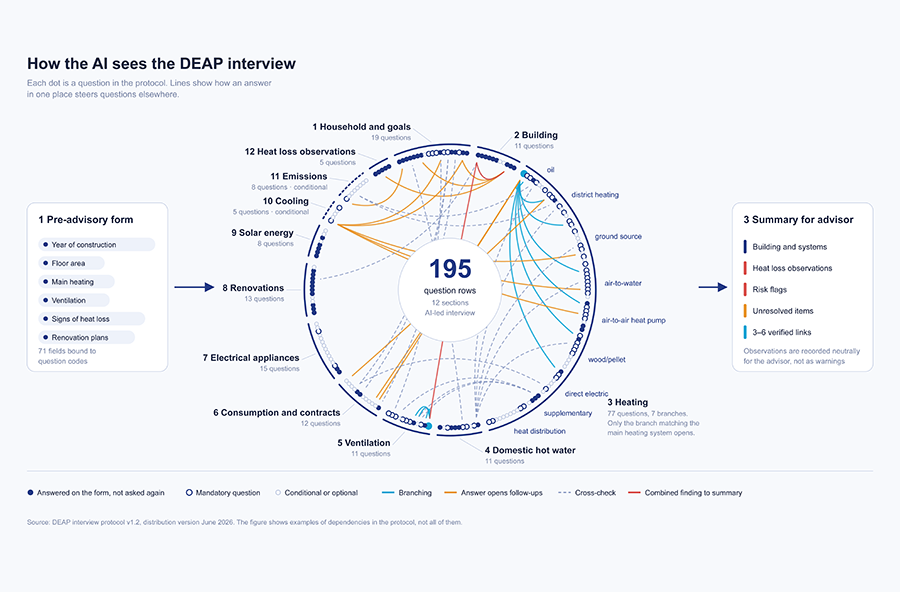
The process begins with a form in which homeowners provide basic information about their house. After that, the language model continues the conversation by asking follow-up questions.
“We did not train our own language model. Instead, we created a 195-question interview protocol that tells the model what information it needs to collect and in what order. The model does not freely invent questions,” Kotilainen explains.
Users do not need to answer all 195 questions. The system selects only those that are relevant to the specific home.
“For example, there are several question branches related to heating systems, but users only see the branch that corresponds to their own heating solution. The language model also skips topics that have already been covered in earlier responses,” says Kotilainen.
The system can also connect information provided by the user. For example, if a homeowner mentions overheating during the summer, the tool can introduce questions related to cooling solutions.
Privacy by design
Data privacy was a key principle in the development of the tool.
“We do not ask for names, contact information, or addresses. The information is stored only in the user’s own browser and is not collected on a server,” Kotilainen says.
The generated summary remains under the user’s control, and homeowners decide whether they want to share it with an energy advisor.
The solution remains available after the project
The DEAP project, funded by the EU Interreg Central Baltic Programme, ended in June 2026. However, the tool developed during the project remains freely available.
The service is available in Finnish, Swedish, English, and Estonian, and will be maintained by EcoFellows (Ekokumppanit). In addition to TAMK and EcoFellows, the project partners included the University of Tartu and the Tartu Regional Energy Agency.
According to Kotilainen, the solution demonstrates how AI can efficiently collect the right information to support expert work.
“AI does not replace experts. It helps them to do their jobs better.”
Try the AI-assisted energy advisory tool developed in the DEAP project
Downloadable implementation package: https://centralbaltic.eu/project/deap/
Try the version currently used in energy advisory services: https://energialomake.neuvoo.fi/

Contact person
Rami Kotilainen
Project Engineer Rami Kotilainen
Author: Hanna Ylli


