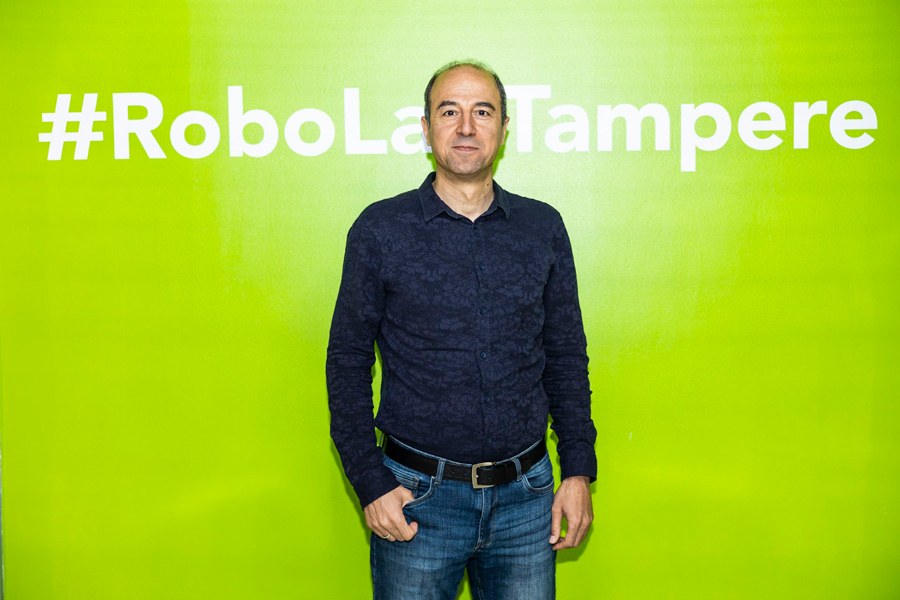
Professor Reza Ghabcheloo: Autonomous mobile machines make work easier and create economic growth

When the research group's name is Autonomous Mobile Machines, the first thing that comes to mind are flying cars and intelligent humanoids from science fiction movies.
The group does study robotics, but in more everyday applications. The research focuses on, for example, self-driving wheel loaders, forestry machines and harbour cranes, which perform heavy work for and on behalf of people.
– These machines build our homes, streets and infrastructure, carry heavy loads, manage warehouses and work in ports and mines. It is a rewarding task to develop them to be safer and more efficient, says Reza Ghabcheloo, the leader of the research group and professor of Heavy Machine Automation.
Autonomous machines bring many benefits to industry. First, they can be programmed to work autonomously, reducing the need for human labor for heavy-duty tasks. The machines can also be partially automated, making them easier for the operator to use and requiring less training.
However, the machines and their software still need to be developed so that they can perform complex tasks accurately and safely. Ghabcheloo's group is conducting this research in close collaboration with companies in the industry.
Submarines changed to heavy-duty machines
Reza Ghabcheloo has worked as a researcher at Tampere University and its predecessor, Tampere University of Technology, since 2008. In 2015, he was appointed a Tenure track professor and in February 2023, a professor.
Originally from Iran, Ghabcheloo studied electronics and control engineering. After graduating with a Master of Science in Engineering, he became a doctoral researcher at the Institute of Systems and Robotics in Lisbon, Portugal. In his doctoral thesis, he developed multiple marine vehicle cooperative control.
– I have always liked mechanics, mathematics and solving complex problems. Robots are perfect in this respect: they are mechanically complex, require electronics and software to function, and lots of elegant math to derive their intelligence and even design. This is exactly what I enjoy doing, he says.
Ghabcheloo ended up in Tampere when a robotics expert was sought for a centre of excellence funded by The Research Council of Finland. However, there were no ships or submarines here, so the research focus changed to heavy machinery.
Over the years, Ghabcheloo’s research group has grown to about 20 people. The group includes four postdocs, seven doctoral researchers, and several master’s thesis workers with backgrounds from around the world.
In the professor's job, especially with such a large group, a smaller proportion of Ghabcheloo's working time is spent on research and a larger proportion on management and administration. This has taken some getting used to.
– Leadership and coaching people are things I enjoy doing, and I am trying to improve my management skills, Ghabcheloo laughs.
Safety is still a big challenge
When a person controls a heavy machine, he constantly observes his environment and makes decisions about how and in which direction the machine should be moved.
If a machine is to be programmed to perform tasks independently, it should perform the same observation, data processing and decision-making automatically. This requires various sensors and complex data transfer and processing.
For example, Ghabcheloo's group is developing how the machine locates itself and its surrounding objects using radars and other sensors. The goal is to teach machines to perform complex tasks accurately and efficiently, without direct human guidance. In addition, the group has studied how increased level of automation is shaping future business ecosystems and safety regulations.
Until now, autonomous machines have usually been used in restricted areas where humans do not have direct access. However, the goal is that autonomous and human-driven machines can work together or in proximity of each other safely. Therefore, it is particularly important to ensure that machines do not collide with people or each other.
– Safety remains a big challenge. We use machine learning to help us to develop intelligence, but it is still not easy to ensure that machines always make the right decisions, Ghabcheloo describes.
Strong connection to industry
An international research consortium led by Reza Ghabcheloo has just received funding for a large European project that will recruit 13 doctoral students to develop autonomous mobile machines. Five of them will come to Tampere University.
The project involves five universities from Finland, Germany and Sweden, as well as some leading companies in the industry.
– We have a strong connection to industry. Our group includes students and projects funded by companies, as well as consortium projects involving several companies, Ghabcheloo says.
Tampere is a particularly good place to conduct research in the field, as most of the world's intelligent mobile machines come from the Tampere region. Autonomous machines are developed and manufactured here, for example, for mines, ports, and for agricultural and forestry use.
According to Ghabceloo, the sector is also growing fast.
– We work hard developing autonomous machine hoping to increase competitiveness, bring economic growth and jobs to Finland. We need these companies and the development of the sector.
Expertise in the field will be further strengthened by the Master of Science programme in Robotics, which was launched at Tampere University in autumn 2023.
– We will get great graduates, future employees, and start-up founders from these students. I am very excited about this, Ghabcheloo says with a smile.
Reza Ghabcheloo
- Originally from Iran, lives with his family in Jyväskylä.
- Completed his PhD in marine robotics in 2007, Institute for Systems and Robotics, Lisbon, Portugal.
- Worked as a researcher at Tampere University of Technology and Tampere University since 2008.
- Appointed as a Tenure track professor in 2015.
- Professor of Heavy Machine Automation since February 2023, Faculty of Engineering and Natural Sciences, Automation Technology and Mechanical Engineering. Head of the Autonomous Mobile Machines research group.
- In his free time, he enjoys playing ball games, skiing, downhill skiing and reading interesting articles. However, he prefers to spend time with his 10-year-old daughter.

Author: Virpi Ekholm


